Clinical Knowledge › Paediatrics › Renal and urological disorders
Phimosis and balanitis
In almost all newborn boys the foreskin cannot be retracted because its inner layer is joined to the glans; separation is gradual, and a non-retractile foreskin is normal for many years (physiological phimosis). Fewer than 1–2% of boys still have a tight foreskin by the late teens. Ballooning of the foreskin on voiding and white smegma 'pearls' are normal and are not indications for treatment. Pathological phimosis is true scarring of the preputial opening, most often from lichen sclerosus (balanitis xerotica obliterans): a white, firm, non-stretchy ring, usually after age 5, which may cause meatal stenosis and needs circumcision. Balanitis (inflammation of the glans) and balanoposthitis (glans and foreskin) are common in young uncircumcised boys; most episodes are irritant or non-specific and settle with gentle hygiene and saline baths, while candidal (often with nappy dermatitis or diabetes) and streptococcal infections need specific treatment. Topical corticosteroid for 4–8 weeks resolves most symptomatic physiological phimosis. Circumcision is reserved for pathological phimosis, recurrent balanoposthitis and selected boys with recurrent UTI and urinary tract anomalies. Paraphimosis is an emergency, and forced retraction must be avoided.
Patient case, mechanism, investigations, management, flashcards and exam-style questions.Open the lesson →
Key facts
- Physiological phimosis is normal: non-retractile foreskin with healthy, pink, pouting preputial tip; separation continues through childhood
- By the late teens only about 1% have a persistently non-retractile foreskin
- Ballooning on micturition and smegma pearls are normal, not reasons for circumcision
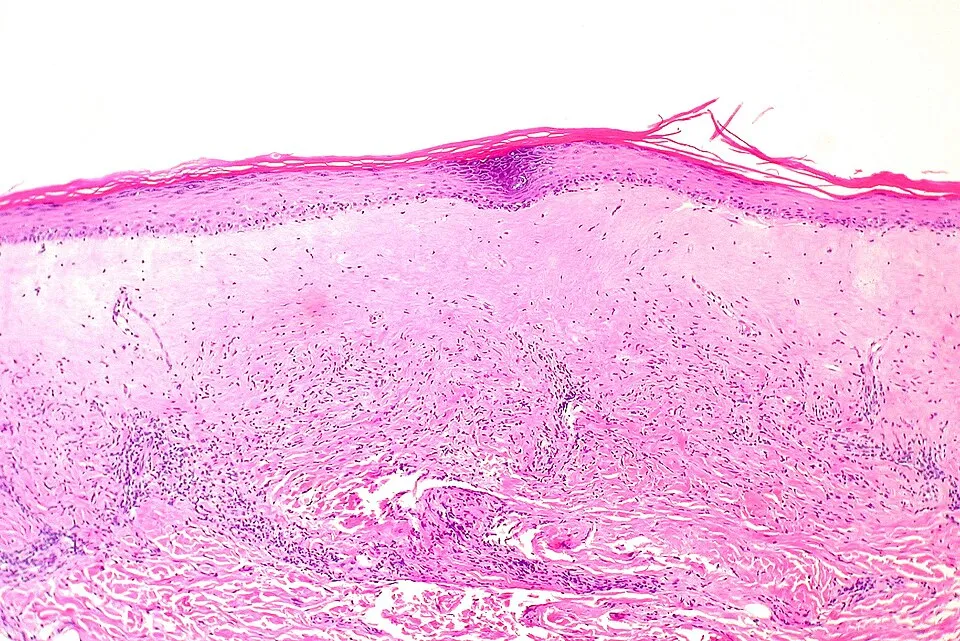
- Pathological phimosis: white, scarred, inelastic preputial ring, usually from lichen sclerosus (BXO); uncommon under 5 years
- Topical corticosteroid (for example betamethasone 0.05–0.1%) to the tight ring twice daily for 4–8 weeks succeeds in most symptomatic physiological phimosis
- Balanoposthitis: red, swollen, tender foreskin with discharge; usually irritant or non-specific; treat with gentle hygiene, saline baths, analgesia
- Indications for circumcision: lichen sclerosus or scarred phimosis, recurrent balanoposthitis, recurrent febrile UTI with urinary tract anomalies (for example high-grade VUR, posterior urethral valves)
- Paraphimosis: retracted foreskin stuck behind the glans, with painful oedema; reduce urgently under analgesia; dorsal slit if manual reduction fails
Differential diagnosis
| Condition | Clues | Key test |
|---|---|---|
| Physiological non-retractile foreskin | Healthy pink preputial tip that pouts on gentle traction; no scarring | Clinical examination |
| Lichen sclerosus (BXO) | White sclerotic ring, fissures, may involve glans and meatus | Clinical; histology of circumcision specimen |
| Candidal balanitis | Shiny red glans with satellite lesions; nappy rash or diabetes | Clinical; swab; urine glucose if recurrent |
| Group A streptococcal balanitis | Bright red, well-demarcated, very tender; may have perianal disease | Swab for culture |
| Contact or irritant dermatitis | Soaps, bubble bath, wipes; itching | History; resolves with avoidance |
| Paraphimosis | Retracted swollen foreskin trapped behind the glans | Clinical; emergency reduction |
| Penile hair-thread tourniquet | Infant with distal swelling and a constricting groove | Careful inspection with magnification |
| Concealed (buried) penis or hypospadias | Short-appearing penis or ventral meatus with hooded foreskin | Examination; avoid circumcision |
Exam pearls
Guideline
EAU/ESPU Guidelines on Paediatric Urology (latest annual edition, 2025) – phimosis; Cochrane review of topical corticosteroids for phimosis (2014); AAP Task Force on Circumcision technical report (2012)
References
- European Association of Urology / European Society for Paediatric Urology. EAU Guidelines on Paediatric Urology: phimosis. EAU Guidelines Office, Arnhem 2025.
- Moreno G, Corbalán J, Peñaloza B, Pantoja T.. Topical corticosteroids for treating phimosis in boys. Cochrane Database Syst Rev 2014.
- Oster J.. Further fate of the foreskin. Incidence of preputial adhesions, phimosis, and smegma among Danish schoolboys. Arch Dis Child 1968.
- Aziz Filho AM, de Azevedo LMS, Rochael MC, de Jesus LE.. Frequency of lichen sclerosus in children presenting with phimosis: a systematic histological study. J Pediatr Urol 2022.
- American Academy of Pediatrics Task Force on Circumcision. Male circumcision (technical report). Pediatrics 2012.
- National Institute for Health and Care Excellence. Urinary tract infection in under 16s: diagnosis and management (NG224). NICE guideline 2022.
Related topics
By Dr Khalid Seidi (B.Sc., M.D.) · MedEd World Clinical Knowledge library. Original teaching content checked against current guidelines (November 2026); confirm the latest local guidance before clinical use. Not a substitute for clinical judgement.