Clinical Knowledge › Internal medicine › Infectious diseases › Basics of infectious diseases
Notifiable diseases and outbreak management
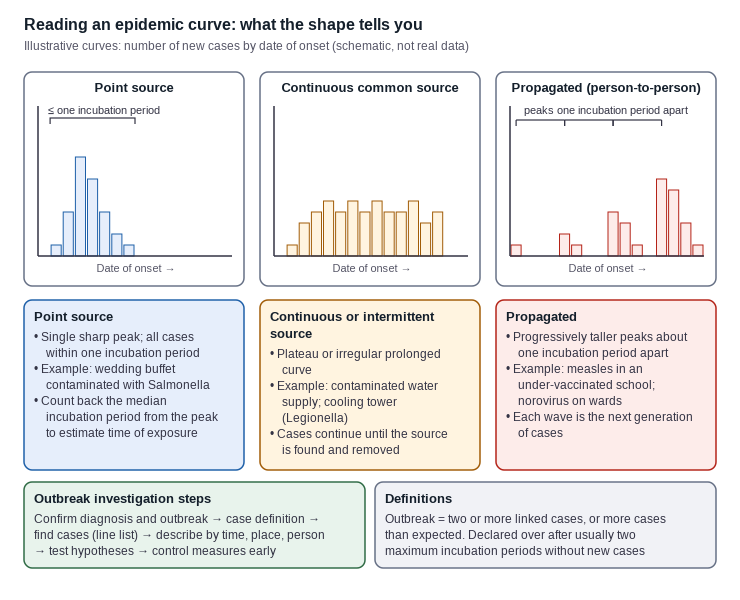
Notification is the legal duty to report certain infections to public health authorities so that they can detect clusters, trace contacts, give prophylaxis and stop spread. In England a registered medical practitioner must notify a suspected case of a listed disease (for example meningococcal disease, measles, TB, food poisoning, mpox) to the local health protection team on clinical suspicion, without waiting for laboratory confirmation; laboratories separately report causative organisms. Most countries have similar systems, and the International Health Regulations (2005), amended in 2024 with a new 'pandemic emergency' alert level that took effect in September 2025, oblige states to report events that may become a public health emergency of international concern. An outbreak is two or more linked cases, or more cases than expected in a place and time. Investigation confirms the outbreak, defines and finds cases, describes them by time, place and person, tests hypotheses and applies control measures early. Control targets the source, the route of transmission and susceptible people through isolation, exclusion, contact tracing, prophylaxis and vaccination.
Patient case, mechanism, investigations, management, flashcards and exam-style questions.Open the lesson →
Key facts
- Doctors notify on clinical suspicion: do not wait for laboratory confirmation
- England: notify the health protection team in writing within 3 days, and by telephone within 24 hours for urgent diseases (e.g. meningococcal disease, measles, diphtheria, VHF)
- Notification overrides normal confidentiality because it is a legal requirement in the public interest; tell the patient
- Outbreak: two or more epidemiologically linked cases, or incidence above the expected level for that place and time
- IHR (2005): a single case of smallpox, wild-type polio, new influenza subtype or SARS must always be reported to WHO
- The 2024 IHR amendments (in force 19 September 2025) created a 'pandemic emergency' alert level above a PHEIC
- Epidemic curve: one sharp peak = point source; plateau = continuous source; successive peaks one incubation period apart = person-to-person (propagated)
- Herd immunity threshold ≈ 1 − 1/R0: for measles (R0 12–18) about 92–95% of the population must be immune
Differential diagnosis
| Condition | Clues | Key test |
|---|---|---|
| True outbreak | Linked cases above baseline, common exposure | Case definition, epidemic curve, typing (WGS) |
| Pseudo-outbreak | Apparent rise from laboratory contamination or a new test | Check specimen handling, new assay introduction, clinical correlation |
| Surveillance artefact | More testing, better reporting or changed case definition | Compare testing rates and denominators |
| Seasonal increase | Expected winter rise (influenza, norovirus, RSV) | Compare with baseline for the same season |
| Sporadic unrelated cases | Same organism but different types and exposures | Molecular typing shows unrelated strains |
| Non-infectious cluster | Toxins, chemicals, mass psychogenic illness | Environmental and toxicology investigation |
Exam pearls
Guideline
International Health Regulations (2005; amendments adopted 2024, in force 19 September 2025), Health Protection (Notification) Regulations 2010 with UKHSA reporting guidance (2025) and PHE outbreak management operational guidance (2014)
References
- World Health Organization. International Health Regulations (2005), third edition. WHO, Geneva 2016.
- World Health Organization (Seventy-seventh World Health Assembly). Amendments to the International Health Regulations (2005) (resolution WHA77.17), in force from 19 September 2025. WHO, Geneva 2024.
- UK Government. The Health Protection (Notification) Regulations 2010 (SI 2010/659). legislation.gov.uk 2010.
- UK Health Security Agency. Notifiable diseases and causative organisms: how to report. GOV.UK guidance 2025.
- Public Health England. Communicable disease outbreak management: operational guidance. PHE, London 2014.
- Reingold AL.. Outbreak investigations--a perspective. Emerg Infect Dis 1998.
Related topics
By Dr Khalid Seidi (B.Sc., M.D.) · MedEd World Clinical Knowledge library. Original teaching content checked against current guidelines (November 2026); confirm the latest local guidance before clinical use. Not a substitute for clinical judgement.