Clinical Knowledge › Obstetrics and gynaecology › Menstrual disorders and reproductive endocrinology
Premenstrual syndrome
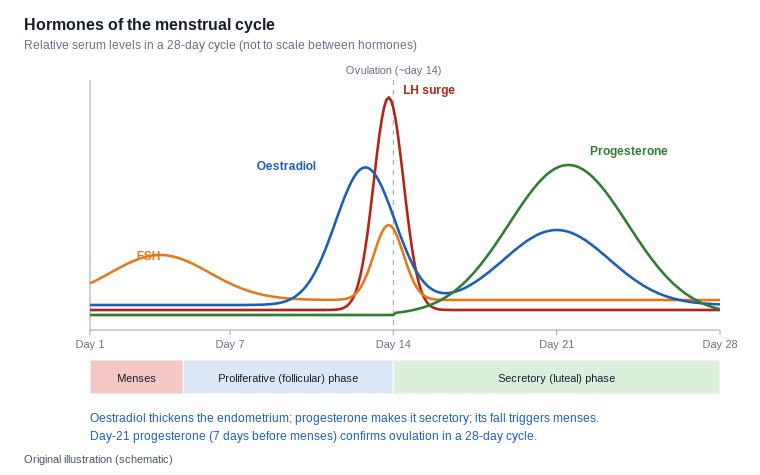
Premenstrual syndrome (PMS) is a recurrent pattern of psychological and physical symptoms that appear in the luteal phase, resolve within a few days of menstruation, leave a symptom-free week after the period and impair daily life. About 20–30% of menstruating women have moderate to severe PMS and 3–8% meet DSM-5-TR criteria for premenstrual dysphoric disorder (PMDD), the severe, mood-dominant form. Hormone levels are normal: the problem is an abnormal brain response to normal ovulatory changes in oestradiol and progesterone (via the neurosteroid allopregnanolone and serotonin). Diagnosis is clinical and depends on prospective daily symptom ratings for at least two cycles, which separate true PMS from premenstrual worsening of depression, anxiety or other illness. Management is stepped: lifestyle measures and cognitive behavioural therapy, then an SSRI (continuous or luteal phase) or a drospirenone-containing combined pill, then transdermal oestradiol with progestogen protection, then a GnRH analogue with add-back HRT, and rarely hysterectomy with bilateral oophorectomy.
Patient case, mechanism, investigations, management, flashcards and exam-style questions.Open the lesson →
Key facts
- PMS = symptoms in the luteal phase, relief within a few days of bleeding, a symptom-free week, and functional impairment; the timing defines it, not the type of symptom
- PMDD (DSM-5-TR): at least 5 symptoms, one of them affective (mood swings, irritability, depressed mood or anxiety), in most cycles over the past year, confirmed by daily ratings over 2 cycles
- Prevalence: moderate to severe PMS about 20–30%; PMDD 3–8% of menstruating women
- No blood test makes the diagnosis; ovarian hormone levels are normal. Use a prospective diary such as the Daily Record of Severity of Problems (DRSP) for 2 cycles
- Symptoms that persist through the follicular phase mean an underlying disorder with premenstrual exacerbation, usually depression or anxiety
- First-line drug options: SSRI (for example fluoxetine 20 mg or sertraline 50 mg daily, continuous or luteal phase only) or a combined pill containing drospirenone, ideally taken continuously (teaching doses; check local formulary)
- Second and third line: transdermal oestradiol (100 microgram patch or gel) with endometrial protection, then GnRH analogue with add-back HRT; a GnRH trial also confirms that the symptoms are ovarian-driven
- Last resort: total hysterectomy with bilateral salpingo-oophorectomy plus HRT, only after a good response to a GnRH analogue
Differential diagnosis
| Condition | Clues | Key test |
|---|---|---|
| Major depressive disorder with premenstrual exacerbation | Low mood persists into the follicular week | Prospective diary shows no symptom-free interval; PHQ-9 |
| Generalised anxiety or panic disorder | Anxiety throughout the cycle | Daily ratings across 2 cycles; GAD-7 |
| Bipolar disorder | Episodes of elevated mood, not linked to cycle phase | Mood history; collateral history |
| Hypothyroidism | Fatigue, weight gain, low mood, heavy periods | TSH and free T4 |
| Perimenopause | Age over 40, irregular cycles, hot flushes | Clinical diagnosis; FSH only if under 45 and unclear |
| Iron deficiency anaemia | Fatigue with heavy menstrual bleeding | Full blood count and ferritin |
| Endometriosis or dysmenorrhoea | Pelvic pain dominates, may start premenstrually | Pelvic examination and transvaginal ultrasound |
| Premenstrual exacerbation of migraine, epilepsy or asthma | Known condition that worsens at menses | Seizure or headache diary linked to cycle |
Exam pearls
Guideline
RCOG Green-top Guideline No. 48 Management of premenstrual syndrome (2016) and ACOG Clinical Practice Guideline No. 7 Management of premenstrual disorders (2023)
References
- Royal College of Obstetricians and Gynaecologists. Management of premenstrual syndrome: Green-top Guideline No. 48. BJOG 2017.
- American College of Obstetricians and Gynecologists. Management of premenstrual disorders: ACOG Clinical Practice Guideline No. 7. Obstet Gynecol 2023.
- American Psychiatric Association. Diagnostic and Statistical Manual of Mental Disorders, Fifth Edition, Text Revision (DSM-5-TR). American Psychiatric Association Publishing 2022.
- O'Brien PMS, Bäckström T, Brown C, et al.. Towards a consensus on diagnostic criteria, measurement and trial design of the premenstrual disorders: the ISPMD Montreal consensus. Arch Womens Ment Health 2011.
- Marjoribanks J, Brown J, O'Brien PMS, Wyatt K.. Selective serotonin reuptake inhibitors for premenstrual syndrome. Cochrane Database Syst Rev 2013.
- Lopez LM, Kaptein AA, Helmerhorst FM.. Oral contraceptives containing drospirenone for premenstrual syndrome. Cochrane Database Syst Rev 2012.
Related topics
By Dr Khalid Seidi (B.Sc., M.D.) · MedEd World Clinical Knowledge library. Original teaching content checked against current guidelines (November 2026); confirm the latest local guidance before clinical use. Not a substitute for clinical judgement.