Clinical Knowledge › Obstetrics and gynaecology › Menstrual disorders and reproductive endocrinology
Primary amenorrhoea
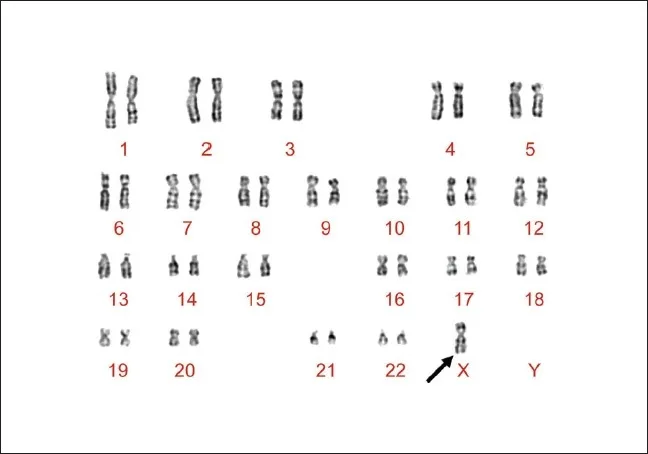
Primary amenorrhoea is failure to start menstruating by age 15 in a girl with normal secondary sexual characteristics, or within 3 years of breast development; absent breast development by 13 also needs assessment. Pregnancy must still be excluded. The commonest causes are gonadal dysgenesis (especially Turner syndrome), Müllerian agenesis (Mayer–Rokitansky–Küster–Hauser syndrome), constitutional delay and hypothalamic causes such as low energy availability; outflow obstruction (imperforate hymen, transverse vaginal septum) and complete androgen insensitivity are classic exam diagnoses. Two questions organise the work-up: are breasts present (oestrogen exposure) and is a uterus present (pelvic ultrasound or MRI)? FSH, LH, prolactin, TSH and karyotype then separate ovarian failure from hypothalamic–pituitary disease and identify XY conditions. Management includes drainage of obstruction, vaginal dilators before surgery for vaginal agenesis, low-dose oestradiol puberty induction, removal of Y-containing dysgenetic gonads and supported fertility counselling.
Patient case, mechanism, investigations, management, flashcards and exam-style questions.Open the lesson →
Key facts
- Investigate if no menses by 15 with normal secondary sexual development, 3 years after thelarche, or no breast development by 13; always do a pregnancy test
- Breasts present means oestrogen has been produced; a uterus on ultrasound separates outflow or hypothalamic causes from Müllerian agenesis and androgen insensitivity
- High FSH with absent breasts = gonadal failure (Turner 45,X or Swyer 46,XY); low or normal FSH = constitutional delay, functional hypothalamic or pituitary disease, or Kallmann syndrome
- MRKH syndrome: 46,XX, normal breasts and pubic hair, normal ovaries, absent uterus and upper vagina; about 1 in 4500–5000 female births; check kidneys (renal anomalies in about a third)
- Complete androgen insensitivity: 46,XY, breasts present, sparse pubic and axillary hair, blind vagina, no uterus, testosterone in the male range
- Imperforate hymen: cyclical pain, bulging bluish membrane, haematocolpos; treat by hymenotomy. Transverse septum: no bulge, needs MRI and specialist excision
- Vaginal dilator therapy is first-line for vaginal agenesis (success in most motivated patients); surgery (for example Vecchietti or Davydov) if it fails
- Remove streak gonads that contain Y material (Swyer syndrome, Turner with Y mosaicism) because of the risk of gonadoblastoma
Differential diagnosis
| Condition | Clues | Key test |
|---|---|---|
| Turner syndrome (45,X and mosaics) | Short stature, webbed neck, absent breasts, high FSH | Karyotype |
| Mayer–Rokitansky–Küster–Hauser syndrome | Normal breasts and pubic hair, short blind vagina, no uterus | Pelvic ultrasound or MRI; 46,XX karyotype |
| Complete androgen insensitivity syndrome | Breasts present, scant pubic hair, inguinal masses | Karyotype 46,XY; testosterone in male range |
| Imperforate hymen or transverse vaginal septum | Cyclical pelvic pain, haematocolpos, normal puberty | Examination; pelvic ultrasound or MRI |
| Constitutional delay of growth and puberty | Family history of late puberty, delayed bone age | Low or normal FSH and LH; bone age; follow-up |
| Functional hypothalamic amenorrhoea | Low weight, eating disorder, high-level sport | Low or normal FSH and LH, low oestradiol |
| Kallmann syndrome | Anosmia, absent puberty | Low FSH and LH; smell test; MRI of olfactory bulbs |
| Swyer syndrome (46,XY gonadal dysgenesis) | Tall, absent breasts, uterus present, high FSH | Karyotype 46,XY |
Exam pearls
Guideline
ASRM Practice Committee Current evaluation of amenorrhea (2024), International Turner syndrome clinical practice guideline (2024), ESHRE/ASRM/CRE/IMS POI guideline (2024) and ACOG Committee Opinion No. 728 Müllerian agenesis (2018)
References
- Practice Committee of the American Society for Reproductive Medicine. Current evaluation of amenorrhea: a committee opinion. Fertil Steril 2024.
- Gravholt CH, Andersen NH, Christin-Maitre S, et al.. Clinical practice guidelines for the care of girls and women with Turner syndrome. Eur J Endocrinol 2024.
- Panay N, Anderson RA, Bennie A, et al.. Evidence-based guideline: premature ovarian insufficiency. Hum Reprod Open 2024.
- Pfeifer SM, Attaran M, Goldstein J, et al.. ASRM müllerian anomalies classification 2021. Fertil Steril 2021.
- American College of Obstetricians and Gynecologists. Müllerian agenesis: diagnosis, management, and treatment. ACOG Committee Opinion No. 728. Obstet Gynecol 2018.
- Brännström M, Johannesson L, Bokström H, et al.. Livebirth after uterus transplantation. Lancet 2015.
Related topics
By Dr Khalid Seidi (B.Sc., M.D.) · MedEd World Clinical Knowledge library. Original teaching content checked against current guidelines (November 2026); confirm the latest local guidance before clinical use. Not a substitute for clinical judgement.