Clinical Knowledge › Urology › Basics of urology
Urinary catheterisation and catheter problems
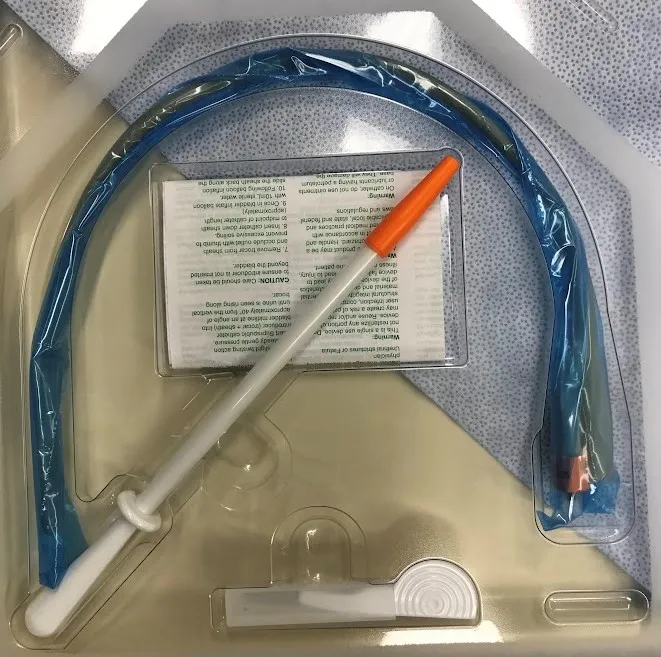
Urinary catheters relieve retention, allow accurate output monitoring and support bladder irrigation, but each day of an indwelling catheter adds a few percent risk of bacteriuria and they are the main source of healthcare-associated urinary infection. Good practice is to avoid unnecessary catheters, choose the smallest suitable size (Charrière equals external circumference in millimetres), insert with aseptic technique and anaesthetic gel, advance fully and see urine before inflating the balloon, replace the foreskin, keep a closed system with the bag below the bladder and remove the catheter as soon as possible. Intermittent catheterisation is preferred to long-term indwelling catheters when feasible; suprapubic catheters need ultrasound guidance and urological expertise. Common problems include blockage, bypassing, haematuria, a balloon that will not deflate, encrustation from urease-producing bacteria, paraphimosis, urethral trauma and post-obstructive diuresis. Bacteriuria is universal with long-term catheters and should not be treated unless symptomatic; for symptomatic infection, change a catheter older than 7 days, culture from the new one and give a 7-day course.
Patient case, mechanism, investigations, management, flashcards and exam-style questions.Open the lesson →
Key facts
- Charrière (Ch) or French (Fr) size is the external circumference in mm (3 Ch ≈ 1 mm diameter); 12–14 Ch suits most adults, 20–24 Ch three-way catheters for clot retention and irrigation
- Appropriate indications include retention, accurate output monitoring in critical illness, perioperative use, clot retention, healing of sacral or perineal wounds in incontinence, and end-of-life comfort – not nursing convenience
- In men insert to the bifurcation and wait for urine before inflating the balloon; then replace the foreskin to prevent paraphimosis
- Bacteriuria develops in most patients with long-term catheters; do not screen with dipsticks or treat asymptomatic bacteriuria
- Symptomatic CAUTI: change a catheter in place more than 7 days, send urine from the new catheter, give antibiotics (usually 7 days)
- No routine antibiotic prophylaxis at catheter insertion, change or removal; consider only after previous symptomatic CAUTI or trauma at change
- Post-obstructive diuresis: urine output above about 200 mL/h for 2 consecutive hours (or more than 3 L/24 h) after relieving chronic retention; monitor fluids and electrolytes
- Offer an alpha-blocker for at least 2 days before trial without catheter in men with acute retention from benign prostatic enlargement
Differential diagnosis
| Condition | Clues | Key test |
|---|---|---|
| Blocked catheter | No drainage, suprapubic pain, bypassing; bladder scan full | Bladder scan; gentle flush |
| Oliguria from AKI or hypovolaemia | Catheter draining but little urine; bladder scan empty | Bladder scan, fluid status, creatinine |
| Bladder spasm | Bypassing with intermittent cramping pain and patent catheter | Flushes freely; consider antimuscarinic |
| Symptomatic CAUTI | Fever, rigors, delirium, loin or suprapubic pain without other cause | Culture from a new catheter; blood cultures |
| Asymptomatic bacteriuria | Cloudy, smelly urine; well patient | Clinical judgement; no test needed |
| Urethral false passage | Bleeding and failed drainage after difficult insertion | Urology review; cystoscopy |
| Post-obstructive diuresis | High output after relieving chronic retention | Hourly output, U&E, weight |
Exam pearls
Guideline
epic3 (2014), CDC/HICPAC CAUTI guideline (2009, updated 2019), SHEA/IDSA/APIC CAUTI prevention compendium (2022 update), NICE NG113 catheter-associated UTI (2018), NICE CG139 (2012, updated 2017), EAU Guidelines on Urological Infections (2025) and BAUS suprapubic catheter guidance (2011)
References
- Loveday HP, Wilson JA, Pratt RJ, et al.. epic3: national evidence-based guidelines for preventing healthcare-associated infections in NHS hospitals in England. J Hosp Infect 2014.
- Gould CV, Umscheid CA, Agarwal RK, Kuntz G, Pegues DA.. Guideline for prevention of catheter-associated urinary tract infections 2009. Infect Control Hosp Epidemiol 2010.
- Patel PK, Advani SD, Kofman AD, et al.. Strategies to prevent catheter-associated urinary tract infections in acute-care hospitals: 2022 update. Infect Control Hosp Epidemiol 2023.
- Hooton TM, Bradley SF, Cardenas DD, et al.. Diagnosis, prevention, and treatment of catheter-associated urinary tract infection in adults: 2009 international clinical practice guidelines. Clin Infect Dis 2010.
- National Institute for Health and Care Excellence. Urinary tract infection (catheter-associated): antimicrobial prescribing (NG113). NICE, London 2018.
- National Institute for Health and Care Excellence. Healthcare-associated infections: prevention and control in primary and community care (CG139). NICE, London (2012, updated 2017) 2017.
Related topics
By Dr Khalid Seidi (B.Sc., M.D.) · MedEd World Clinical Knowledge library. Original teaching content checked against current guidelines (November 2026); confirm the latest local guidance before clinical use. Not a substitute for clinical judgement.