Clinical Knowledge › Urology › Basics of urology
Urological history and examination including digital rectal examination
A good urological assessment sorts symptoms into storage, voiding and post-micturition lower urinary tract symptoms (LUTS), haematuria, pain, scrotal or penile problems and sexual or fertility concerns, then looks for red flags. Validated tools make the history objective: the International Prostate Symptom Score (IPSS, 0–35 plus a quality-of-life item) grades male LUTS, and a frequency–volume chart or bladder diary over at least 3 days separates nocturnal polyuria, global polyuria and reduced bladder capacity. Drug, smoking, occupational, travel, sexual and family histories point to retention, bladder cancer, schistosomiasis, sexually transmitted infection and inherited prostate cancer. Examination includes the abdomen and loins, the bladder, the external genitalia and scrotum, a digital rectal examination (DRE) assessing prostate size, consistency, nodules and the median sulcus, and a focused sacral neurological examination. Every intimate examination needs explanation, consent and the offer of a chaperone. Findings drive urgent action: suspected torsion, cauda equina, infected obstruction, visible haematuria at 45 or over and an abnormal DRE.
Patient case, mechanism, investigations, management, flashcards and exam-style questions.Open the lesson →
Key facts
- LUTS are classified as storage (frequency, urgency, nocturia, urge incontinence), voiding (hesitancy, weak or intermittent stream, straining) and post-micturition (incomplete emptying, post-micturition dribble)
- IPSS: 7 symptom questions scored 0–5 (total 0–35): mild 0–7, moderate 8–19, severe 20–35, plus one quality-of-life question scored 0–6
- A frequency–volume chart over at least 3 days identifies nocturnal polyuria (night-time urine more than about one-third of 24-hour output in older adults) and polyuria (more than 40 mL/kg/24 h)
- Drugs that precipitate retention: anticholinergics, tricyclics, antihistamines, opioids, decongestants (pseudoephedrine) and some anaesthetics
- DRE assesses anal tone, prostate size, surface, consistency, tenderness, nodules and the median sulcus; a hard irregular gland suggests cancer
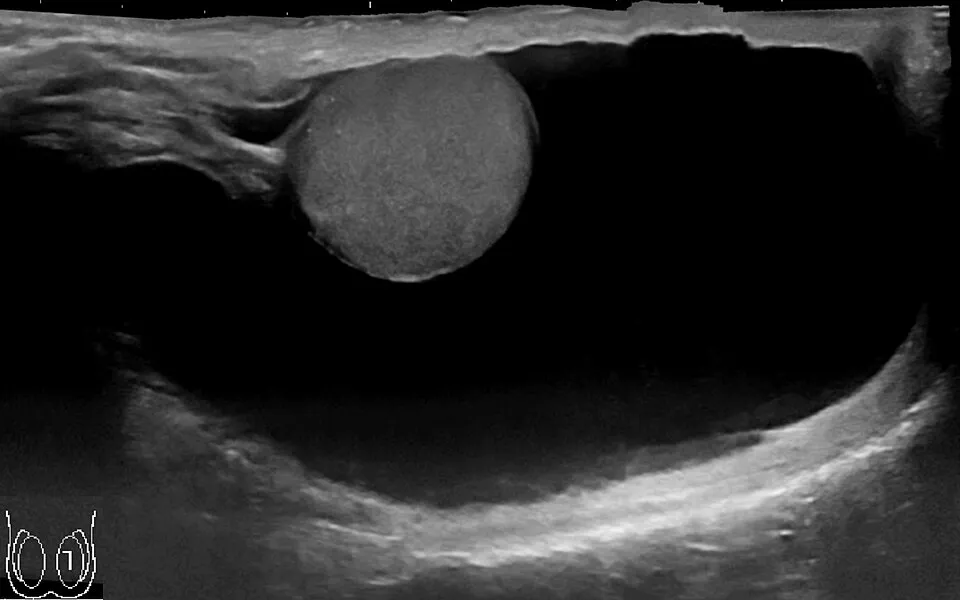
- Scrotal examination asks: can you get above the swelling, is it separate from the testis, does it transilluminate, is it tender?
- Offer a chaperone for every intimate examination, explain and obtain consent, and record who was present or that the offer was declined
- NICE NG12: refer people aged 45 or over with unexplained visible haematuria (no UTI, or persisting after treatment) on a suspected cancer pathway
Differential diagnosis
| Condition | Clues | Key test |
|---|---|---|
| Benign prostatic obstruction | Voiding LUTS, smooth enlarged prostate | IPSS, flow rate, post-void residual |
| Overactive bladder | Urgency, frequency, nocturia, small voided volumes | Frequency–volume chart, urinalysis |
| Nocturnal polyuria | Large night-time volumes, normal daytime voids | Frequency–volume chart (night fraction above one-third) |
| Prostate cancer | Often asymptomatic; hard nodular prostate | PSA, prostate MRI |
| Urothelial cancer | Painless visible haematuria, smoker | Cystoscopy and CT urogram |
| Neurogenic bladder or cauda equina | Saddle anaesthesia, reduced anal tone, painless retention | Emergency MRI spine; bladder scan |
| Urethral stricture | Young man, prolonged weak stream, previous urethritis or instrumentation | Flow curve plateau; urethrogram or urethroscopy |
| Diabetes mellitus or insipidus | Polyuria with thirst | Glucose, HbA1c; plasma and urine osmolality |
Exam pearls
Guideline
EAU Guidelines on Non-neurogenic Male LUTS (2025), NICE CG97 Lower urinary tract symptoms in men (2010, updated 2015), AUA BPH guideline (2021, amended 2023), NICE NG12 Suspected cancer (2015, updated), AUA/SUFU Microhematuria (2025) and GMC guidance on intimate examinations and chaperones (2024)
References
- European Association of Urology. EAU Guidelines on the Management of Non-neurogenic Male Lower Urinary Tract Symptoms. EAU Guidelines Office, Arnhem (edition presented at the EAU Annual Congress 2025; updated annually) 2025.
- National Institute for Health and Care Excellence. Lower urinary tract symptoms in men: management (CG97). NICE, London (2010, updated 2015) 2015.
- Lerner LB, McVary KT, Barry MJ, et al.. Management of lower urinary tract symptoms attributed to benign prostatic hyperplasia: AUA guideline part I – initial work-up and medical management. J Urol 2021.
- Barry MJ, Fowler FJ Jr, O'Leary MP, et al.. The American Urological Association symptom index for benign prostatic hyperplasia. J Urol 1992.
- D'Ancona C, Haylen B, Oelke M, et al.. The International Continence Society (ICS) report on the terminology for adult male lower urinary tract and pelvic floor symptoms and dysfunction. Neurourol Urodyn 2019.
- National Institute for Health and Care Excellence. Suspected cancer: recognition and referral (NG12). NICE, London (first published 2015; regularly updated) 2015.
Related topics
By Dr Khalid Seidi (B.Sc., M.D.) · MedEd World Clinical Knowledge library. Original teaching content checked against current guidelines (November 2026); confirm the latest local guidance before clinical use. Not a substitute for clinical judgement.