Clinical Knowledge › Urology › Basics of urology
Urodynamic studies
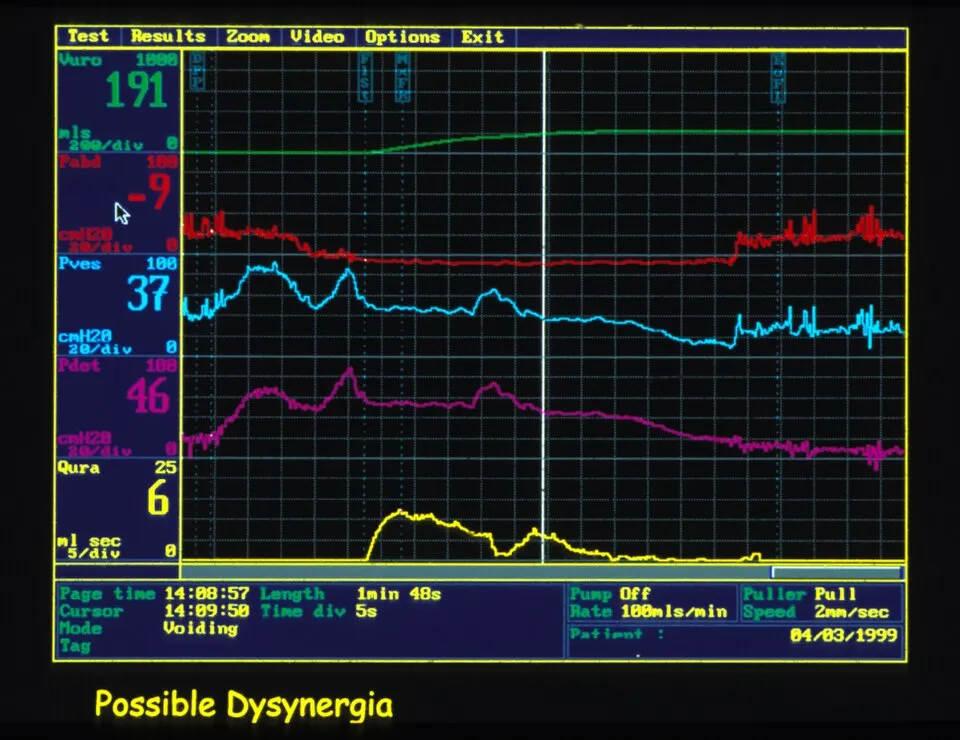
Urodynamic studies measure how the lower urinary tract stores and empties urine, turning symptoms into physiological diagnoses. Non-invasive tests come first: a bladder diary, uroflowmetry (maximum flow rate, Qmax, with a voided volume of at least 150 mL) and post-void residual. Invasive multichannel cystometry records bladder (Pves) and abdominal (Pabd, rectal or vaginal) pressures; detrusor pressure is Pdet = Pves − Pabd. Filling cystometry assesses sensation, capacity, compliance, detrusor overactivity and urodynamic stress incontinence; the pressure–flow study during voiding separates bladder outlet obstruction (BOOI = PdetQmax − 2Qmax, above 40 obstructed) from detrusor underactivity (BCI = PdetQmax + 5Qmax, below 100 weak). Video-urodynamics adds fluoroscopy for neurogenic and complex cases, where storage pressures above 40 cmH2O threaten the kidneys. Testing is justified only when the result will change management: trials show it is unnecessary before primary surgery for clearly defined stress incontinence and does not reduce prostate surgery rates in men.
Patient case, mechanism, investigations, management, flashcards and exam-style questions.Open the lesson →
Key facts
- Detrusor pressure is calculated: Pdet = Pves − Pabd; transducers are zeroed to atmospheric pressure at the level of the upper border of the symphysis pubis
- Uroflowmetry needs a voided volume of at least 150 mL; a Qmax below 10 mL/s suggests obstruction or a weak detrusor but cannot tell them apart
- Filling cystometry assesses sensation, capacity, compliance (ΔV/ΔPdet), detrusor overactivity and urodynamic stress incontinence
- Detrusor overactivity is an involuntary detrusor contraction during filling; urodynamic stress incontinence is leakage with raised abdominal pressure without a detrusor contraction
- Bladder outlet obstruction index (BOOI) = PdetQmax − 2Qmax: above 40 obstructed, 20–40 equivocal, below 20 unobstructed
- Bladder contractility index (BCI) = PdetQmax + 5Qmax: above 150 strong, 100–150 normal, below 100 weak
- In neurogenic bladders, sustained storage or leak-point pressures above 40 cmH2O predict upper tract damage; video-urodynamics detects reflux and detrusor–sphincter dyssynergia
- Do not perform urodynamics before primary surgery for clearly defined pure stress incontinence (VALUE trial; NICE NG123)
Differential diagnosis
| Condition | Clues | Key test |
|---|---|---|
| Bladder outlet obstruction | Low Qmax with high voiding Pdet | Pressure–flow study: BOOI above 40 |
| Detrusor underactivity | Low Qmax with low voiding Pdet, straining | Pressure–flow study: BCI below 100 |
| Detrusor overactivity | Urgency with involuntary detrusor contractions during filling | Filling cystometry |
| Urodynamic stress incontinence | Leak on cough without detrusor contraction | Filling cystometry with provocation |
| Detrusor–sphincter dyssynergia | Spinal cord lesion; interrupted voiding | Video-urodynamics with EMG |
| Low-compliance bladder | Steady pressure rise on filling; hydronephrosis | Filling cystometry; renal ultrasound |
| Urethral stricture | Plateau-shaped flow curve in a young man | Retrograde urethrogram or urethroscopy |
Exam pearls
Guideline
ICS Good Urodynamic Practices (2016), EAU Guidelines on Non-neurogenic Male LUTS, Non-neurogenic Female LUTS and Neuro-Urology (2025 editions), NICE NG123 (2019), NICE CG97 (2010, updated 2015) and AUA/SUFU urodynamics guideline (2012)
References
- Rosier PFWM, Schaefer W, Lose G, et al.. International Continence Society Good Urodynamic Practices and Terms 2016: urodynamics, uroflowmetry, cystometry, and pressure-flow study. Neurourol Urodyn 2017.
- Abrams P.. Bladder outlet obstruction index, bladder contractility index and bladder voiding efficiency: three simple indices to define bladder voiding function. BJU Int 1999.
- Nager CW, Brubaker L, Litman HJ, et al.. A randomized trial of urodynamic testing before stress-incontinence surgery. N Engl J Med 2012.
- Drake MJ, Lewis AL, Young GJ, et al.. Diagnostic assessment of lower urinary tract symptoms in men considering prostate surgery: a noninferiority randomised controlled trial of urodynamics in 26 hospitals. Eur Urol 2020.
- Winters JC, Dmochowski RR, Goldman HB, et al.. Urodynamic studies in adults: AUA/SUFU guideline. J Urol 2012.
- National Institute for Health and Care Excellence. Urinary incontinence and pelvic organ prolapse in women: management (NG123). NICE, London 2019.
Related topics
By Dr Khalid Seidi (B.Sc., M.D.) · MedEd World Clinical Knowledge library. Original teaching content checked against current guidelines (November 2026); confirm the latest local guidance before clinical use. Not a substitute for clinical judgement.