Clinical Knowledge › Internal medicine › Haematology and oncology › Myeloid neoplasms
Acute promyelocytic leukaemia (APL)
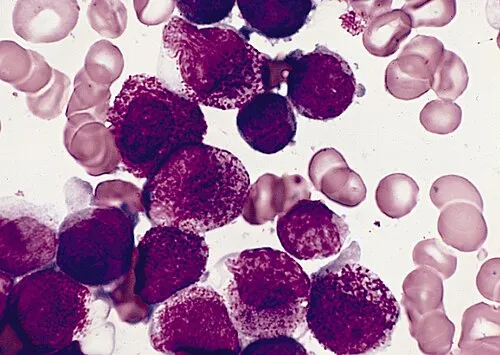
Acute promyelocytic leukaemia (APL) is a subtype of acute myeloid leukaemia defined by the PML::RARA fusion, usually from t(15;17)(q24;q21). The fusion protein blocks myeloid differentiation at the promyelocyte stage. APL affects younger adults more than other AML and presents with pancytopenia, often a low white cell count, and a severe coagulopathy combining DIC with hyperfibrinolysis: bruising, gum bleeding, menorrhagia and intracranial or pulmonary haemorrhage. The blood film shows hypergranular promyelocytes with bilobed nuclei and bundles of Auer rods (faggot cells). It is a medical emergency: all-trans retinoic acid (ATRA) must start on clinical suspicion, before genetic confirmation, with aggressive platelet, fibrinogen and plasma support. Low- and intermediate-risk disease (WBC ≤10 ×10⁹/L) is cured in over 90% with ATRA plus arsenic trioxide without chemotherapy; high-risk disease receives ATRA plus arsenic with limited idarubicin (APOLLO, 2025) or ATRA plus chemotherapy. Key toxicities are differentiation syndrome and QT prolongation.
Patient case, mechanism, investigations, management, flashcards and exam-style questions.Open the lesson →
Key facts
- Genetic hallmark: PML::RARA fusion from t(15;17)(q24.1;q21.2); WHO-HAEM5 (2022) defines APL by the fusion regardless of blast count
- About 5–10% of adult AML; median age about 40–45 years; commoner in people of Latin American and southern European ancestry
- Early death (first 30 days) is mainly from haemorrhage – intracranial or pulmonary – caused by DIC with marked hyperfibrinolysis
- Start ATRA (45 mg/m²/day in two doses) immediately when the film suggests APL; do not wait for PML::RARA confirmation
- Support: keep platelets above 30–50 ×10⁹/L, fibrinogen above 1.0–1.5 g/L and PT/APTT near normal; avoid central line insertion, lumbar puncture and leukapheresis
- Sanz risk: high risk = WBC >10 ×10⁹/L; low/intermediate risk = WBC ≤10 ×10⁹/L
- Low/intermediate risk: ATRA + arsenic trioxide (APL0406) – event-free survival over 95%; chemotherapy-free
- Differentiation syndrome (about 15–25%): fever, weight gain, oedema, dyspnoea, pulmonary infiltrates, effusions, hypotension and renal failure – treat with dexamethasone 10 mg IV twice daily
Differential diagnosis
| Condition | Clues | Key test |
|---|---|---|
| Other AML subtypes | Blasts without heavy granulation or faggot cells; DIC less marked | Flow cytometry (HLA-DR, CD34), cytogenetics, PML::RARA negative |
| DIC from sepsis or obstetric cause | Coagulopathy without circulating abnormal promyelocytes | Film, clinical context, marrow if unexplained |
| Thrombotic thrombocytopenic purpura | Thrombocytopenia with schistocytes, neurological signs; normal coagulation | ADAMTS13 activity; PT and fibrinogen normal |
| Aplastic anaemia | Pancytopenia without blasts or coagulopathy | Hypocellular trephine |
| Leukaemoid reaction or marrow recovery after G-CSF | Many promyelocytes after G-CSF or infection, no coagulopathy | History; PML::RARA negative |
| Acute lymphoblastic leukaemia | Bone pain, lymphadenopathy; no Auer rods | Flow cytometry (CD19, CD10, TdT) |
| Variant RARA rearrangements (ZBTB16::RARA, STAT5B::RARA) | APL-like morphology but poor ATRA/arsenic response | FISH/RT-PCR for variant fusions |
Exam pearls
Guideline
European LeukemiaNet APL recommendations (2019), WHO-HAEM5 and ICC classifications (2022), APL0406 (2013) and APOLLO (2025) trials, with current NCCN AML guidance (2025–2026)
References
- Sanz MA, Fenaux P, Tallman MS, et al.. Management of acute promyelocytic leukemia: updated recommendations from an expert panel of the European LeukemiaNet. Blood 2019.
- Lo-Coco F, Avvisati G, Vignetti M, et al.. Retinoic acid and arsenic trioxide for acute promyelocytic leukemia. N Engl J Med 2013.
- Platzbecker U, Adès L, Montesinos P, et al.. Arsenic trioxide and all-trans retinoic acid combination therapy for the treatment of high-risk acute promyelocytic leukemia: results from the APOLLO trial. J Clin Oncol 2025.
- Chin L, Tallman MS.. Curative strategies for high-risk acute promyelocytic leukemia. Curr Opin Oncol 2025.
- Khoury JD, Solary E, Abla O, et al.. The 5th edition of the World Health Organization Classification of Haematolymphoid Tumours: Myeloid and Histiocytic/Dendritic Neoplasms. Leukemia 2022.
- Arber DA, Orazi A, Hasserjian RP, et al.. International Consensus Classification of Myeloid Neoplasms and Acute Leukemias: integrating morphologic, clinical, and genomic data. Blood 2022.
Related topics
By Dr Khalid Seidi (B.Sc., M.D.) · MedEd World Clinical Knowledge library. Original teaching content checked against current guidelines (November 2026); confirm the latest local guidance before clinical use. Not a substitute for clinical judgement.