Clinical Knowledge › Internal medicine › Haematology and oncology › Myeloid neoplasms
Essential thrombocythaemia
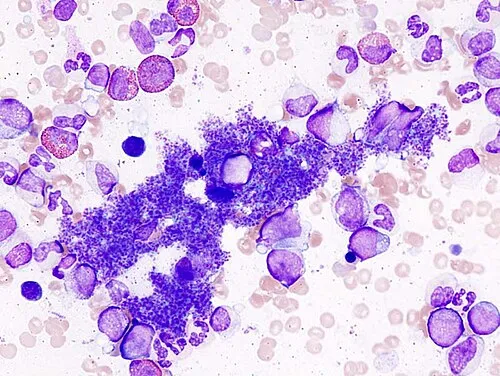
Essential thrombocythaemia (ET) is a Philadelphia-negative myeloproliferative neoplasm in which a clonal stem cell drives sustained overproduction of platelets from enlarged, mature megakaryocytes. Driver mutations are JAK2 V617F (about 55%), CALR (about 25%) and MPL (about 4%); about 10–15% are 'triple-negative'. Many are found incidentally; others present with vasomotor symptoms (headache, visual disturbance, erythromelalgia), arterial or venous (including splanchnic) thrombosis, or bleeding from acquired von Willebrand syndrome when platelets exceed about 1000 ×10⁹/L. Diagnosis uses WHO-HAEM5 and ICC 2022 criteria: platelets ≥450 ×10⁹/L, a characteristic trephine, exclusion of CML, PV, PMF and MDS, and a driver mutation or other clonal marker. Management is guided by thrombotic risk (revised IPSET-thrombosis): low-dose aspirin for most, and cytoreduction with hydroxycarbamide, interferon (ropeginterferon alfa-2b outperformed anagrelide in SURPASS ET) or anagrelide for high-risk disease. Life expectancy is close to normal; a minority progress to myelofibrosis or acute leukaemia.
Patient case, mechanism, investigations, management, flashcards and exam-style questions.Open the lesson →
Key facts
- WHO-HAEM5 major criteria: platelets ≥450 ×10⁹/L; trephine with increased enlarged mature hyperlobulated megakaryocytes without significant left shift; not CML, PV, PMF or MDS; JAK2, CALR or MPL mutation (minor: other clonal marker or no reactive cause)
- Driver mutations: JAK2 V617F about 55%, CALR about 25%, MPL about 4%, triple-negative 10–15%; BCR::ABL1 must be excluded because CML can mimic ET
- Revised IPSET-thrombosis: very low (≤60 years, no thrombosis, JAK2 unmutated), low (≤60, no thrombosis, JAK2-mutated), intermediate (>60, no thrombosis, JAK2 unmutated), high (previous thrombosis, or >60 with JAK2)
- Low-dose aspirin for most low- and intermediate-risk patients (especially JAK2-mutated or with cardiovascular risk factors); observation may suffice in very low-risk CALR-mutated disease
- High risk: cytoreduction plus aspirin – hydroxycarbamide first line in older adults; interferon in younger patients and pregnancy; anagrelide second line
- Extreme thrombocytosis (above about 1000 ×10⁹/L) causes acquired von Willebrand syndrome: check VWF activity before aspirin
- Thrombosis at unusual sites (Budd–Chiari, portal or mesenteric vein) in a young adult should prompt JAK2 testing even with a normal count
- Progression: post-ET myelofibrosis in roughly 5–10% and AML in about 1–3% over 15–20 years; median survival is about 18–20 years
Differential diagnosis
| Condition | Clues | Key test |
|---|---|---|
| Reactive thrombocytosis | Infection, inflammation, iron deficiency, bleeding, post-splenectomy, cancer | CRP, ferritin; count settles when trigger resolves |
| Chronic myeloid leukaemia | Thrombocytosis with basophilia, left-shifted neutrophilia, splenomegaly | BCR::ABL1 by PCR or FISH |
| Polycythaemia vera (masked) | JAK2-positive with Hb near the upper limit | Hb/haematocrit criteria, marrow panmyelosis, low EPO |
| Prefibrotic primary myelofibrosis | Anaemia, raised LDH, splenomegaly, leucocytosis | Trephine: atypical clustered megakaryocytes with granulocytic proliferation |
| MDS/MPN with ring sideroblasts and thrombocytosis | Anaemia with high platelets, SF3B1 mutation | Marrow ring sideroblasts ≥15%; SF3B1 |
| MDS with isolated del(5q) | Older woman, macrocytic anaemia, normal or high platelets | Karyotype del(5q); hypolobated megakaryocytes |
| Familial thrombocytosis | Lifelong high count in several relatives, young age | Germline THPO or MPL variants; no somatic driver |
Exam pearls
Guideline
WHO-HAEM5 and ICC classifications (2022), European LeukemiaNet management recommendations for Philadelphia-negative MPN (2018), 2024 ET risk-adapted management update, and the SURPASS ET trial of ropeginterferon alfa-2b (2025)
References
- Khoury JD, Solary E, Abla O, et al.. The 5th edition of the World Health Organization Classification of Haematolymphoid Tumours: Myeloid and Histiocytic/Dendritic Neoplasms. Leukemia 2022.
- Arber DA, Orazi A, Hasserjian RP, et al.. International Consensus Classification of Myeloid Neoplasms and Acute Leukemias: integrating morphologic, clinical, and genomic data. Blood 2022.
- Barbui T, Tefferi A, Vannucchi AM, et al.. Philadelphia chromosome-negative classical myeloproliferative neoplasms: revised management recommendations from European LeukemiaNet. Leukemia 2018.
- Tefferi A, Vannucchi AM, Barbui T.. Essential thrombocythemia: 2024 update on diagnosis, risk stratification, and management. Am J Hematol 2024.
- Harrison CN, Campbell PJ, Buck G, et al.. Hydroxyurea compared with anagrelide in high-risk essential thrombocythemia. N Engl J Med 2005.
- Mesa R, Gill H, Zhang L, et al.. Ropeginterferon alfa-2b in hydroxyurea-intolerant or hydroxyurea-refractory essential thrombocythaemia (SURPASS ET): a multicentre, open-label, randomised, active-controlled, phase 3 study. Lancet Haematol 2025.
Related topics
By Dr Khalid Seidi (B.Sc., M.D.) · MedEd World Clinical Knowledge library. Original teaching content checked against current guidelines (November 2026); confirm the latest local guidance before clinical use. Not a substitute for clinical judgement.