Clinical Knowledge › Internal medicine › Haematology and oncology › Myeloid neoplasms
Chronic myeloid leukaemia (CML)
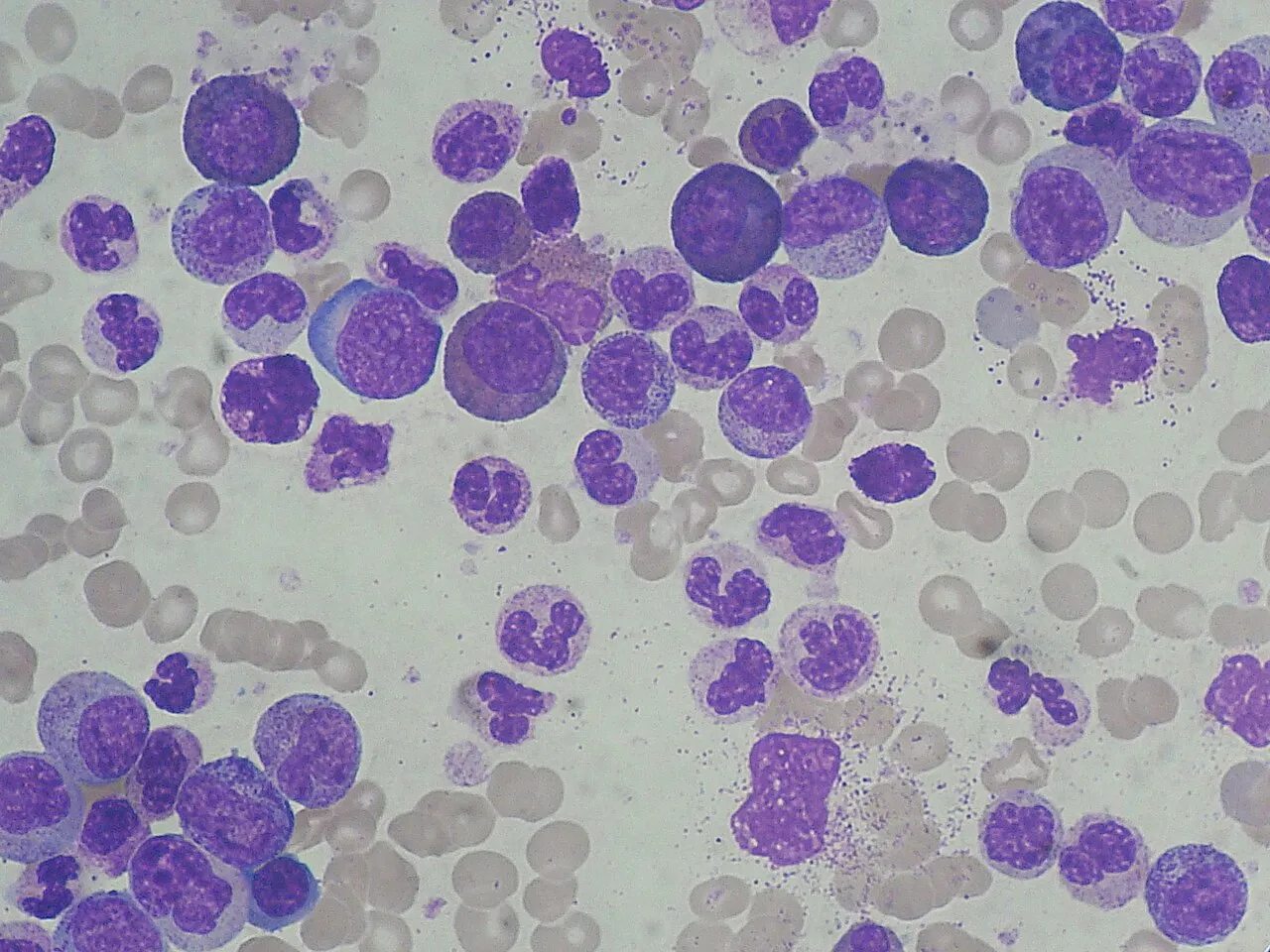
Chronic myeloid leukaemia (CML) is a myeloproliferative neoplasm driven by the BCR::ABL1 fusion gene, created by the t(9;22) translocation that forms the Philadelphia chromosome. The constitutively active ABL1 tyrosine kinase drives expansion of maturing granulocytes. Most patients are diagnosed in chronic phase, often incidentally, with a very high white count showing the full spectrum of myeloid cells, basophilia, and splenomegaly that may be massive; fatigue, weight loss, left upper quadrant pain and early satiety are common. Diagnosis is confirmed by karyotype or FISH for t(9;22) and quantitative PCR for BCR::ABL1 transcripts. Oral tyrosine kinase inhibitors (imatinib, dasatinib, nilotinib, bosutinib and the STAMP inhibitor asciminib) have transformed CML into a chronic condition with near-normal life expectancy. Response is monitored by BCR::ABL1 on the International Scale against ELN milestones, and patients with sustained deep molecular response can attempt treatment-free remission. Untreated disease progresses to blast phase, which behaves like acute leukaemia.
Patient case, mechanism, investigations, management, flashcards and exam-style questions.Open the lesson →
Key facts
- t(9;22)(q34;q11) creates the Philadelphia chromosome and the BCR::ABL1 fusion gene encoding a constitutively active tyrosine kinase (usually p210)
- Classic blood picture: WBC often above 100 × 10⁹/L with neutrophils, myelocytes ('myelocyte bulge'), basophilia and eosinophilia; platelets often high
- Splenomegaly is present in about half and may be massive
- WHO 2022 recognises chronic and blast phase (blasts 20% or more, or extramedullary blasts); ICC 2022 retains accelerated phase
- First-line therapy is a TKI: imatinib, a second-generation TKI (dasatinib, nilotinib, bosutinib) or asciminib
- ELN milestones (BCR::ABL1 IS): 10% or less at 3 months, 1% or less at 6 months, 0.1% or less (major molecular response) at 12 months
- T315I mutation causes resistance to imatinib and second-generation TKIs; use ponatinib or asciminib
- Treatment-free remission is possible in about half of those with sustained deep molecular response after several years of TKI
Differential diagnosis
| Condition | Clues | Key test |
|---|---|---|
| Leukaemoid reaction | Severe infection or inflammation, toxic granulation, no basophilia | BCR::ABL1 negative; resolves with cause |
| Primary myelofibrosis | Massive spleen, teardrop cells, leucoerythroblastic film | JAK2/CALR/MPL mutation; fibrotic trephine; BCR::ABL1 negative |
| Polycythaemia vera | Raised haematocrit, pruritus, plethora | JAK2 V617F; BCR::ABL1 negative |
| Essential thrombocythaemia | Isolated thrombocytosis, small or no spleen | JAK2/CALR/MPL; BCR::ABL1 negative (must be excluded) |
| Chronic myelomonocytic leukaemia | Persistent monocytosis, dysplasia | Monocytes 0.5 × 10⁹/L or more and 10% or more of WBC; BCR::ABL1 negative |
| Acute leukaemia | Rapid marrow failure, many blasts | Blasts 20% or more; check BCR::ABL1 for CML blast phase or Ph+ ALL |
Exam pearls
Guideline
2025 European LeukemiaNet (ELN) recommendations for the management of CML, with WHO 5th edition (2022) and ICC 2022 classifications
References
- Apperley JF, et al.. 2025 European LeukemiaNet recommendations for the management of chronic myeloid leukemia. Leukemia 2025.
- Hochhaus A, Baccarani M, Silver RT, et al.. European LeukemiaNet 2020 recommendations for treating chronic myeloid leukemia. Leukemia 2020.
- Khoury JD, Solary E, Abla O, et al.. The 5th edition of the World Health Organization Classification of Haematolymphoid Tumours: myeloid and histiocytic/dendritic neoplasms. Leukemia 2022.
- Arber DA, Orazi A, Hasserjian RP, et al.. International Consensus Classification of myeloid neoplasms and acute leukemias: integrating morphologic, clinical, and genomic data. Blood 2022.
- Hochhaus A, Wang J, Kim DW, et al.. Asciminib in newly diagnosed chronic myeloid leukemia. N Engl J Med 2024.
- Hochhaus A, Larson RA, Guilhot F, et al.. Long-term outcomes of imatinib treatment for chronic myeloid leukemia. N Engl J Med 2017.
Related topics
By Dr Khalid Seidi (B.Sc., M.D.) · MedEd World Clinical Knowledge library. Original teaching content checked against current guidelines (November 2026); confirm the latest local guidance before clinical use. Not a substitute for clinical judgement.