Clinical Knowledge › Dermatology › Pigmentation, hair and nail disorders
Alopecia areata
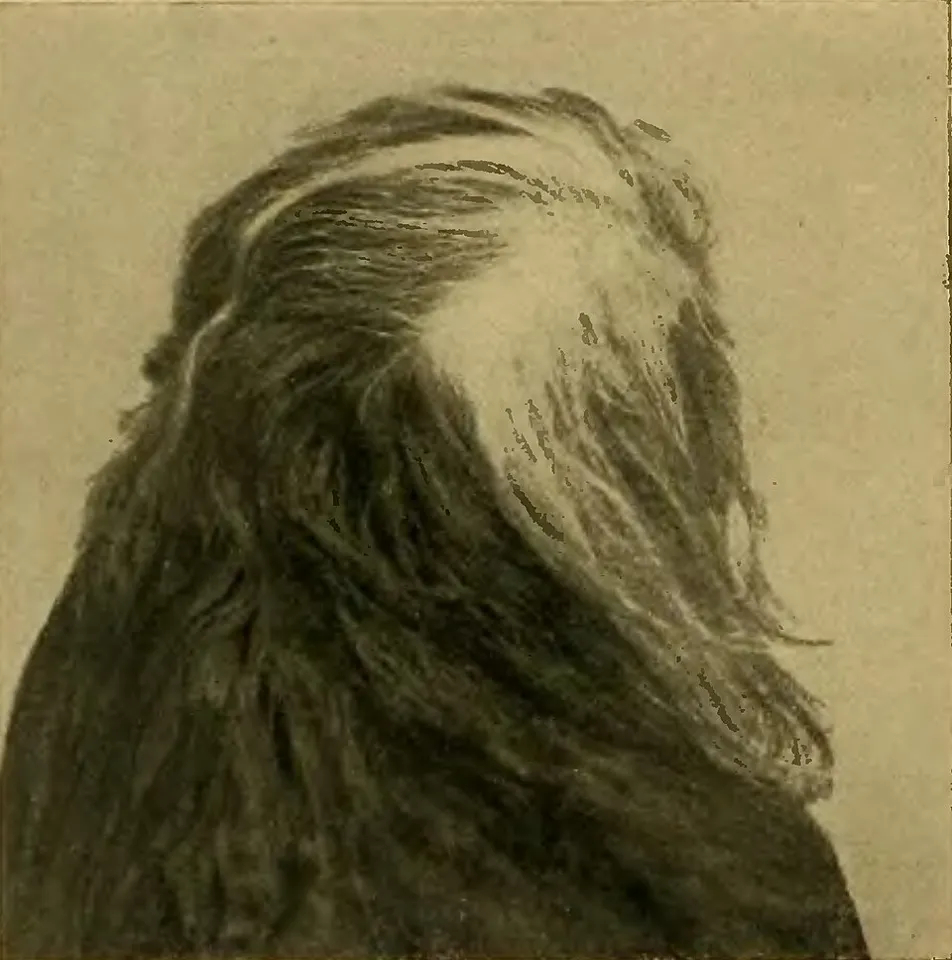
Alopecia areata is a common chronic autoimmune disease in which cytotoxic CD8+ T cells attack anagen hair follicles after loss of immune privilege, driven by IFN-gamma and IL-15 signalling through JAK pathways. Because follicular stem cells are spared, the hair loss is non-scarring and potentially reversible. It presents with sudden smooth round patches of hair loss with exclamation mark hairs at the edge, and can extend to ophiasis, alopecia totalis or universalis; fine nail pitting and trachyonychia are common. Diagnosis is clinical with trichoscopy (yellow dots, black dots, exclamation mark hairs), the SALT score measures severity, and biopsy is reserved for uncertain cases. Associations include atopy, thyroid disease and vitiligo. Limited disease may regrow spontaneously or respond to intralesional or very potent topical corticosteroids. Severe disease (SALT 50 or more) can be treated with oral JAK inhibitors such as ritlecitinib, baricitinib or deuruxolitinib after infection and cardiovascular risk screening. Psychological support and wigs are central throughout.
Patient case, mechanism, investigations, management, flashcards and exam-style questions.Open the lesson →
Key facts
- Non-scarring autoimmune hair loss: follicles survive, so regrowth is possible
- Smooth round patches with exclamation mark hairs; positive pull test at the active edge
- Trichoscopy: yellow dots, black dots, exclamation mark and tapered hairs
- Nails: fine geometric pitting and trachyonychia in 10-30%
- Severity by SALT score; SALT 50 or more = severe
- Limited patches: intralesional triamcinolone 2.5-10 mg/mL every 4-6 weeks or very potent topical steroid (teaching dose; check local formulary)
- Severe AA: JAK inhibitors (ritlecitinib from 12 years; baricitinib, deuruxolitinib adults) after TB, hepatitis and lipid screening
- Poor prognosis: childhood onset, ophiasis, totalis/universalis, nail involvement, atopy
Differential diagnosis
| Condition | Clues | Key test |
|---|---|---|
| Tinea capitis | Scaly patch, broken hairs, pustules or kerion, occipital nodes, child | KOH and fungal culture of plucked hairs |
| Trichotillomania | Irregular patch, hairs broken at different lengths, never fully bald | Trichoscopy: coiled, split, flame hairs |
| Telogen effluvium | Diffuse shedding 2-3 months after a trigger, club hairs | Pull test with telogen club hairs; history |
| Androgenetic alopecia | Patterned vertex or frontal thinning, miniaturisation | Trichoscopy: hair diameter variation |
| Lichen planopilaris / discoid lupus | Scarring with loss of follicular openings, perifollicular scale or erythema | Scalp biopsy |
| Secondary syphilis | Moth-eaten patchy alopecia, rash, mucosal lesions | Syphilis serology |
| Traction alopecia | Marginal loss linked to tight hairstyles; fringe sign | History and examination |
Exam pearls
Guideline
BAD living guideline for managing people with alopecia areata 2025 (update of 2024 version); NICE TA958 ritlecitinib (2024); FDA approvals baricitinib (2022), ritlecitinib (2023), deuruxolitinib (2024)
References
- Harries MJ, Ahmed A, Ascott A, et al.. British Association of Dermatologists living guideline for managing people with alopecia areata 2025. Br J Dermatol 2026.
- Harries MJ, Ascott A, Asfour L, et al.. British Association of Dermatologists living guideline for managing people with alopecia areata 2024. Br J Dermatol 2025.
- King B, Zhang X, Harcha WG, et al.. Efficacy and safety of ritlecitinib in adults and adolescents with alopecia areata: a randomised, double-blind, multicentre, phase 2b-3 trial. Lancet 2023.
- King B, Ohyama M, Kwon O, et al.. Two phase 3 trials of baricitinib for alopecia areata. N Engl J Med 2022.
- King B, Senna MM, Mesinkovska NA, et al.. Efficacy and safety of deuruxolitinib, an oral selective Janus kinase inhibitor, in adults with alopecia areata: results from the phase 3 randomized, controlled trial (THRIVE-AA1). J Am Acad Dermatol 2024.
- National Institute for Health and Care Excellence. Ritlecitinib for treating severe alopecia areata in people 12 years and over (TA958). NICE technology appraisal guidance 2024.
Related topics
By Dr Khalid Seidi (B.Sc., M.D.) · MedEd World Clinical Knowledge library. Original teaching content checked against current guidelines (November 2026); confirm the latest local guidance before clinical use. Not a substitute for clinical judgement.