Clinical Knowledge › Dermatology › Pigmentation, hair and nail disorders
Nail signs of systemic disease
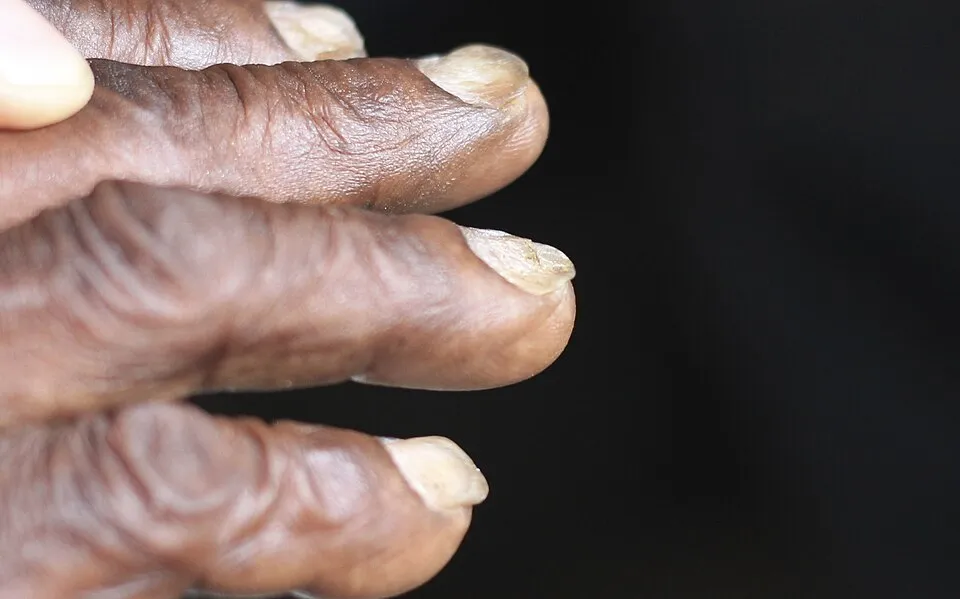
The nails are a quick window on systemic disease. Fingernails grow about 3 mm a month, so plate changes made by the matrix grow out and can be dated, while nail bed and vascular signs stay fixed. Clubbing (lost Lovibond angle and Schamroth window) points to lung cancer, interstitial lung disease, bronchiectasis, cyanotic heart disease, endocarditis, inflammatory bowel disease or cirrhosis, and never to COPD alone. Koilonychia suggests iron deficiency; Beau lines mark a past severe illness; pitting suggests psoriasis or alopecia areata. White nails are classified by site: Terry nails (cirrhosis, heart failure, diabetes), half-and-half nails (chronic kidney disease), Muehrcke lines (hypoalbuminaemia) and Mees lines (arsenic, chemotherapy). Splinter haemorrhages may signal endocarditis or vasculitis, onycholysis thyrotoxicosis or psoriasis, and yellow nails with lymphoedema and effusions define yellow nail syndrome. Nailfold capillary changes indicate connective tissue disease. A single widening brown-black band, especially with Hutchinson sign, is subungual melanoma until proved otherwise and needs urgent referral.
Patient case, mechanism, investigations, management, flashcards and exam-style questions.Open the lesson →
Key facts
- Fingernails grow about 3 mm per month (full regrowth 6 months); toenails 12-18 months
- Clubbing: lung cancer, ILD, bronchiectasis, CF, cyanotic heart disease, endocarditis, IBD, cirrhosis; not COPD alone
- Koilonychia = iron deficiency (also haemochromatosis, infants)
- Terry nails = cirrhosis; half-and-half nails = CKD; Muehrcke lines = hypoalbuminaemia; Mees lines = arsenic
- Splinter haemorrhages (proximal, multiple) with fever = infective endocarditis
- Pitting: psoriasis (irregular) or alopecia areata (regular); onycholysis: psoriasis, trauma, fungi, hyperthyroidism
- Yellow nail syndrome = yellow nails + lymphoedema + pleural effusions or bronchiectasis
- Single wide or changing pigmented band or Hutchinson sign = urgent referral for subungual melanoma
Differential diagnosis
| Condition | Clues | Key test |
|---|---|---|
| Onychomycosis | Thickened, yellow, crumbly toenails with subungual debris, often asymmetrical | Nail clippings: KOH, culture, PCR |
| Nail psoriasis | Irregular pits, oil drop, onycholysis, plaques elsewhere | Clinical; exclude fungus |
| Subungual haematoma | Red-purple to black patch after trauma that grows out | Onychoscopy; follow growth |
| Subungual melanoma | Single widening brown-black band, Hutchinson sign | Nail matrix biopsy |
| Pseudoclubbing | Asymmetric overcurvature without lost angle, e.g. hyperparathyroidism, scleroderma acro-osteolysis | Lovibond angle preserved; X-ray shows resorption |
| Physiological melanonychia | Multiple uniform bands in dark skin | Onychoscopy; stable over time |
Exam pearls
Guideline
No dedicated guideline: nail signs are integrated into disease-specific guidance, e.g. NICE NG12 suspected cancer recognition and referral (2015, updated) for suspected melanoma (applied to pigmented nail lesions) and finger clubbing; ESC 2023 infective endocarditis guideline; BAD onychomycosis guidance; and expert reviews (2004-2022)
References
- Fawcett RS, Linford S, Stulberg DL. Nail abnormalities: clues to systemic disease. Am Fam Physician 2004.
- Singal A, Arora R. Nail as a window of systemic diseases. Indian Dermatol Online J 2015.
- Essouma M, Nkeck JR, Agbor VN, Noubiap JJ. Epidemiology of digital clubbing and hypertrophic osteoarthropathy: a systematic review and meta-analysis. J Clin Rheumatol 2022.
- Sarkar M, Mahesh DM, Madabhavi I. Digital clubbing. Lung India 2012.
- Griffiths CEM, Barker J, Bleiker TO, Hussain W, Simpson RC, eds.. Rook's Textbook of Dermatology. 2024.
- Papadakis MA, Rabow MW, McQuaid KR, eds.. CURRENT Medical Diagnosis & Treatment 2026. 2026.
Related topics
By Dr Khalid Seidi (B.Sc., M.D.) · MedEd World Clinical Knowledge library. Original teaching content checked against current guidelines (November 2026); confirm the latest local guidance before clinical use. Not a substitute for clinical judgement.