Clinical Knowledge › Internal medicine › Pulmonology › Pleural diseases
Asbestos-related pleural disease
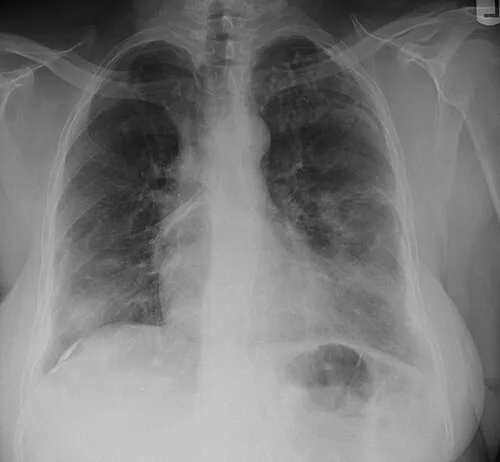
Asbestos is a group of fibrous silicate minerals once used widely in shipbuilding, construction, insulation, brake linings and cement. Inhaled fibres, especially the amphiboles crocidolite and amosite, travel to the pleura and cause a spectrum of non-malignant disease decades later: pleural plaques, benign asbestos pleural effusion, diffuse pleural thickening, rounded atelectasis and chronic pleuritic pain. Pleural plaques are the commonest finding; they are discrete, often calcified patches on the parietal pleura that mark past exposure but are not premalignant and rarely affect lung function. Benign effusion is the earliest manifestation and a diagnosis of exclusion, because mesothelioma must be ruled out. Diffuse pleural thickening involves the visceral pleura, blunts the costophrenic angle and can cause a restrictive defect and breathlessness. Rounded atelectasis is folded lung next to thickened pleura that can mimic cancer. Diagnosis relies on a detailed occupational history, chest radiography and CT. There is no specific drug treatment: care focuses on excluding malignancy, stopping smoking, managing symptoms, and advising on compensation and prevention.
Patient case, mechanism, investigations, management, flashcards and exam-style questions.Open the lesson →
Key facts
- Latency is long: effusions appear from about 10 years after exposure, plaques after 20–30 years, mesothelioma after 30–40 years
- Amphibole fibres (crocidolite, amosite) are more pathogenic than chrysotile, but all forms of asbestos are carcinogenic
- Pleural plaques: commonest manifestation, posterolateral chest wall and diaphragm, spare apices and costophrenic angles, 'holly leaf' when calcified; benign and usually asymptomatic
- Benign asbestos pleural effusion is the earliest pleural manifestation; it is often small, bloodstained or eosinophilic, recurs, and is diagnosed only after malignancy is excluded
- Diffuse pleural thickening involves the visceral pleura with costophrenic angle obliteration and can cause restrictive physiology with reduced TLC and FVC
- Rounded atelectasis shows a pleural-based mass with a 'comet tail' of vessels and bronchi swirling into it; it mimics lung cancer
- CT is far more sensitive than chest X-ray for plaques and thickening; the ILO classification standardises radiograph reading
- Smoking and asbestos multiply lung cancer risk; smoking cessation, exposure history, compensation advice and vigilance for mesothelioma are core management
Differential diagnosis
| Condition | Clues | Key test |
|---|---|---|
| Pleural mesothelioma | Progressive chest pain, weight loss, nodular or circumferential thickening including mediastinal pleura | Contrast CT and pleural biopsy (thoracoscopy) |
| Metastatic pleural malignancy | Known primary, nodular thickening, exudate with malignant cells | Cytology, CT, biopsy |
| Post-inflammatory pleural thickening | Previous TB, empyema or haemothorax, usually unilateral | History and old imaging |
| Extrapleural fat | Symmetrical smooth thickening in obese patients | CT fat density |
| Lung cancer | Enlarging solid mass, no comet-tail sign | CT, PET-CT, biopsy |
| Drug-induced pleural fibrosis | Ergot-derived drugs, methysergide, bromocriptine | Drug history |
Exam pearls
Guideline
ATS statement on diagnosis and initial management of non-malignant asbestos-related disease (2004); Helsinki criteria for asbestos-related diseases (2014 update); BTS Guideline for pleural disease (2023); ILO International Classification of Radiographs of Pneumoconioses (revised edition 2022)
References
- American Thoracic Society. Diagnosis and initial management of nonmalignant diseases related to asbestos. Am J Respir Crit Care Med 2004.
- Wolff H, Vehmas T, Oksa P, Rantanen J, Vainio H. Asbestos, asbestosis, and cancer, the Helsinki criteria for diagnosis and attribution 2014: recommendations. Scand J Work Environ Health 2015.
- Roberts ME, Rahman NM, Maskell NA, et al.. British Thoracic Society Guideline for pleural disease. Thorax 2023.
- International Labour Office. Guidelines for the use of the ILO International Classification of Radiographs of Pneumoconioses, revised edition 2022. 2022.
- Epler GR, McLoud TC, Gaensler EA. Prevalence and incidence of benign asbestos pleural effusion in a working population. JAMA 1982.
- Caceres JD, Venkata AN. Asbestos-associated pulmonary disease. Curr Opin Pulm Med 2023.
Related topics
By Dr Khalid Seidi (B.Sc., M.D.) · MedEd World Clinical Knowledge library. Original teaching content checked against current guidelines (November 2026); confirm the latest local guidance before clinical use. Not a substitute for clinical judgement.