Clinical Knowledge › Internal medicine › Pulmonology › Pleural diseases
Tension pneumothorax
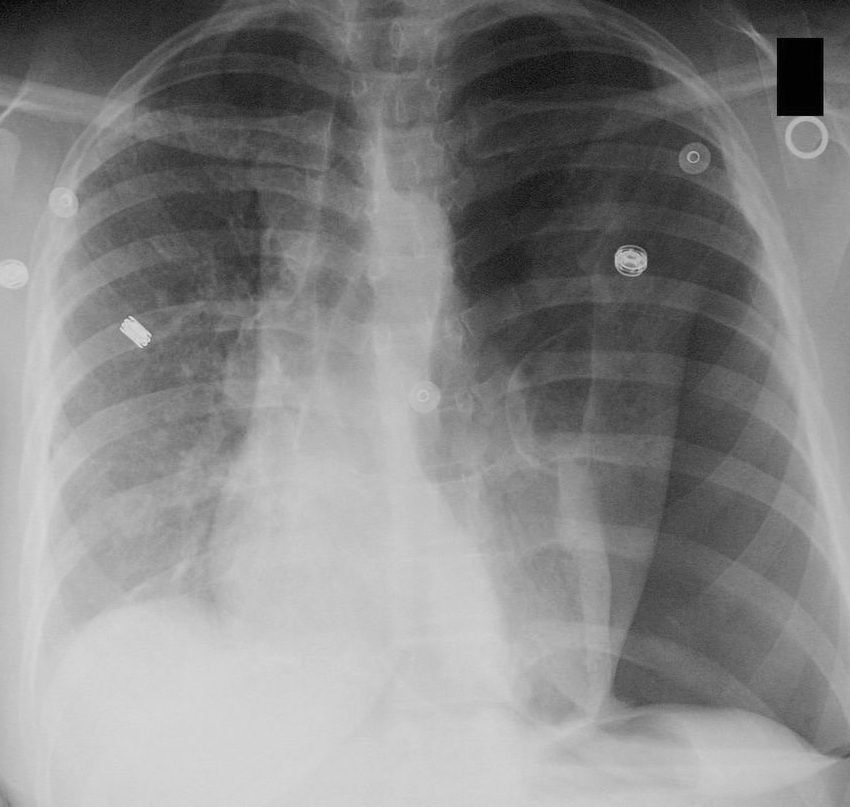
Tension pneumothorax is a life-threatening emergency in which a one-way valve leak lets air enter the pleural space with each breath but not leave, so pleural pressure rises above atmospheric. The result is progressive hypoxaemia, mediastinal shift, impaired venous return and, without decompression, cardiac arrest. It occurs most often after chest trauma, during positive-pressure ventilation or CPR, after procedures such as central line insertion, and occasionally with spontaneous pneumothorax. The diagnosis is clinical: severe respiratory distress, falling saturation, tachycardia and hypotension with reduced air entry on one side; in ventilated patients, sudden hypotension, hypoxaemia and rising airway pressures. Tracheal deviation and raised neck veins are late and unreliable signs. Treatment must not wait for a radiograph: immediate needle decompression or, in ventilated patients, finger thoracostomy, followed by a chest drain. Knowing the anatomy of decompression sites and why needles fail is core exam and resuscitation knowledge.
Patient case, mechanism, investigations, management, flashcards and exam-style questions.Open the lesson →
Key facts
- Tension is a physiological diagnosis: pneumothorax plus progressive cardiorespiratory compromise from rising pleural pressure
- Commonest settings: trauma, positive-pressure ventilation (including NIV), CPR and procedures; rarely spontaneous pneumothorax
- Awake patients present mainly with respiratory distress and hypoxaemia; hypotension is often late
- Ventilated patients deteriorate rapidly with hypotension, desaturation and high airway pressures
- Tracheal deviation and distended neck veins are late and frequently absent; do not wait for them
- Treat before imaging: needle decompression or finger thoracostomy, then a chest drain
- ATLS (10th edition) adult needle site: 4th or 5th intercostal space just anterior to the mid-axillary line; the 2nd space mid-clavicular line remains an option and is used in children
- Needles fail through inadequate length, kinking or blockage: if no improvement, proceed to finger thoracostomy
Differential diagnosis
| Condition | Clues | Key test |
|---|---|---|
| Cardiac tamponade | Hypotension, raised JVP, muffled heart sounds but equal breath sounds | Point-of-care echocardiography: pericardial fluid with right ventricular collapse |
| Massive haemothorax | Shock with dull percussion rather than hyper-resonance | Ultrasound or radiograph showing fluid; chest drain output |
| Right main bronchus intubation | Absent left breath sounds after intubation without hypotension | Check tube depth; radiograph; withdraw tube |
| Massive pulmonary embolism | Shock and hypoxia with clear lung fields and dilated right ventricle | Bedside echocardiography; CT pulmonary angiography if stable |
| Dynamic hyperinflation (auto-PEEP) | Ventilated asthma or COPD with bilateral reduced breath sounds and hypotension | Disconnect from ventilator briefly; improvement confirms |
| Anaphylaxis | Hypotension and wheeze with rash or angio-oedema | Clinical; mast cell tryptase later |
| Blocked endotracheal tube | High airway pressures and desaturation | Pass a suction catheter; check capnography |
Exam pearls
Guideline
ATLS (American College of Surgeons, 10th edition 2018 and later editions), European Resuscitation Council Guidelines 2021: special circumstances, and BTS pleural disease guideline 2023
References
- Leigh-Smith S, Harris T.. Tension pneumothorax--time for a re-think?. Emerg Med J 2005.
- Roberts DJ, Leigh-Smith S, Faris PD, et al.. Clinical presentation of patients with tension pneumothorax: a systematic review. Ann Surg 2015.
- Laan DV, Vu TD, Thiels CA, et al.. Chest wall thickness and decompression failure: a systematic review and meta-analysis comparing anatomic locations in needle thoracostomy. Injury 2016.
- Lott C, Truhlář A, Alfonzo A, et al.. European Resuscitation Council Guidelines 2021: cardiac arrest in special circumstances. Resuscitation 2021.
- Roberts ME, Rahman NM, Maskell NA, et al.. British Thoracic Society Guideline for pleural disease. Thorax 2023.
- American College of Surgeons Committee on Trauma. Advanced Trauma Life Support (ATLS) Student Course Manual. 2018.
Related topics
By Dr Khalid Seidi (B.Sc., M.D.) · MedEd World Clinical Knowledge library. Original teaching content checked against current guidelines (November 2026); confirm the latest local guidance before clinical use. Not a substitute for clinical judgement.