Clinical Knowledge › Internal medicine › Pulmonology › Pleural diseases
Mesothelioma
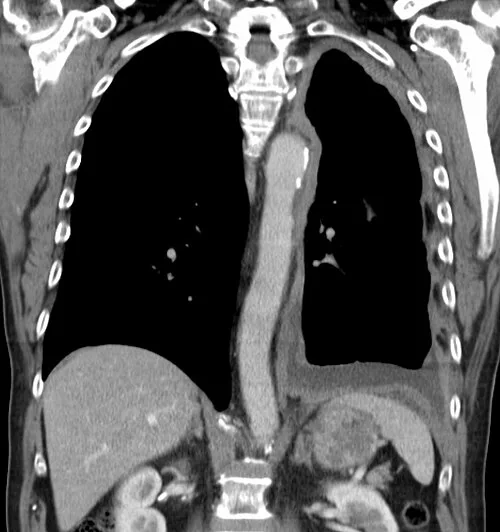
Mesothelioma is a malignant tumour of mesothelial cells, arising in the pleura in about 80–90% of cases and less often in the peritoneum, pericardium or tunica vaginalis. Most pleural cases follow occupational or household asbestos exposure, with a latency of 30–40 years; germline BAP1 and other DNA-repair variants explain a minority. Patients present with dull chest wall pain, breathlessness, a unilateral effusion and weight loss. Contrast CT shows nodular or circumferential pleural thickening, often involving the mediastinal pleura. Because effusion cytology is frequently negative, diagnosis usually needs pleural biopsy, ideally by thoracoscopy, with immunohistochemistry (calretinin, WT1, D2-40 positive) and tests for BAP1 loss or CDKN2A deletion. Histology (epithelioid, biphasic, sarcomatoid) drives prognosis and treatment. Immunotherapy has changed first-line care: nivolumab plus ipilimumab improved survival over chemotherapy, especially in non-epithelioid disease, and pembrolizumab added to platinum–pemetrexed also prolonged survival. MARS 2 showed that extended pleurectomy decortication worsened outcomes, so radical surgery is now reserved for highly selected patients. Effusion control, early palliative care and compensation advice are essential.
Patient case, mechanism, investigations, management, flashcards and exam-style questions.Open the lesson →
Key facts
- About 80% of pleural mesotheliomas in men relate to asbestos; latency is typically 30–40 years and there is no safe threshold; smoking does not increase risk
- Presentation: dull, non-pleuritic chest wall pain, breathlessness, unilateral effusion, weight loss and sweats
- CT features of malignancy: circumferential or nodular thickening, mediastinal pleural involvement and thickness over 1 cm
- Pleural fluid cytology is often negative; thoracoscopic biopsy is the diagnostic standard and allows talc pleurodesis
- Immunohistochemistry: calretinin, WT1, D2-40 and CK5/6 positive; TTF-1, claudin-4 and CEA negative (unlike adenocarcinoma); BAP1 loss or CDKN2A deletion confirms malignancy
- Histology: epithelioid (best prognosis), biphasic and sarcomatoid (worst); median survival is around 1–2 years overall
- First line: nivolumab plus ipilimumab (preferred for non-epithelioid), or platinum–pemetrexed with pembrolizumab or with bevacizumab; extended pleurectomy decortication worsened survival in MARS 2
- Offer early palliative care, effusion control (talc or indwelling catheter), germline testing and compensation advice
Differential diagnosis
| Condition | Clues | Key test |
|---|---|---|
| Benign asbestos pleural disease | Smooth thickening, stable over time, no weight loss | Serial CT; biopsy if any doubt |
| Metastatic adenocarcinoma of the pleura | Lung or breast primary; TTF-1 or hormone receptor positive | Immunohistochemistry panel on biopsy |
| Tuberculous pleuritis | Lymphocytic exudate, fever, high ADA, endemic setting | Pleural biopsy for granulomas and culture |
| Pleural lymphoma or sarcoma | Systemic B symptoms, unusual histology | Biopsy with lymphoid and soft-tissue markers |
| Reactive mesothelial hyperplasia | Atypical mesothelial cells without invasion | BAP1 retention, intact CDKN2A, no invasion on biopsy |
| Chronic empyema or fibrothorax | Previous infection, smooth peel | History, imaging, microbiology |
Exam pearls
Guideline
ASCO guideline update: treatment of pleural mesothelioma (2025); ESMO Clinical Practice Guideline for malignant pleural mesothelioma (2022); ERS/ESTS/EACTS/ESTRO guideline (2020); BTS Guideline for pleural disease (2023)
References
- Kindler HL, Ismaila N, Bazhenova L, et al.. Treatment of pleural mesothelioma: ASCO guideline update. J Clin Oncol 2025.
- Popat S, Baas P, Faivre-Finn C, et al.. Malignant pleural mesothelioma: ESMO Clinical Practice Guidelines for diagnosis, treatment and follow-up. Ann Oncol 2022.
- Scherpereel A, Opitz I, Berghmans T, et al.. ERS/ESTS/EACTS/ESTRO guidelines for the management of malignant pleural mesothelioma. Eur Respir J 2020.
- Baas P, Scherpereel A, Nowak AK, et al.. First-line nivolumab plus ipilimumab in unresectable malignant pleural mesothelioma (CheckMate 743): a multicentre, randomised, open-label, phase 3 trial. Lancet 2021.
- Scherpereel A, Baas P, Nowak AK, et al.. Five-year clinical outcomes with nivolumab plus ipilimumab versus chemotherapy as first-line treatment for unresectable pleural mesothelioma in CheckMate 743. J Clin Oncol 2026.
- Chu Q, Perrone F, Greillier L, et al.. Pembrolizumab plus chemotherapy versus chemotherapy in untreated advanced pleural mesothelioma in Canada, Italy, and France: a phase 3, open-label, randomised controlled trial. Lancet 2023.
Related topics
By Dr Khalid Seidi (B.Sc., M.D.) · MedEd World Clinical Knowledge library. Original teaching content checked against current guidelines (November 2026); confirm the latest local guidance before clinical use. Not a substitute for clinical judgement.