Clinical Knowledge › Obstetrics and gynaecology › Basics of obstetrics and gynaecology
Beta-hCG interpretation
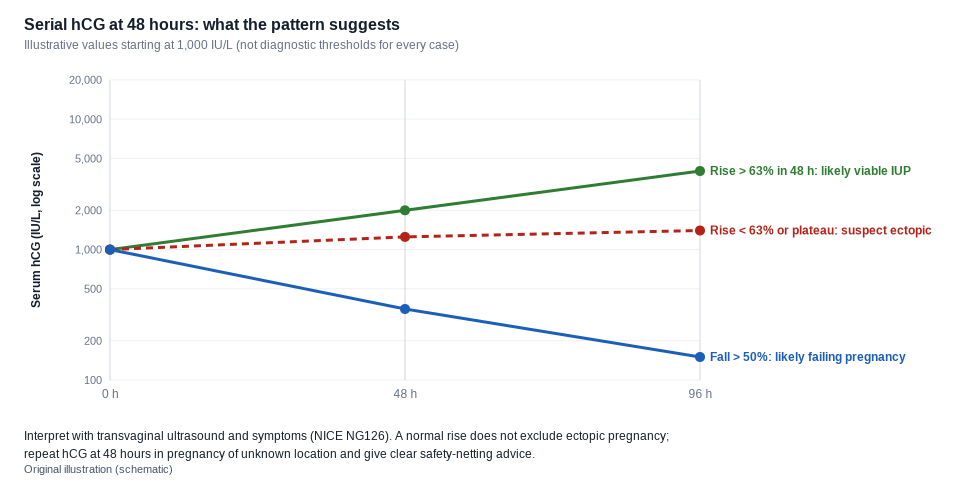
Human chorionic gonadotrophin (hCG) is a glycoprotein made by the syncytiotrophoblast; its alpha subunit is shared with LH, FSH and TSH, so assays measure the unique beta subunit. hCG appears in serum about 8–10 days after ovulation, keeps the corpus luteum producing progesterone, peaks at 8–11 weeks and then falls. Urine tests detect about 20–25 IU/L; serum assays quantify down to a few IU/L. A single level cannot locate or date a pregnancy: it is interpreted with transvaginal ultrasound and serial values 48 hours apart. A viable intrauterine pregnancy usually rises by at least 35–50% in 48 hours (NICE uses a rise above 63% as reassuring), a fall of more than 50% suggests a failing pregnancy, and anything in between with no pregnancy seen raises concern for ectopic pregnancy. Very high levels suggest molar pregnancy or multiple pregnancy; hCG guides methotrexate eligibility for ectopic pregnancy and surveillance after molar pregnancy. Beware false results: heterophile antibodies, pituitary hCG, recent pregnancy, hCG injections, germ cell tumours and the hook effect.
Patient case, mechanism, investigations, management, flashcards and exam-style questions.Open the lesson →
Key facts
- hCG alpha subunit is identical to LH, FSH and TSH; beta subunit gives specificity; very high hCG can stimulate the TSH receptor (gestational hyperthyroidism)
- Urine tests detect about 20–25 IU/L (around the first missed period); serum quantitative assays detect 1–5 IU/L
- Early pregnancy: hCG roughly doubles every 48 h; minimum rise of a viable IUP is about 35% in 48 h (slower when the starting value is high)
- NICE NG126 PUL protocol: rise >63% in 48 h → likely IUP; fall >50% → likely failing; between → review within 24 h in an early pregnancy unit
- Discriminatory zone: hCG above which an IUP is usually seen on TVS – traditionally 1500–2000 IU/L, but viable IUPs may not be seen until up to 3500 IU/L
- Ectopic methotrexate (NICE): first-line if hCG <1500 IU/L and criteria met; offered as an option at 1500–5000; surgery if ≥5000 IU/L
- Complete mole: hCG often >100 000 IU/L with hyperemesis, early pre-eclampsia, hyperthyroidism and theca-lutein cysts
- False positives: heterophile antibodies (serum positive, urine negative), pituitary hCG after menopause, recent pregnancy, exogenous hCG, hCG-secreting tumours
Differential diagnosis
| Condition | Clues | Key test |
|---|---|---|
| Normal intrauterine pregnancy (early) | hCG rising ≥35–63% per 48 h; sac seen once hCG passes the discriminatory zone | Serial hCG and TVS |
| Ectopic pregnancy | Suboptimal rise or plateau; empty uterus with adnexal mass | TVS and serial hCG |
| Failing pregnancy (complete or ongoing miscarriage) | hCG falling by >50% in 48 h | Repeat hCG or urine test at 2–3 weeks |
| Molar pregnancy | Very high hCG for gestation, hyperemesis, large-for-dates uterus | TVS and histology |
| Multiple pregnancy | High hCG with normal rise | TVS |
| Phantom hCG (heterophile antibodies) | Persistently low serum hCG, negative urine, no pregnancy | Urine hCG, alternative assay, heterophile blocking |
| Pituitary hCG | Perimenopausal or postmenopausal woman, low-level hCG (usually <14 IU/L), high FSH | Repeat after 2–3 weeks of oestrogen–progestogen suppression |
| hCG-secreting tumour | Testicular or ovarian germ cell tumour, choriocarcinoma, rarely lung or bladder cancer | Imaging and tumour markers (AFP, LDH) |
Exam pearls
Guideline
NICE NG126 Ectopic pregnancy and miscarriage (2019, updated 2023); ACOG Practice Bulletin No. 193 Tubal ectopic pregnancy (2018) and No. 200 Early pregnancy loss (2018); RCOG Green-top Guideline No. 38 Management of gestational trophoblastic disease (2020); ESHRE terminology for ectopic pregnancy (2020)
References
- National Institute for Health and Care Excellence (NICE). Ectopic pregnancy and miscarriage: diagnosis and initial management (NG126). NICE guideline 2019.
- American College of Obstetricians and Gynecologists. ACOG Practice Bulletin No. 193: Tubal ectopic pregnancy. Obstet Gynecol 2018.
- American College of Obstetricians and Gynecologists. ACOG Practice Bulletin No. 200: Early pregnancy loss. Obstet Gynecol 2018.
- Royal College of Obstetricians and Gynaecologists. Management of gestational trophoblastic disease. Green-top Guideline No. 38. RCOG 2020.
- Barnhart KT, Sammel MD, Rinaudo PF, Zhou L, Hummel AC, Guo W.. Symptomatic patients with an early viable intrauterine pregnancy: HCG curves redefined. Obstet Gynecol 2004.
- Seeber BE, Sammel MD, Guo W, Zhou L, Hummel A, Barnhart KT.. Application of redefined human chorionic gonadotropin curves for the diagnosis of women at risk for ectopic pregnancy. Fertil Steril 2006.
Related topics
By Dr Khalid Seidi (B.Sc., M.D.) · MedEd World Clinical Knowledge library. Original teaching content checked against current guidelines (November 2026); confirm the latest local guidance before clinical use. Not a substitute for clinical judgement.