Clinical Knowledge › Obstetrics and gynaecology › Basics of obstetrics and gynaecology
Physiology of the menstrual cycle
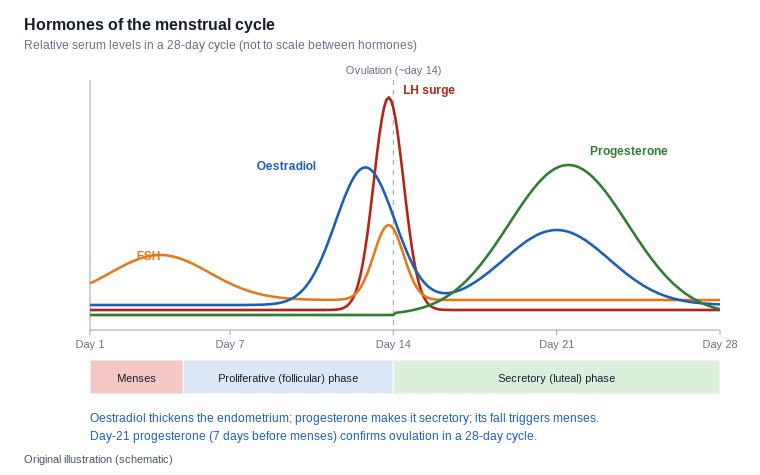
The menstrual cycle is the coordinated monthly output of the hypothalamic–pituitary–ovarian axis that prepares the endometrium for implantation. Pulsatile GnRH drives FSH and LH secretion. In the follicular phase FSH recruits a cohort of antral follicles; the dominant follicle, selected by about day 7, makes rising oestradiol through the two-cell, two-gonadotrophin system and proliferates the endometrium. Sustained high oestradiol switches pituitary feedback from negative to positive, producing the LH surge; ovulation follows about 36 hours after its onset. The corpus luteum then secretes progesterone and oestradiol, converting the endometrium to a secretory, receptive state and raising basal temperature. The luteal phase is relatively constant at about 12–14 days, so variation in cycle length comes mostly from the follicular phase. Without hCG from an implanting embryo the corpus luteum regresses, and progesterone withdrawal triggers prostaglandin release, spiral arteriole constriction and shedding of the functional layer. Normal cycles last 24–38 days (FIGO 2018). These mechanisms explain ovulation tests, contraception, dysmenorrhoea and abnormal bleeding.
Patient case, mechanism, investigations, management, flashcards and exam-style questions.Open the lesson →
Key facts
- GnRH is released in pulses (roughly every 60–90 minutes in the follicular phase, slower in the luteal phase); continuous GnRH agonist exposure suppresses gonadotrophins
- Two-cell, two-gonadotrophin model: LH drives theca cells to make androgens; FSH induces granulosa cell aromatase to convert them to oestradiol
- Oestradiol above a threshold (about 200 pg/mL, roughly 700 pmol/L) for about 48 hours triggers the LH surge by positive feedback
- Ovulation occurs about 34–36 hours after the onset of the LH surge (about 10–12 hours after its peak)
- The luteal phase lasts about 12–14 days; differences in cycle length come mainly from the follicular phase
- Mid-luteal (day 21 of a 28-day cycle, or 7 days before the expected period) serum progesterone above about 30 nmol/L confirms ovulation
- Menstruation results from progesterone withdrawal: prostaglandins (PGF2α), spiral arteriole vasoconstriction, matrix metalloproteinases and shedding of the functionalis; the basalis regenerates it
- Normal cycle (FIGO 2018): frequency 24–38 days, bleeding up to 8 days, variation up to 7–9 days between shortest and longest cycles
Differential diagnosis
| Condition | Clues | Key test |
|---|---|---|
| Anovulation (e.g. PCOS) | Irregular cycles over 38 days, hirsutism, polycystic ovarian morphology | Mid-luteal progesterone low; testosterone, LH:FSH, ultrasound |
| Hypothalamic amenorrhoea | Low weight, excess exercise, stress; low oestrogen | Low or normal FSH and LH, low oestradiol |
| Primary ovarian insufficiency | Amenorrhoea under 40 years with menopausal symptoms | FSH above 25 IU/L with oligo/amenorrhoea (one raised value suffices, ESHRE 2024; repeat FSH or AMH if uncertain) |
| Hyperprolactinaemia | Oligomenorrhoea, galactorrhoea, headaches | Serum prolactin; pituitary MRI if raised |
| Thyroid dysfunction | Cycle disturbance with features of hypo- or hyperthyroidism | TSH and free T4 |
| Luteal phase deficiency (debated) | Short luteal phase, premenstrual spotting | Not routinely diagnosable; progesterone timing |
| Pregnancy | Missed period in a sexually active woman | hCG |
Exam pearls
Guideline
FIGO systems for normal and abnormal uterine bleeding (2018), NICE NG257 Fertility problems: assessment and treatment (2026, replacing CG156), International evidence-based guideline for PCOS (2023) and NICE NG88 Heavy menstrual bleeding (2018, updated)
References
- Munro MG, Critchley HOD, Fraser IS; FIGO Menstrual Disorders Committee.. The two FIGO systems for normal and abnormal uterine bleeding symptoms and classification of causes of abnormal uterine bleeding in the reproductive years: 2018 revisions. Int J Gynaecol Obstet 2018.
- Critchley HOD, Babayev E, Bulun SE, et al.. Menstruation: science and society. Am J Obstet Gynecol 2020.
- Bull JR, Rowland SP, Scherwitzl EB, et al.. Real-world menstrual cycle characteristics of more than 600,000 menstrual cycles. NPJ Digit Med 2019.
- National Institute for Health and Care Excellence (NICE). Fertility problems: assessment and treatment (NG257). NICE guideline 2026.
- American College of Obstetricians and Gynecologists (ACOG). Committee Opinion No. 651: Menstruation in girls and adolescents: using the menstrual cycle as a vital sign. Obstet Gynecol 2015.
- National Institute for Health and Care Excellence (NICE). Heavy menstrual bleeding: assessment and management (NG88). NICE guideline 2018.
Related topics
By Dr Khalid Seidi (B.Sc., M.D.) · MedEd World Clinical Knowledge library. Original teaching content checked against current guidelines (November 2026); confirm the latest local guidance before clinical use. Not a substitute for clinical judgement.