Clinical Knowledge › Obstetrics and gynaecology › Basics of obstetrics and gynaecology
Maternal mortality and morbidity
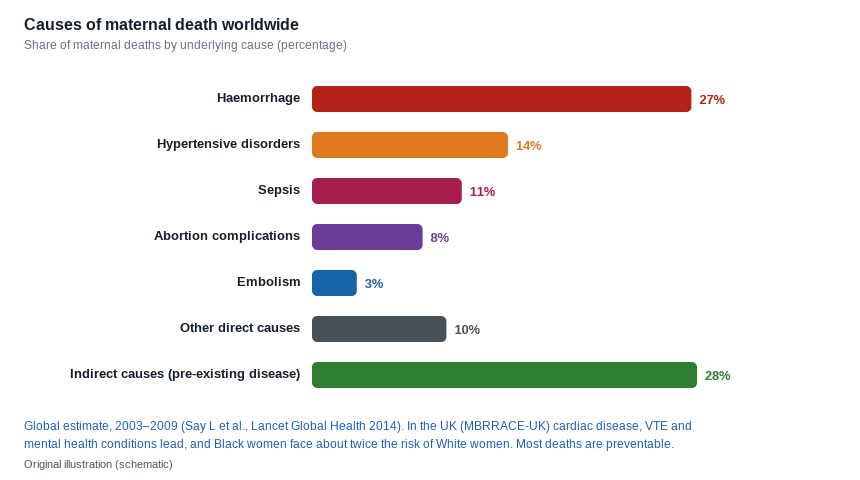
A maternal death is the death of a woman while pregnant or within 42 days of the end of pregnancy from a cause related to or aggravated by the pregnancy or its management; late maternal deaths occur from 42 days to 1 year. Deaths are classed as direct (obstetric complications), indirect (pre-existing or new disease worsened by pregnancy) or coincidental. WHO estimates about 260 000 maternal deaths in 2023 (maternal mortality ratio, MMR, 197 per 100 000 live births), 92% in low- and lower-middle-income countries and about 70% in sub-Saharan Africa – far above the SDG target of below 70 by 2030. Haemorrhage, hypertensive disorders, sepsis, unsafe abortion and indirect medical causes dominate globally; in the UK the leading causes are thromboembolism, cardiac disease and, in the late period, suicide, with Black women about twice as likely to die. For every death many more women suffer severe morbidity (near-miss events). Most are preventable by tackling the three delays, skilled birth attendance, emergency obstetric care, early warning systems and confidential enquiries.
Patient case, mechanism, investigations, management, flashcards and exam-style questions.Open the lesson →
Key facts
- Maternal death: during pregnancy or within 42 days of its end, from causes related to or aggravated by pregnancy; late maternal death: 42 days to 1 year
- Maternal mortality ratio (MMR) = maternal deaths per 100 000 live births; WHO 2023 global MMR 197, about 260 000 deaths
- SDG 3.1 target: global MMR below 70 per 100 000 live births by 2030; global MMR fell about 40% from 2000 to 2023
- Globally haemorrhage is the leading single cause (about 27%), followed by indirect causes (about 23%) and hypertensive disorders (about 16%)
- UK (MBRRACE-UK 2025, 2021–23): rate 12.67 per 100 000 maternities; leading causes thrombosis/thromboembolism, cardiac disease and COVID-19; suicide leads late deaths
- Black women in the UK are about twice as likely to die as White women, and women in the most deprived areas about twice as likely as those in the least deprived
- Three delays: deciding to seek care, reaching care, and receiving adequate care
- Severe maternal morbidity ('near-miss') is far more common than death and is a key quality indicator
Differential diagnosis
| Condition | Clues | Key test |
|---|---|---|
| Postpartum haemorrhage | Leading global cause; uterine atony after delivery; shock index >1 | Measured blood loss, Hb, clotting, fibrinogen |
| Pre-eclampsia/eclampsia | BP ≥160/110, headache, seizures, HELLP | BP, urine PCR, platelets, LFTs, sFlt-1/PlGF |
| Maternal sepsis | Fever or hypothermia, tachycardia, abdominal pain after birth or miscarriage | Lactate, blood cultures, early warning score |
| Venous thromboembolism | Leg swelling, pleuritic pain, dyspnoea, collapse | Compression ultrasound, CTPA or V/Q |
| Cardiac disease (peripartum cardiomyopathy, aortic dissection, ischaemia) | Breathlessness, orthopnoea, chest pain radiating to the back | ECG, troponin, BNP, echocardiogram, CT aorta |
| Amniotic fluid embolism | Sudden collapse, hypoxia and DIC in labour or just after | Clinical diagnosis; clotting screen |
| Suicide and perinatal mental illness | Rapid-onset psychosis, violent methods, history of severe illness | Mental state and risk assessment |
| Early pregnancy death (ectopic, unsafe abortion) | Collapse with positive pregnancy test; sepsis after unsafe abortion | Urine hCG, FAST, TVS |
Exam pearls
Guideline
WHO/UNICEF/UNFPA/World Bank/UNDESA Trends in maternal mortality 2000 to 2023 (2025); MBRRACE-UK Saving Lives, Improving Mothers' Care (2025, data 2021–23); WHO recommendations on antenatal care (2016) and intrapartum care (2018); WHO/FIGO/ICM consolidated PPH guidance (2025)
References
- WHO, UNICEF, UNFPA, World Bank Group and UNDESA/Population Division. Trends in maternal mortality 2000 to 2023: estimates by WHO, UNICEF, UNFPA, World Bank Group and UNDESA/Population Division. World Health Organization, Geneva 2025.
- MBRRACE-UK. Saving Lives, Improving Mothers' Care: lessons learned to inform maternity care from the UK and Ireland Confidential Enquiries into Maternal Deaths and Morbidity 2021–23. National Perinatal Epidemiology Unit, University of Oxford 2025.
- Cresswell JA, Alexander M, Chong MYC, et al.. Global and regional causes of maternal deaths 2009-20: a WHO systematic analysis. Lancet Glob Health 2025.
- Say L, Chou D, Gemmill A, et al.. Global causes of maternal death: a WHO systematic analysis. Lancet Glob Health 2014.
- Thaddeus S, Maine D.. Too far to walk: maternal mortality in context. Soc Sci Med 1994.
- WOMAN Trial Collaborators.. Effect of early tranexamic acid administration on mortality, hysterectomy, and other morbidities in women with post-partum haemorrhage (WOMAN): an international, randomised, double-blind, placebo-controlled trial. Lancet 2017.
Related topics
By Dr Khalid Seidi (B.Sc., M.D.) · MedEd World Clinical Knowledge library. Original teaching content checked against current guidelines (November 2026); confirm the latest local guidance before clinical use. Not a substitute for clinical judgement.