Clinical Knowledge › Dermatology › Relevant pharmacology
Cryotherapy
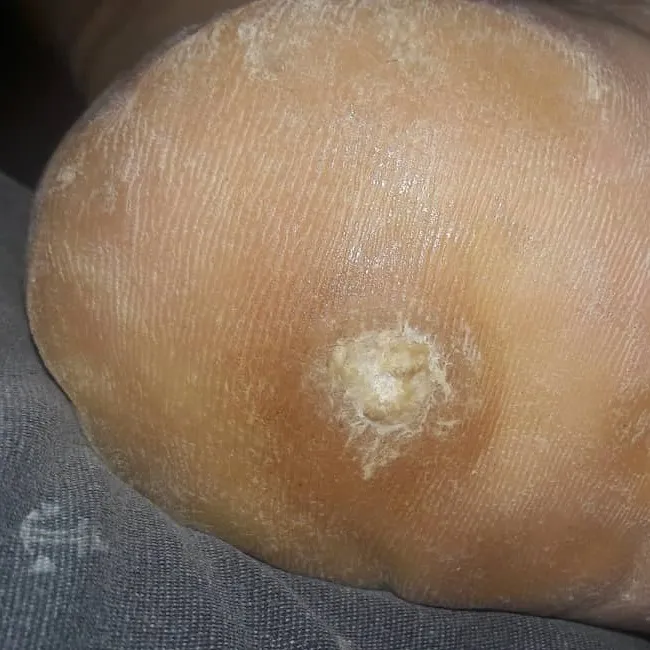
Cryotherapy (cryosurgery) destroys tissue by controlled freezing, usually with liquid nitrogen at -196 °C applied by spray, cotton bud or probe. Rapid freezing forms intracellular ice that ruptures cell membranes, and slow thawing plus vascular stasis complete the injury. Cells differ in sensitivity: melanocytes die at about -5 °C (hence frequent hypopigmentation), keratinocytes at about -20 to -30 °C, and malignant cells need about -50 °C with a double freeze-thaw cycle. Cryotherapy is quick, cheap and needs no anaesthetic, making it a mainstay for viral warts, actinic keratoses and seborrhoeic keratoses; specialists also use it for selected Bowen disease and low-risk superficial basal cell carcinoma. Because it leaves no specimen for histology, the diagnosis must be certain - pigmented or suspicious lesions must never be frozen. Expected effects are pain, swelling and a blister that heals in 1-3 weeks; complications include hypopigmentation (especially in darker skin), scarring, nerve damage, alopecia and poor healing on the lower legs. For common warts, cryotherapy is about as effective as salicylic acid.
Patient case, mechanism, investigations, management, flashcards and exam-style questions.Open the lesson →
Key facts
- Liquid nitrogen boils at -196 °C; applied by open spray, cotton-tipped applicator or closed probe
- Freeze time counts from when the ice field covers the lesion plus a margin (1-2 mm for benign lesions, 3-5 mm for malignant lesions)
- Melanocytes are most cold-sensitive (about -4 to -7 °C): hypopigmentation is common, especially in skin of colour
- Malignant lesions need tissue temperatures of about -40 to -50 °C, achieved with two freeze-thaw cycles
- Viral warts: pare first, freeze 5-20 seconds, repeat every 2-3 weeks for up to 3-4 sessions; efficacy similar to salicylic acid (Cochrane; BMJ 2011 trial)
- Actinic keratoses: single freeze of about 5-10 seconds is effective for isolated lesions (BAD 2017)
- Never freeze a lesion whose diagnosis is uncertain - especially pigmented lesions - because no histology is obtained
- Contraindications include cold urticaria, cryoglobulinaemia, cold agglutinin disease and pyoderma gangrenosum; caution in Raynaud phenomenon and poor peripheral circulation
Differential diagnosis
| Condition | Clues | Key test |
|---|---|---|
| Cryotherapy | Benign or premalignant lesions with certain clinical diagnosis | No histology; hypopigmentation |
| Salicylic acid (wart paint) | Common and plantar warts, especially children | Painless home treatment; similar efficacy |
| Curettage and cautery | Seborrhoeic keratoses, thick AKs, selected low-risk BCC | Provides specimen for histology |
| Shave or excision biopsy | Uncertain diagnosis, pigmented or suspicious lesion | Gold standard for diagnosis |
| Topical field therapy (5-FU, imiquimod, PDT) | Multiple actinic keratoses, Bowen disease on lower leg | Treats subclinical field |
| Laser or electrosurgery | Vascular lesions, skin tags, some warts | Equipment and anaesthesia needed |
| Watchful waiting | Warts in children (often resolve spontaneously) | About two-thirds clear within 2 years |
Exam pearls
Guideline
BAD guidelines for cutaneous warts (2014); Cochrane topical treatments for cutaneous warts (2012); BAD actinic keratosis guideline (2017); European AK and field cancerization guideline (2024); BAD basal cell carcinoma guideline (2021)
References
- Sterling JC, Gibbs S, Haque Hussain SS, Mohd Mustapa MF, Handfield-Jones SE. British Association of Dermatologists' guidelines for the management of cutaneous warts 2014. Br J Dermatol 2014.
- Kwok CS, Gibbs S, Bennett C, Holland R, Abbott R. Topical treatments for cutaneous warts. Cochrane Database Syst Rev 2012.
- Cockayne S, Hewitt C, Hicks K, et al.. Cryotherapy versus salicylic acid for the treatment of plantar warts (verrucae): a randomised controlled trial. BMJ 2011.
- de Berker D, McGregor JM, Mohd Mustapa MF, Exton LS, Hughes BR. British Association of Dermatologists' guidelines for the care of patients with actinic keratosis 2017. Br J Dermatol 2017.
- Kandolf L, Peris K, Malvehy J, et al.. European consensus-based interdisciplinary guideline for diagnosis, treatment and prevention of actinic keratoses, epithelial UV-induced dysplasia and field cancerization. J Eur Acad Dermatol Venereol 2024.
- Nasr I, McGrath EJ, Harwood CA, et al.. British Association of Dermatologists guidelines for the management of adults with basal cell carcinoma 2021. Br J Dermatol 2021.
Related topics
By Dr Khalid Seidi (B.Sc., M.D.) · MedEd World Clinical Knowledge library. Original teaching content checked against current guidelines (November 2026); confirm the latest local guidance before clinical use. Not a substitute for clinical judgement.