Clinical Knowledge › Dermatology › Relevant pharmacology
Topical treatments for skin cancer and precancer (fluorouracil, imiquimod)
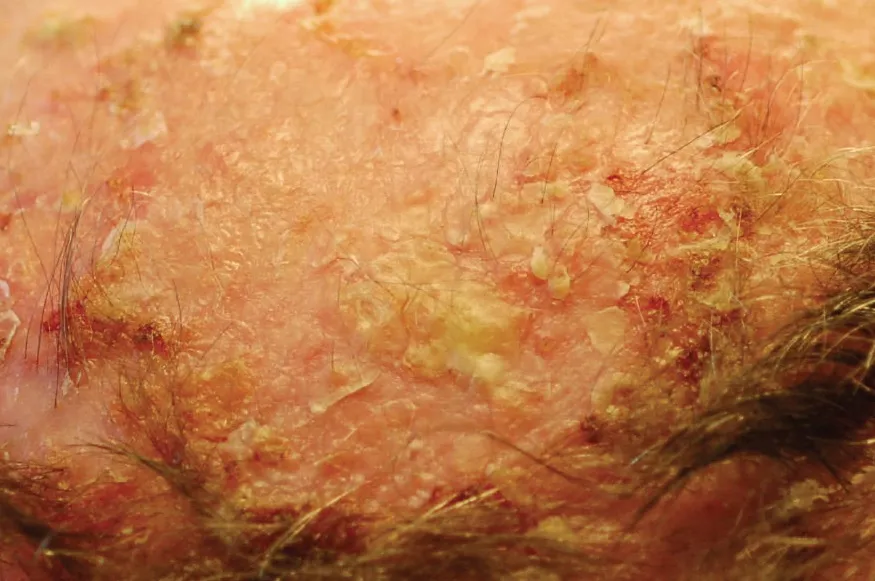
Field-directed topical therapies treat actinic keratoses (AK), Bowen disease (squamous cell carcinoma in situ) and low-risk superficial basal cell carcinoma (sBCC), and treat the surrounding sun-damaged 'field' that harbours subclinical lesions. Fluorouracil (5-FU), a pyrimidine analogue that inhibits thymidylate synthase, is the most effective topical for multiple AKs: in a 2019 randomised trial 5% 5-FU cream outperformed imiquimod, photodynamic therapy and ingenol mebutate at 12 months, and a single course reduced later SCC surgery in veterans. Imiquimod is a toll-like receptor 7 agonist that triggers local interferon-alpha and a T-helper-1 immune attack; it is licensed for AK, sBCC and anogenital warts. Other options include 0.5% 5-FU with salicylic acid, diclofenac 3% gel, tirbanibulin ointment and photodynamic therapy. All cause an expected inflammatory reaction - erythema, erosion and crusting - that patients must be warned about. Topicals are unsuitable for nodular, infiltrative or recurrent BCC, invasive SCC and melanoma, and any lesion that persists after treatment should be biopsied.
Patient case, mechanism, investigations, management, flashcards and exam-style questions.Open the lesson →
Key facts
- 5-FU inhibits thymidylate synthase, blocking DNA synthesis in rapidly dividing dysplastic keratinocytes
- Teaching dose: 5-FU 5% cream once or twice daily for 3-4 weeks for AK on face or scalp; check local formulary
- Imiquimod is a TLR7 agonist: induces interferon-alpha, TNF and IL-12 from dendritic cells and macrophages
- Imiquimod 5% regimens: AK three times weekly for 4 weeks; superficial BCC five times weekly for 6 weeks; anogenital warts three times weekly up to 16 weeks
- Expected local skin reaction: erythema, then erosion and crusting, healing within 2-4 weeks after stopping; intensity does not mean harm
- Jansen 2019 (NEJM): 5% 5-FU had the highest 12-month AK clearance versus imiquimod, MAL-PDT and ingenol mebutate
- Topicals are for low-risk superficial lesions only - not nodular or infiltrative BCC, invasive SCC or melanoma (lentigo maligna imiquimod off-label only when surgery unsuitable)
- 5-FU is contraindicated in pregnancy; severe toxicity can occur in DPD deficiency and pets can be poisoned by licking treated skin or tubes
Differential diagnosis
| Condition | Clues | Key test |
|---|---|---|
| Fluorouracil 5% cream | Multiple AKs, Bowen disease, superficial BCC (licensed in the UK and US) | Most effective field therapy; marked reaction |
| Fluorouracil 0.5% with salicylic acid 10% | Thin to moderately thick AKs (lesion-directed) | Once daily up to 12 weeks |
| Imiquimod 5% or 3.75% | AK fields, superficial BCC, anogenital warts | Flu-like symptoms; pigment change |
| Diclofenac 3% gel | Mild AKs; frail patients | Gentle but long course (60-90 days), less effective |
| Tirbanibulin 1% ointment | AKs on face or scalp | 5-day course; microtubule and Src kinase inhibitor |
| Photodynamic therapy (MAL or ALA) | Field AK, Bowen disease, superficial BCC | Pain during illumination; daylight PDT option |
| Cryotherapy | Isolated AKs, small Bowen disease, selected sBCC | Lesion-directed; hypopigmentation |
| Surgical excision | Nodular BCC, suspected invasive SCC, uncertain diagnosis | Gold standard; provides histology |
Exam pearls
Guideline
BAD guidelines for actinic keratosis (2017); European EADO/EDF/EADV/UEMS guideline on actinic keratoses and field cancerization (2024); BAD basal cell carcinoma guideline (2021); European BCC guideline update (2023)
References
- de Berker D, McGregor JM, Mohd Mustapa MF, Exton LS, Hughes BR. British Association of Dermatologists' guidelines for the care of patients with actinic keratosis 2017. Br J Dermatol 2017.
- Kandolf L, Peris K, Malvehy J, et al.. European consensus-based interdisciplinary guideline for diagnosis, treatment and prevention of actinic keratoses, epithelial UV-induced dysplasia and field cancerization. J Eur Acad Dermatol Venereol 2024.
- Jansen MHE, Kessels JPHM, Nelemans PJ, et al.. Randomized trial of four treatment approaches for actinic keratosis. N Engl J Med 2019.
- Weinstock MA, Thwin SS, Siegel JA, et al.. Chemoprevention of basal and squamous cell carcinoma with a single course of fluorouracil, 5%, cream: a randomized clinical trial. JAMA Dermatol 2018.
- Nasr I, McGrath EJ, Harwood CA, et al.. British Association of Dermatologists guidelines for the management of adults with basal cell carcinoma 2021. Br J Dermatol 2021.
- Peris K, Fargnoli MC, Kaufmann R, et al.. European consensus-based interdisciplinary guideline for diagnosis and treatment of basal cell carcinoma - update 2023. Eur J Cancer 2023.
Related topics
By Dr Khalid Seidi (B.Sc., M.D.) · MedEd World Clinical Knowledge library. Original teaching content checked against current guidelines (November 2026); confirm the latest local guidance before clinical use. Not a substitute for clinical judgement.