Clinical Knowledge › Dermatology › Bacterial skin infections
Cutaneous tuberculosis
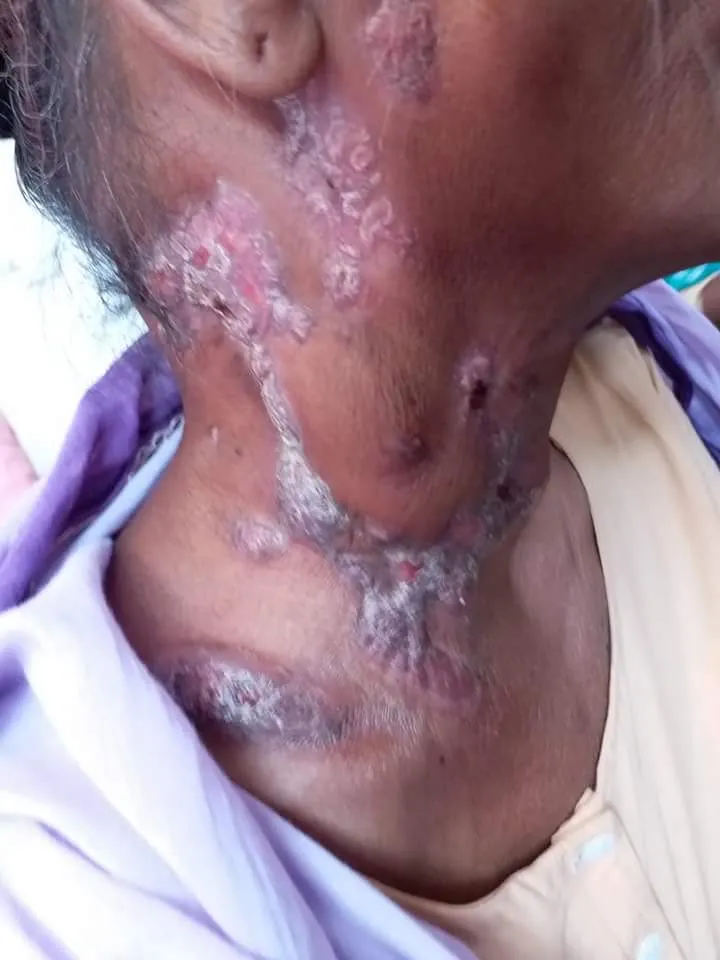
Cutaneous tuberculosis (about 1-1.5% of extrapulmonary TB) is skin infection by Mycobacterium tuberculosis complex, including M. bovis and BCG; its forms depend on the route of infection and host immunity. Exogenous inoculation causes a tuberculous chancre in non-immune people or warty tuberculosis verrucosa cutis in sensitised people. Endogenous spread produces scrofuloderma over infected lymph nodes or bone, orificial tuberculosis in advanced disease and lupus vulgaris, a slowly enlarging plaque with 'apple-jelly' nodules on diascopy that scars and can develop squamous cell carcinoma. Tuberculids such as erythema induratum (Bazin disease) are hypersensitivity reactions with few bacilli. Diagnosis rests on biopsy showing caseating tuberculoid granulomas, tissue culture and nucleic acid amplification (Xpert MTB/RIF Ultra), supported by IGRA or tuberculin testing and a search for systemic tuberculosis and HIV. Treatment follows standard regimens: 2 months of isoniazid, rifampicin, pyrazinamide and ethambutol, then 4 months of isoniazid and rifampicin.
Patient case, mechanism, investigations, management, flashcards and exam-style questions.Open the lesson →
Key facts
- Cutaneous TB is about 1-1.5% of extrapulmonary TB; commonest in South Asia, sub-Saharan Africa and Latin America
- Classification by route: exogenous (chancre, TB verrucosa cutis), endogenous contiguous (scrofuloderma, orificial), haematogenous (lupus vulgaris, miliary, gumma) and tuberculids
- Lupus vulgaris: commonest form in many series; reddish-brown plaque with apple-jelly nodules on diascopy, central scarring, risk of SCC
- Scrofuloderma: firm subcutaneous nodule over a cervical lymph node or bone that breaks down to sinuses, ulcers and cord-like scars
- TB verrucosa cutis ('prosector's wart'): warty plaque on hands, knees or buttocks in previously sensitised people (good immunity)
- Erythema induratum of Bazin: tender ulcerating nodules on the posterior calves of women; a tuberculid with strongly positive IGRA
- Histology: tuberculoid granulomas with Langhans giant cells and caseation; bacilli often sparse on Ziehl-Neelsen stain
- Treatment: 2HRZE/4HR (6 months) for drug-susceptible disease, as for other extrapulmonary TB; CNS TB needs 12 months and some guidelines extend bone and joint TB
Differential diagnosis
| Condition | Clues | Key test |
|---|---|---|
| Cutaneous sarcoidosis (lupus pernio) | Violaceous nose and cheek plaques; non-caseating granulomas | Biopsy (no caseation), negative cultures, chest imaging for hilar nodes |
| Discoid lupus erythematosus | Scaly scarring plaques with follicular plugging on sun-exposed sites | Biopsy with interface dermatitis; immunofluorescence |
| Leprosy (tuberculoid) | Anaesthetic hypopigmented plaque with thickened nerve | Slit-skin smear, biopsy with nerve involvement |
| Cutaneous leishmaniasis | Volcano-like ulcer after travel to endemic area | Smear or PCR for Leishmania amastigotes |
| Non-tuberculous mycobacterial infection (M. marinum) | Sporotrichoid nodules after fish tank or water exposure | Tissue culture at 30-32 °C; PCR |
| Sporotrichosis or chromoblastomycosis | Nodules along lymphatics or verrucous plaques after plant injury | Fungal culture and histology |
| Squamous cell carcinoma or viral wart | Verrucous or ulcerated plaque on a limb | Biopsy |
| Hidradenitis suppurativa (vs scrofuloderma) | Recurrent nodules and sinus tracts in axillae and groin | Clinical; negative TB cultures |
Exam pearls
Guideline
WHO consolidated guidelines on tuberculosis, Module 4: treatment and care (2025); ATS/CDC/IDSA drug-susceptible TB guideline (2016); NICE NG33 Tuberculosis (2016, updated 2019)
References
- de Brito AC, de Oliveira CMM, Unger DA, Bittencourt MJS. Cutaneous tuberculosis: epidemiological, clinical, diagnostic and therapeutic update. An Bras Dermatol 2022.
- Dias MFRG, Bernardes Filho F, Quaresma MV, et al.. Update on cutaneous tuberculosis. An Bras Dermatol 2014.
- Bhandari A, Mahajan R, Ramesh V. Drug-resistance and its impact on cutaneous tuberculosis. Indian Dermatol Online J 2022.
- Verma P, Suvirya S, Jha A, Shukla P, Singhai A. Atypical presentations of cutaneous tuberculosis: series of 10 cases. Indian J Tuberc 2022.
- World Health Organization. WHO consolidated guidelines on tuberculosis. Module 4: treatment and care. WHO, Geneva 2025.
- American Thoracic Society, CDC and Infectious Diseases Society of America (Nahid P, Dorman SE, Alipanah N, et al.). Official ATS/CDC/IDSA clinical practice guidelines: treatment of drug-susceptible tuberculosis. Clin Infect Dis 2016.
Related topics
By Dr Khalid Seidi (B.Sc., M.D.) · MedEd World Clinical Knowledge library. Original teaching content checked against current guidelines (November 2026); confirm the latest local guidance before clinical use. Not a substitute for clinical judgement.