Clinical Knowledge › Dermatology › Bacterial skin infections
Erythrasma
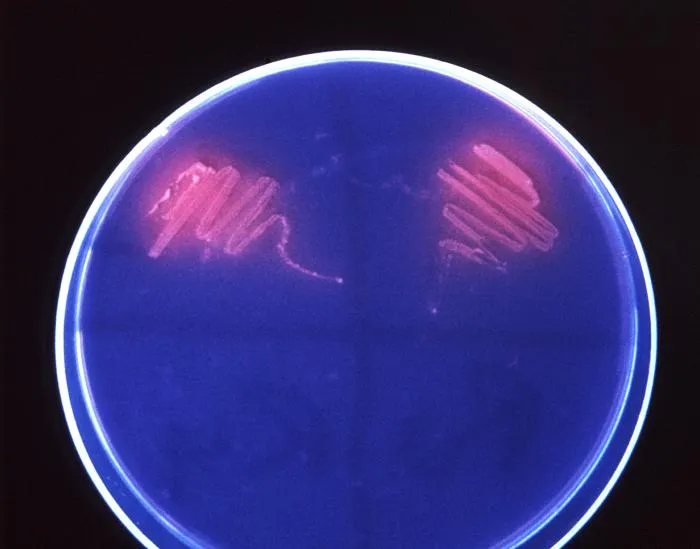
Erythrasma is a chronic superficial infection of the stratum corneum caused mainly by Corynebacterium minutissimum, a Gram-positive, non-spore-forming rod that thrives in warm, moist, occluded skin. It causes sharply demarcated, reddish-brown (dark brown in darker skin) patches with a fine wrinkled scale in the toe webs, groin, axillae and inframammary or intergluteal folds. Unlike tinea cruris there is no raised active edge or central clearing, and unlike candidal intertrigo there are no satellite pustules. Itch is usually mild. Risk factors include diabetes, obesity, hyperhidrosis and humid climates. The organism produces coproporphyrin III, so the lesions fluoresce coral-red under a Wood's lamp; skin scrapings show Gram-positive rods and are negative on potassium hydroxide microscopy unless a fungus coexists. Localised disease responds to topical fusidic acid, clindamycin, erythromycin or an imidazole; extensive or resistant disease is treated with oral clarithromycin or erythromycin. Recurrence is common, so drying measures and antibacterial washes are advised.
Patient case, mechanism, investigations, management, flashcards and exam-style questions.Open the lesson →
Key facts
- Organism: Corynebacterium minutissimum, a Gram-positive diphtheroid rod living in the stratum corneum
- Commonest site is the fourth toe web (interdigital form), often coexisting with dermatophyte or Candida infection
- Flexural form: sharply marginated reddish-brown finely scaly patches in groin, axillae, inframammary and intergluteal folds
- Wood's lamp (UV-A, about 365 nm): coral-red fluorescence from coproporphyrin III; recent washing can give a false negative
- KOH microscopy negative (unless co-infection); Gram stain shows Gram-positive rods and filaments
- Risk factors: diabetes, obesity, hyperhidrosis, warm humid climate, older age, immunosuppression
- Treatment: topical fusidic acid, clindamycin, erythromycin or an imidazole for 2 weeks; oral clarithromycin 1 g single dose for extensive disease
- Part of the corynebacterial triad with pitted keratolysis and trichomycosis axillaris
Differential diagnosis
| Condition | Clues | Key test |
|---|---|---|
| Tinea cruris | Raised scaly active edge with central clearing; spreads onto thighs; scrotum usually spared | KOH microscopy shows septate hyphae; culture |
| Candidal intertrigo | Beefy-red moist plaques with satellite papules and pustules; scrotum often involved | KOH or culture: budding yeasts and pseudohyphae |
| Inverse (flexural) psoriasis | Shiny, well-demarcated red plaques without scale; nail pitting, scalp disease | Clinical; biopsy if uncertain |
| Seborrhoeic dermatitis | Greasy scale also on scalp, eyebrows, nasolabial folds | Clinical |
| Pityriasis versicolor | Trunk rather than folds; hypo- or hyperpigmented macules | Wood's lamp yellow-green or yellow-orange (not always); KOH 'spaghetti and meatballs' |
| Acanthosis nigricans | Velvety thickened hyperpigmented plaques in neck and axillae, no scale | Clinical; check glucose and insulin resistance |
| Irritant intertrigo | Symmetric moist erythema of opposing skin surfaces, maceration | Diagnosis of exclusion; negative Wood's lamp and KOH |
Exam pearls
Guideline
No dedicated international guideline: Holdiness 2002 management review, Radhakrishnan 2025 systematic review of interventions, NICE/WHO AWaRe antimicrobial stewardship principles (2022)
References
- Holdiness MR. Management of cutaneous erythrasma. Drugs 2002.
- Forouzan P, Cohen PR. Erythrasma revisited: diagnosis, differential diagnoses, and comprehensive review of treatment. Cureus 2020.
- Radhakrishnan S, Logamoorthy R, Karthikeyan K, Mohan R, Mary JJF. Erythrasma: a systematic review of interventions. Clin Exp Dermatol 2025.
- Jobbagy S, Laga AC, Watkins JC. Erythrasma of the vulva: an invisible dermatosis. Int J Gynecol Pathol 2025.
- World Health Organization. The WHO AWaRe (Access, Watch, Reserve) antibiotic book. WHO, Geneva 2022.
- Papadakis MA, Rabow MW, McQuaid KR, eds.. CURRENT Medical Diagnosis & Treatment 2026 (65th ed). McGraw Hill 2026.
Related topics
By Dr Khalid Seidi (B.Sc., M.D.) · MedEd World Clinical Knowledge library. Original teaching content checked against current guidelines (November 2026); confirm the latest local guidance before clinical use. Not a substitute for clinical judgement.