Clinical Knowledge › Dermatology › Bacterial skin infections
Staphylococcal scalded skin syndrome
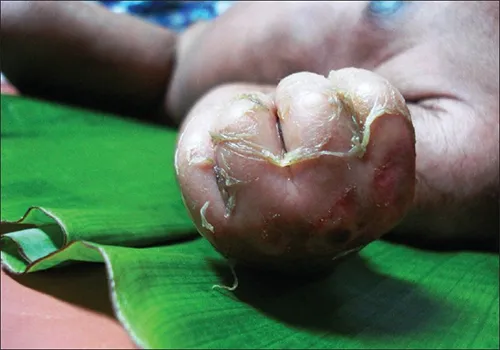
Staphylococcal scalded skin syndrome (SSSS) is a toxin-mediated blistering emergency caused by Staphylococcus aureus strains that release exfoliative toxins A or B. These serine proteases cleave desmoglein 1, splitting the epidermis high in the granular layer. It mainly affects children under 5 years and adults with renal impairment or immunosuppression, who cannot clear the toxin. A febrile, irritable child develops tender erythema that starts around the mouth, eyes and flexures, then forms flaccid bullae and sheets of wrinkled, peeling skin with a positive Nikolsky sign; radial crusting around the mouth is typical and the mucous membranes are spared. The infective focus is often trivial and the blisters themselves are sterile. Diagnosis is clinical, supported by swabs of the focus and, when toxic epidermal necrolysis is a concern, a frozen section showing a subcorneal split. Treatment is admission, an intravenous anti-staphylococcal beta-lactam, fluids, analgesia, emollients and gentle skin care; healing without scarring is usual in children.
Patient case, mechanism, investigations, management, flashcards and exam-style questions.Open the lesson →
Key facts
- Cause: exfoliative toxins A and B from S. aureus (often phage group II) act as serine proteases that cleave desmoglein 1
- Split level: within the granular layer just beneath the stratum corneum - the same level as pemphigus foliaceus and bullous impetigo
- Peak age under 5 years (immature renal toxin clearance and lack of antitoxin antibody); in adults think renal failure or immunosuppression
- Tender erythema first, periorificial and flexural; flaccid bullae and sheet-like peeling follow within 24-48 hours
- Nikolsky sign positive; mucous membranes spared - the key clinical difference from toxic epidermal necrolysis
- Blister fluid and blood cultures are usually sterile in children; culture the focus (nose, conjunctiva, umbilicus, perioral crusts)
- First-line therapy: IV flucloxacillin (or nafcillin/oxacillin); vancomycin if MRSA is likely or the child is critically ill
- Mortality under 5% in children but considerably higher in adults, reflecting comorbidity
Differential diagnosis
| Condition | Clues | Key test |
|---|---|---|
| Toxic epidermal necrolysis | Drug exposure 4-28 days earlier; mucosal erosions; adults; dusky atypical targets | Frozen section or biopsy: full-thickness epidermal necrosis |
| Bullous impetigo | Localised flaccid bullae with honey crusts; child otherwise well | Swab of blister grows S. aureus (toxin acts locally) |
| Scarlet fever | Sandpaper rash, strawberry tongue, pharyngitis; later peeling of palms | Throat swab for group A streptococcus; ASO |
| Kawasaki disease | Fever 5 days or more, conjunctival injection, cracked lips, periungual peeling | Echocardiography; raised CRP, platelets later |
| Toxic shock syndrome | Hypotension and multi-organ dysfunction; diffuse erythroderma then palmar desquamation | Clinical criteria; blood cultures, CK, renal function |
| Scald burn or non-accidental injury | Sharp margins, immersion pattern, history inconsistent | Safeguarding assessment; skeletal survey if indicated |
| Epidermolysis bullosa (neonate) | Blisters at friction sites from birth; family history | Skin biopsy with immunofluorescence mapping; genetics |
Exam pearls
Guideline
No dedicated international SSSS guideline: expert reviews (Leung 2018; Brazel 2021), Gray 2025 systematic review of paediatric SSSS, IDSA skin and soft tissue infection guideline 2014 and WHO AWaRe antibiotic book 2022
References
- Ladhani S, Joannou CL, Lochrie DP, Evans RW, Poston SM. Clinical, microbial, and biochemical aspects of the exfoliative toxins causing staphylococcal scalded-skin syndrome. Clin Microbiol Rev 1999.
- Amagai M, Matsuyoshi N, Wang ZH, Andl C, Stanley JR. Toxin in bullous impetigo and staphylococcal scalded-skin syndrome targets desmoglein 1. Nat Med 2000.
- Leung AKC, Barankin B, Leong KF. Staphylococcal-scalded skin syndrome: evaluation, diagnosis, and management. World J Pediatr 2018.
- Brazel M, Desai A, Are A, Motaparthi K. Staphylococcal scalded skin syndrome and bullous impetigo. Medicina (Kaunas) 2021.
- Liy-Wong C, Pope E, Weinstein M, Lara-Corrales I. Staphylococcal scalded skin syndrome: an epidemiological and clinical review of 84 cases. Pediatr Dermatol 2021.
- Infectious Diseases Society of America (Stevens DL, Bisno AL, Chambers HF, et al.). Practice guidelines for the diagnosis and management of skin and soft tissue infections: 2014 update by the Infectious Diseases Society of America. Clin Infect Dis 2014.
Related topics
By Dr Khalid Seidi (B.Sc., M.D.) · MedEd World Clinical Knowledge library. Original teaching content checked against current guidelines (November 2026); confirm the latest local guidance before clinical use. Not a substitute for clinical judgement.