Clinical Knowledge › Anaesthesiology › General anaesthesia
Depth of anaesthesia monitoring and accidental awareness
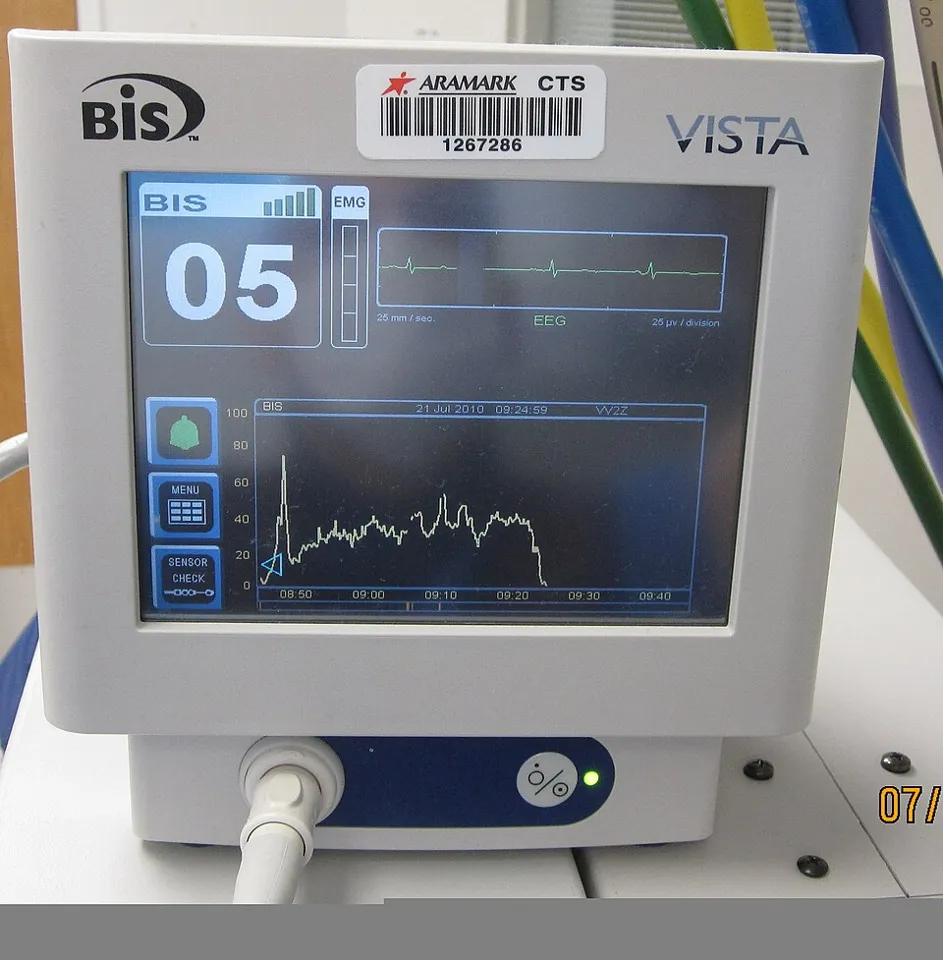
Accidental awareness during general anaesthesia (AAGA) is unintended consciousness with explicit recall of events during an intended general anaesthetic. NAP5 (2014) found spontaneously reported AAGA in about 1 in 19,600 anaesthetics, rising to about 1 in 8,200 with neuromuscular blockade and about 1 in 670 for caesarean section; structured questioning detects it more often (about 1–2 per 1,000). Most episodes occur at induction or emergence and stem from drug delivery gaps, inadequate doses, rapid sequence induction, difficult airways, TIVA failures and paralysis without adequate hypnosis; residual paralysis on waking is often perceived as awareness. Depth of anaesthesia is assessed by clinical signs, end-tidal volatile concentration relative to MAC and processed EEG monitors such as the bispectral index (target 40–60). Processed EEG is recommended with TIVA plus neuromuscular blockade and helps avoid excessive depth in older patients. AAGA can cause lasting psychological harm, so suspected cases need prompt, empathetic follow-up.
Patient case, mechanism, investigations, management, flashcards and exam-style questions.Open the lesson →
Key facts
- AAGA = consciousness with explicit recall during intended general anaesthesia; it differs from expected recall during sedation or regional anaesthesia
- NAP5 incidence: about 1 in 19,600 overall, 1 in 8,200 with neuromuscular blockade, 1 in 136,000 without, and about 1 in 670 for caesarean section
- About two-thirds of NAP5 cases occurred at induction or emergence; many involved paralysis with inadequate or interrupted hypnotic delivery
- Risk factors: neuromuscular blockade, TIVA, rapid sequence induction, thiopental, obesity, difficult airway, obstetric, cardiac and thoracic surgery, emergencies, out-of-hours work, junior anaesthetist, younger adult women, previous AAGA
- Keeping end-tidal volatile at or above about 0.7 MAC with an alarm makes AAGA very unlikely in most adults
- Processed EEG monitors (BIS, entropy, patient state index) display an index of 0–100; 40–60 is the usual target for general anaesthesia
- Processed EEG is recommended when TIVA is combined with neuromuscular blockade (Association of Anaesthetists 2021)
- AAGA, especially with paralysis and pain, can lead to post-traumatic stress disorder: listen, believe, document, apologise and refer early
Differential diagnosis
| Condition | Clues | Key test |
|---|---|---|
| Residual neuromuscular blockade at emergence | Patient conscious but weak and distressed after surgery | Quantitative train-of-four ratio below 0.9; no intraoperative recall |
| Dreaming | Pleasant or neutral dream-like content without operative events | Structured Brice interview; no verifiable intraoperative details |
| Recall during intended sedation or regional anaesthesia | Memories of theatre during sedation where awareness was expected | Review consent and anaesthetic record |
| Recall from the anaesthetic room or recovery | Memories before induction or after emergence | Timeline reconstruction against anaesthetic record |
| Postoperative delirium with misperceptions | Fluctuating attention, hallucinations after surgery | CAM or 4AT assessment |
| Drug error (syringe swap) | Paralysis before hypnosis, 'awake paralysis' at induction | Review drug chart, syringes and pump history |
Exam pearls
Guideline
Association of Anaesthetists monitoring standards (2021), NAP5 recommendations (Royal College of Anaesthetists and Association of Anaesthetists, 2014), NICE diagnostics guidance DG6 depth of anaesthesia monitors (2012) and ESAIC postoperative delirium guideline update (2024)
References
- Pandit JJ, Andrade J, Bogod DG, et al.. 5th National Audit Project (NAP5) on accidental awareness during general anaesthesia: summary of main findings and risk factors. Br J Anaesth 2014.
- Klein AA, Meek T, Allcock E, et al.. Recommendations for standards of monitoring during anaesthesia and recovery 2021: Guideline from the Association of Anaesthetists. Anaesthesia 2021.
- Myles PS, Leslie K, McNeil J, Forbes A, Chan MT.. Bispectral index monitoring to prevent awareness during anaesthesia: the B-Aware randomised controlled trial. Lancet 2004.
- Avidan MS, Jacobsohn E, Glick D, et al.. Prevention of intraoperative awareness in a high-risk surgical population. N Engl J Med 2011.
- Short TG, Campbell D, Frampton C, et al.. Anaesthetic depth and complications after major surgery: an international, randomised controlled trial. Lancet 2019.
- Wildes TS, Mickle AM, Ben Abdallah A, et al.. Effect of electroencephalography-guided anesthetic administration on postoperative delirium among older adults undergoing major surgery: the ENGAGES randomized clinical trial. JAMA 2019.
Related topics
By Dr Khalid Seidi (B.Sc., M.D.) · MedEd World Clinical Knowledge library. Original teaching content checked against current guidelines (November 2026); confirm the latest local guidance before clinical use. Not a substitute for clinical judgement.