Clinical Knowledge › Anaesthesiology › General anaesthesia
Maintenance of anaesthesia: volatile versus total intravenous anaesthesia
Maintenance of general anaesthesia keeps the patient unconscious, immobile and haemodynamically stable between induction and emergence, using either an inhaled volatile agent (sevoflurane, isoflurane, desflurane) or total intravenous anaesthesia (TIVA), usually propofol with remifentanil given by target-controlled infusion. Volatiles are dosed by end-tidal concentration relative to MAC; their speed depends on the blood:gas partition coefficient and potency on lipid solubility (Meyer–Overton). TIVA has no end-tidal measurement, so delivery depends on a secure, visible cannula, correct pump programming and, when neuromuscular blockade is used, processed EEG monitoring. TIVA reduces postoperative nausea and vomiting and avoids malignant hyperthermia triggers and greenhouse gas emissions; volatiles are simple, cheap and directly measurable. Large trials (MYRIAD 2019, GA-CARES 2025–2026) show no survival advantage for either technique, so the choice is individual. Desflurane has been withdrawn from routine use in the UK and restricted in the EU from 2026 because of its climate impact.
Patient case, mechanism, investigations, management, flashcards and exam-style questions.Open the lesson →
Key facts
- MAC is the alveolar concentration at 1 atmosphere that prevents movement to surgical incision in 50% of patients; approximate adult values: sevoflurane 2.0%, desflurane 6.0%, isoflurane 1.15%, nitrous oxide 104%
- MAC falls by about 6% per decade after 40 years and with opioids, benzodiazepines, hypothermia, pregnancy and acute alcohol intoxication; it rises with chronic alcohol use and hyperthermia
- Blood:gas partition coefficient determines speed: desflurane 0.42, nitrous oxide 0.47, sevoflurane 0.65, isoflurane 1.4 (low = fast onset and offset)
- Oil:gas partition coefficient determines potency (Meyer–Overton): the more lipid soluble the agent, the lower its MAC
- TIVA is usually propofol by effect-site target-controlled infusion (Marsh, Schnider or Eleveld models) with remifentanil (Minto model)
- Remifentanil has a context-sensitive half-time of about 3–4 minutes regardless of infusion length because it is hydrolysed by non-specific esterases
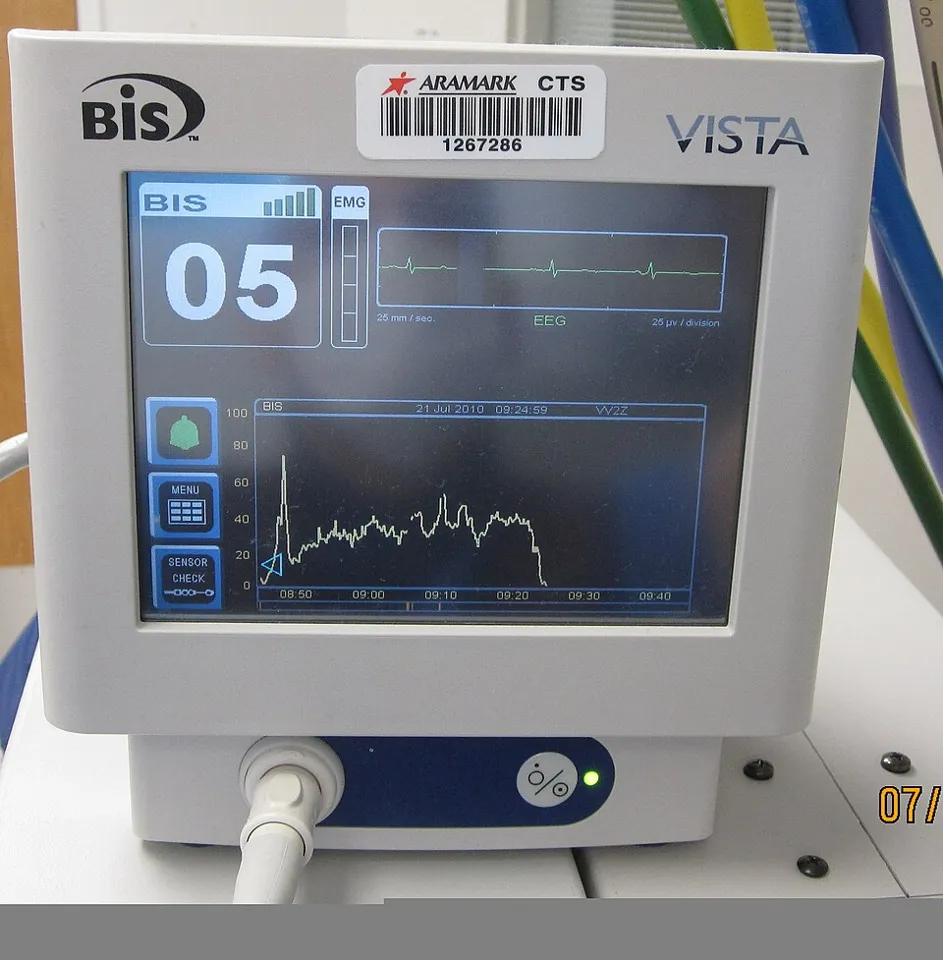
- NAP5 found accidental awareness about 1 in 19,600 overall, but higher with neuromuscular blockade and with TIVA; processed EEG is recommended when TIVA is combined with neuromuscular blockade
- Propofol TIVA reduces the baseline risk of PONV and is the technique of choice in malignant hyperthermia susceptibility
Differential diagnosis
| Condition | Clues | Key test |
|---|---|---|
| Light anaesthesia from TIVA delivery failure | Tachycardia, hypertension, movement or rising processed EEG index with an infusion running | Inspect cannula site, line connections, syringe and pump history |
| Light anaesthesia from empty vaporiser | End-tidal agent falling while dial unchanged | Gas analyser end-tidal concentration; check vaporiser level and seating |
| Nociceptive surge with adequate hypnosis | Haemodynamic response to surgical stimulus with appropriate processed EEG value | Clinical context; response to opioid bolus |
| Hypovolaemia or vasodilatation | Hypotension with low end-tidal CO2 and pulse pressure variation | Fluid responsiveness assessment, blood loss estimate |
| Malignant hyperthermia | Unexplained rise in end-tidal CO2, tachycardia, rigidity during volatile anaesthesia | Arterial blood gas, potassium, creatine kinase, temperature trend |
| Delayed emergence from accumulation | Slow waking after long propofol or fentanyl infusion | Review doses and context-sensitive half-times; glucose, temperature, neuromuscular monitoring |
| Residual neuromuscular blockade mimicking awareness | Patient distressed, unable to move at emergence | Quantitative train-of-four ratio below 0.9 |
Exam pearls
Guideline
Association of Anaesthetists/Society for Intravenous Anaesthesia TIVA guidelines (2018, published 2019), Association of Anaesthetists monitoring standards (2021), consensus guidelines for PONV (fourth 2020; fifth 2025–2026) and NHS England desflurane decommissioning guidance (2024)
References
- Nimmo AF, Absalom AR, Bagshaw O, et al.. Guidelines for the safe practice of total intravenous anaesthesia (TIVA): Joint Guidelines from the Association of Anaesthetists and the Society for Intravenous Anaesthesia. Anaesthesia 2019.
- Klein AA, Meek T, Allcock E, et al.. Recommendations for standards of monitoring during anaesthesia and recovery 2021: Guideline from the Association of Anaesthetists. Anaesthesia 2021.
- Pandit JJ, Andrade J, Bogod DG, et al.. 5th National Audit Project (NAP5) on accidental awareness during general anaesthesia: summary of main findings and risk factors. Br J Anaesth 2014.
- Gan TJ, Jin Z, Ayad S, et al.. Fifth Consensus Guidelines for the Management of Postoperative Nausea and Vomiting: Executive Summary. Anesth Analg 2026.
- Landoni G, Lomivorotov VV, Nigro Neto C, et al.. Volatile anesthetics versus total intravenous anesthesia for cardiac surgery. N Engl J Med 2019.
- Bennett-Guerrero E, Romeiser JL, DeMaria S, et al.. Anesthesia type during cancer surgery: results of the GA-CARES randomized, multicenter trial. Anesthesiology 2026.
Related topics
By Dr Khalid Seidi (B.Sc., M.D.) · MedEd World Clinical Knowledge library. Original teaching content checked against current guidelines (November 2026); confirm the latest local guidance before clinical use. Not a substitute for clinical judgement.