Clinical Knowledge › Internal medicine › Pulmonology › Clinical problems
Digital clubbing: approach to the patient
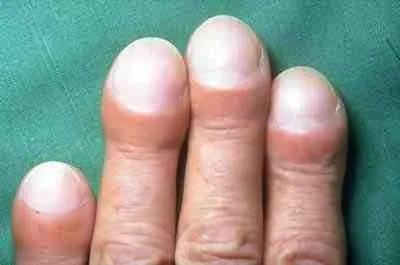
Digital clubbing is painless bulbous enlargement of the distal fingers (and often toes) caused by proliferation of connective tissue and new vessels in the nail bed, so that the normal angle between nail plate and proximal nail fold is lost. It is an old sign with a modern message: in an adult, new clubbing is never 'just a finger shape' and must prompt a search for intrathoracic disease, above all lung cancer, followed by suppurative lung disease (bronchiectasis, cystic fibrosis, empyema, abscess), fibrotic interstitial lung disease, cyanotic congenital heart disease, infective endocarditis, inflammatory bowel disease and cirrhosis. COPD alone does not cause clubbing. The leading theory is that megakaryocytes and platelet clumps bypass the pulmonary capillary filter and lodge in fingertips, releasing PDGF and VEGF; raised prostaglandin E2 also contributes, as shown by inherited HPGD and SLCO2A1 defects. Confirm clubbing with Schamroth's window test, the profile angle and the phalangeal depth ratio, then take a focused history, examine, and request a chest X-ray as the first test. Management is that of the cause; clubbing may regress after cure.
Patient case, mechanism, investigations, management, flashcards and exam-style questions.Open the lesson →
Key facts
- Clubbing = loss of the nail-fold angle (profile angle above 180°) and phalangeal depth ratio above 1, with fluctuant, spongy nail bed
- Schamroth's window test: the diamond-shaped gap between opposed nail beds disappears in clubbing
- Lung cancer (especially non-small cell) is the commonest serious cause in adults; NICE advises an urgent chest X-ray for people aged 40 or over with clubbing
- Suppurative lung disease (bronchiectasis, cystic fibrosis, abscess, empyema) and fibrotic ILD such as idiopathic pulmonary fibrosis are classic causes
- Uncomplicated COPD and asthma do not cause clubbing: if a smoker with COPD develops clubbing, look for cancer or bronchiectasis
- Cardiac causes: cyanotic congenital heart disease and infective endocarditis; GI causes: inflammatory bowel disease, cirrhosis and coeliac disease
- Hypertrophic osteoarthropathy (clubbing, periostitis of long bones, painful joints) strongly suggests lung cancer, often adenocarcinoma
- Unilateral clubbing points to a local vascular cause (aneurysm, arteriovenous fistula); toes-only (differential) clubbing to patent ductus arteriosus with Eisenmenger reversal
Differential diagnosis
| Condition | Clues | Key test |
|---|---|---|
| Pseudoclubbing (hyperparathyroidism, scleroderma) | Distal phalanx resorption (acro-osteolysis) with preserved nail-fold angle; often asymmetric | Hand X-ray showing acro-osteolysis; calcium and PTH |
| Curved nails (normal variant) | Increased longitudinal nail curvature but normal Lovibond angle and depth ratio | Bedside measurement; no further tests |
| Paronychia or nail-fold infection | Painful, red, swollen fold in one or two digits | Clinical; pus swab if needed |
| Thyroid acropachy | Clubbing-like swelling with Graves' eye disease and pretibial myxoedema | TSH, free T4, TSH-receptor antibodies |
| Primary hypertrophic osteoarthropathy (pachydermoperiostosis) | Young man, thick furrowed facial skin, family history, no underlying disease | Long-bone X-ray periostitis; HPGD or SLCO2A1 genetic testing |
| Heberden's nodes (osteoarthritis) | Bony swelling at the DIP joint itself, nail-fold angle normal | Hand X-ray |
| Familial (hereditary) clubbing | Present since childhood in several relatives, no symptoms | Family history; exclude acquired causes with chest X-ray |
Exam pearls
Guideline
NICE NG12 Suspected cancer: recognition and referral (2015, updated through 2025) and NICE NG122 Lung cancer: diagnosis and management (2019, updated 2024), with the JAMA Rational Clinical Examination review of clubbing (2001)
References
- National Institute for Health and Care Excellence (NICE). Suspected cancer: recognition and referral (NICE guideline NG12). 2015.
- National Institute for Health and Care Excellence (NICE). Lung cancer: diagnosis and management (NICE guideline NG122). 2019.
- Myers KA, Farquhar DR.. The rational clinical examination. Does this patient have clubbing?. JAMA 2001.
- Spicknall KE, Zirwas MJ, English JC.. Clubbing: an update on diagnosis, differential diagnosis, pathophysiology, and clinical relevance. J Am Acad Dermatol 2005.
- Sarkar M, Mahesh DM, Madabhavi I.. Digital clubbing. Lung India 2012.
- Callemeyn J, Van Haecke P, Peetermans WE, Blockmans D.. Clubbing and hypertrophic osteoarthropathy: insights in diagnosis, pathophysiology, and clinical significance. Acta Clin Belg 2016.
Related topics
By Dr Khalid Seidi (B.Sc., M.D.) · MedEd World Clinical Knowledge library. Original teaching content checked against current guidelines (November 2026); confirm the latest local guidance before clinical use. Not a substitute for clinical judgement.