Clinical Knowledge › Internal medicine › Pulmonology › Clinical problems
Stridor: approach to the patient
Stridor is a harsh, high-pitched sound produced by turbulent airflow through a narrowed larynx or trachea. It is a sign of upper airway obstruction and must always be taken seriously, because the airway can deteriorate suddenly to complete obstruction. Its timing helps localise the problem: inspiratory stridor suggests a supraglottic or glottic (extrathoracic) lesion, expiratory stridor an intrathoracic tracheal lesion, and biphasic stridor a fixed or subglottic narrowing. In infants the commonest cause is laryngomalacia; in young children viral croup is by far the most frequent, with epiglottitis, bacterial tracheitis, foreign bodies and retropharyngeal abscess as rarer emergencies. In adults, anaphylaxis and ACE-inhibitor angio-oedema, post-extubation laryngeal oedema, laryngeal and thyroid tumours, bilateral vocal cord palsy, tracheal stenosis and deep neck infection dominate. The first priority is to keep the patient calm, give oxygen and summon senior airway help; examination of the throat in a child with suspected epiglottitis can precipitate obstruction. Treatment targets the cause, within a planned airway strategy that follows current difficult airway guidance.
Patient case, mechanism, investigations, management, flashcards and exam-style questions.Open the lesson →
Key facts
- Stridor is a sign of upper airway obstruction: inspiratory = extrathoracic (larynx), expiratory = intrathoracic trachea, biphasic = subglottic or fixed lesion
- Laryngomalacia is the commonest cause of stridor in infants; it is worse when supine, feeding or crying and usually resolves by 18–24 months
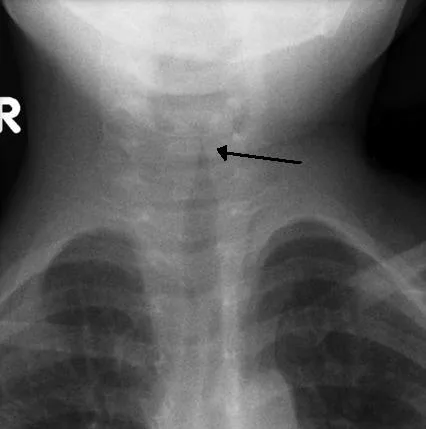
- Croup (6 months to 3 years, parainfluenza virus): barking cough, hoarseness, inspiratory stridor; single-dose oral dexamethasone 0.15–0.6 mg/kg for all severities
- Nebulised adrenaline (0.5 mL/kg of 1 mg/mL, maximum 5 mL) gives rapid but temporary relief in moderate to severe croup; observe for at least 2–4 hours after
- Epiglottitis: drooling, tripod position, muffled voice, toxic appearance, little cough; do not examine the throat or distress the child; secure the airway in theatre
- Adult anaphylaxis with stridor: IM adrenaline 0.5 mg (0.5 mL of 1 mg/mL), repeat after 5 minutes if needed
- ACE-inhibitor angio-oedema is bradykinin-mediated and responds poorly to antihistamines and steroids; stop the drug permanently and plan the airway early
- Post-extubation stridor: in high-risk patients perform a cuff leak test and give systemic steroids at least 4 hours before extubation if it fails (ATS/CHEST 2017)
Differential diagnosis
| Condition | Clues | Key test |
|---|---|---|
| Croup (laryngotracheobronchitis) | 6 months–3 years, coryza, barking cough, worse at night, non-toxic | Clinical; Westley score; no X-ray needed |
| Epiglottitis | Sudden high fever, drooling, muffled voice, tripod position, toxic; now commoner in adults | Clinical; examination under anaesthesia or nasendoscopy in adults; blood cultures |
| Bacterial tracheitis | Croup-like illness that fails to improve, high fever, toxic, purulent secretions | Laryngotracheobronchoscopy; culture (Staphylococcus aureus) |
| Inhaled foreign body | Sudden choking, toddler, no fever | Rigid bronchoscopy |
| Anaphylaxis or angio-oedema | Rapid onset, urticaria, lip and tongue swelling, hypotension; ACE inhibitor use | Clinical; mast cell tryptase; C4 and C1-esterase inhibitor if recurrent |
| Laryngomalacia | Infant, intermittent inspiratory stridor from early weeks, worse supine or feeding | Flexible laryngoscopy |
| Laryngeal or tracheal tumour, goitre | Progressive stridor, hoarseness, smoker, weight loss, neck mass | Nasendoscopy, CT neck and chest, flow–volume loop |
| Post-intubation laryngeal oedema or tracheal stenosis | Recent extubation (oedema) or weeks to months after intubation or tracheostomy (stenosis) | Cuff leak test; laryngoscopy; CT trachea; bronchoscopy |
Exam pearls
Guideline
Difficult Airway Society guideline for unanticipated difficult tracheal intubation in adults (2025), ATS/CHEST guideline on liberation from mechanical ventilation including cuff leak testing (2017), Resuscitation Council UK anaphylaxis guideline (2021), Cochrane review of glucocorticoids for croup (2018) and AAP-derived national croup guidance
References
- Ahmad I, El-Boghdadly K, Iliff H, et al.. Difficult Airway Society 2025 guidelines for management of unanticipated difficult tracheal intubation in adults. Br J Anaesth 2026.
- Girard TD, Alhazzani W, Kress JP, et al.. An official American Thoracic Society/American College of Chest Physicians clinical practice guideline: liberation from mechanical ventilation in critically ill adults. Rehabilitation protocols, ventilator liberation protocols, and cuff leak tests. Am J Respir Crit Care Med 2017.
- Resuscitation Council UK. Emergency treatment of anaphylaxis: guidelines for healthcare providers. Resuscitation Council UK 2021.
- Gates A, Gates M, Vandermeer B, et al.. Glucocorticoids for croup in children. Cochrane Database Syst Rev 2018.
- Parker CM, Cooper MN.. Prednisolone versus dexamethasone for croup: a randomized controlled trial. Pediatrics 2019.
- Bjornson CL, Johnson DW.. Croup in children. CMAJ 2013.
Related topics
By Dr Khalid Seidi (B.Sc., M.D.) · MedEd World Clinical Knowledge library. Original teaching content checked against current guidelines (November 2026); confirm the latest local guidance before clinical use. Not a substitute for clinical judgement.