Clinical Knowledge › Dermatology › Urticaria, drug eruptions and reactive disorders
Erythema multiforme
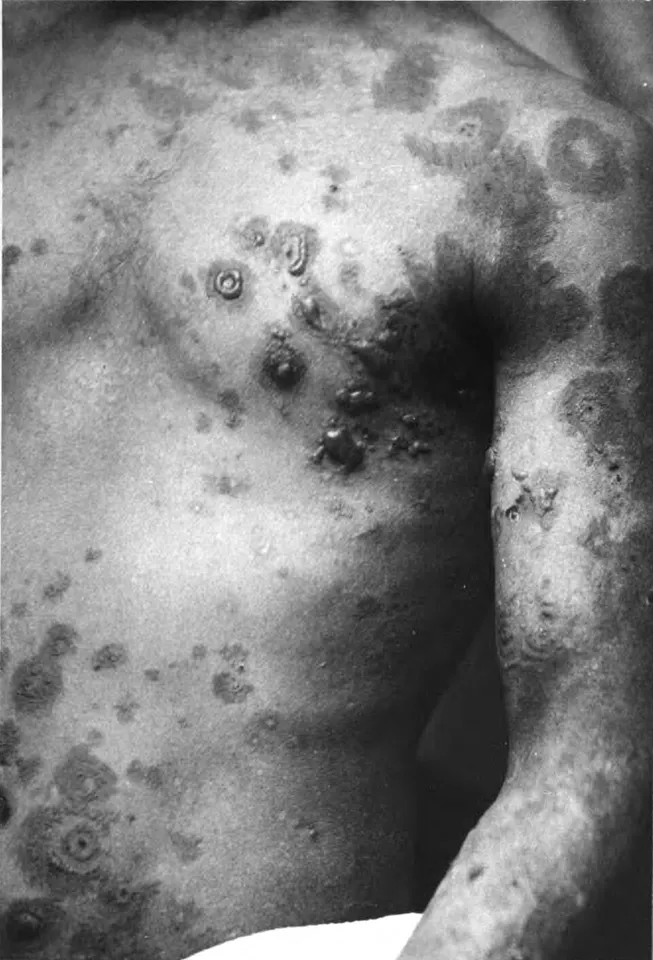
Erythema multiforme (EM) is an acute, self-limiting and often recurrent immune-mediated reaction of skin and mucosa, most often triggered by infection. Herpes simplex virus causes most cases in adults, typically 1-3 weeks after a cold sore; Mycoplasma pneumoniae is important in children, and drugs cause a minority. Its hallmark is the typical target lesion: a raised papule under 3 cm with three zones: dusky or blistered centre, pale oedematous ring and red outer ring. Lesions appear abruptly, symmetrically, on the hands, feet and extensor limbs, spread centripetally, persist for at least a week and heal without scarring. EM minor has little or no mucosal involvement; EM major adds severe erosions of the mouth, eyes or genitals. EM is no longer considered part of the Stevens-Johnson syndrome spectrum, which has flat atypical targets, widespread macules, drug causation and epidermal detachment. Diagnosis is clinical. Treatment addresses the trigger and symptoms; recurrent HSV-associated EM is prevented with continuous aciclovir or valaciclovir.
Patient case, mechanism, investigations, management, flashcards and exam-style questions.Open the lesson →
Key facts
- Typical target: raised, round, under 3 cm, three zones (dusky or bullous centre, pale oedematous ring, red outer ring)
- Distribution: acral and symmetric (backs of hands, palms, feet, extensor forearms and knees), spreading centripetally; Koebner phenomenon
- Triggers: HSV in up to about 70-90% of adult cases; Mycoplasma pneumoniae in children; drugs under 10%
- EM minor: skin with mild or one-site mucosal disease; EM major: severe mucosal involvement of two or more sites, detachment under 10%
- Lesions are fixed for 7 days or more (unlike urticarial wheals that last under 24 hours)
- Histology: interface (vacuolar) dermatitis with necrotic keratinocytes; direct immunofluorescence negative
- Recurrent HSV-associated EM: continuous aciclovir 400 mg twice daily or valaciclovir 500 mg twice daily for at least 6 months
- Separate from SJS/TEN (Bastuji-Garin 1993): SJS has flat atypical targets and dusky macules on the trunk with drug causation
Differential diagnosis
| Condition | Clues | Key test |
|---|---|---|
| Stevens-Johnson syndrome / TEN | Flat atypical targets and dusky macules on trunk and face, new drug, systemic upset, skin detachment | Clinical; biopsy shows full-thickness necrosis; SCORTEN |
| Urticaria (including 'urticaria multiforme' in children) | Wheals with pale or bruised centre lasting under 24 hours; no epidermal change; angio-oedema | Clinical; lesions move day to day |
| Fixed drug eruption | One or few dusky round plaques recurring at the same site with each drug exposure | Drug history; post-inflammatory pigmentation |
| Mycoplasma-induced rash and mucositis (MIRM) | Prominent mucositis with sparse or absent skin lesions in a child with pneumonia | Mycoplasma PCR or serology; chest X-ray |
| Bullous pemphigoid (early) | Elderly; tense bullae, urticarial plaques; itchy | Biopsy and DIF: linear IgG/C3 at basement membrane |
| Subacute cutaneous lupus (Rowell syndrome) | Annular lesions on sun-exposed skin; anti-Ro positive | ANA, anti-Ro; biopsy |
| Kawasaki disease | Fever 5 days or more, conjunctivitis, oral changes, polymorphous rash in a young child | Echocardiography; inflammatory markers |
| Urticarial vasculitis | Wheals lasting more than 24 hours with bruising; burning | Biopsy (leukocytoclastic vasculitis); complement levels |
Exam pearls
Guideline
No dedicated international guideline: consensus clinical classification (Bastuji-Garin 1993), AAFP review (Trayes 2019), systematic review of interventions (de Risi-Pugliese, JEADV 2019), and MIRM definition (Canavan 2015)
References
- Bastuji-Garin S, Rzany B, Stern RS, Shear NH, Naldi L, Roujeau JC. Clinical classification of cases of toxic epidermal necrolysis, Stevens-Johnson syndrome, and erythema multiforme. Arch Dermatol 1993.
- Trayes KP, Love G, Studdiford JS. Erythema multiforme: recognition and management. Am Fam Physician 2019.
- de Risi-Pugliese T, Sbidian E, Ingen-Housz-Oro S, Le Cleach L. Interventions for erythema multiforme: a systematic review. J Eur Acad Dermatol Venereol 2019.
- Canavan TN, Mathes EF, Frieden I, Shinkai K. Mycoplasma pneumoniae-induced rash and mucositis as a syndrome distinct from Stevens-Johnson syndrome and erythema multiforme: a systematic review. J Am Acad Dermatol 2015.
- Whitley RJ, Roizman B. Herpes simplex virus infections. Lancet 2001.
- Papadakis MA, Rabow MW, McQuaid KR, eds.. CURRENT Medical Diagnosis & Treatment 2026 (65th ed). McGraw Hill 2026.
Related topics
By Dr Khalid Seidi (B.Sc., M.D.) · MedEd World Clinical Knowledge library. Original teaching content checked against current guidelines (November 2026); confirm the latest local guidance before clinical use. Not a substitute for clinical judgement.