Clinical Knowledge › Dermatology › Urticaria, drug eruptions and reactive disorders
Morbilliform drug eruption
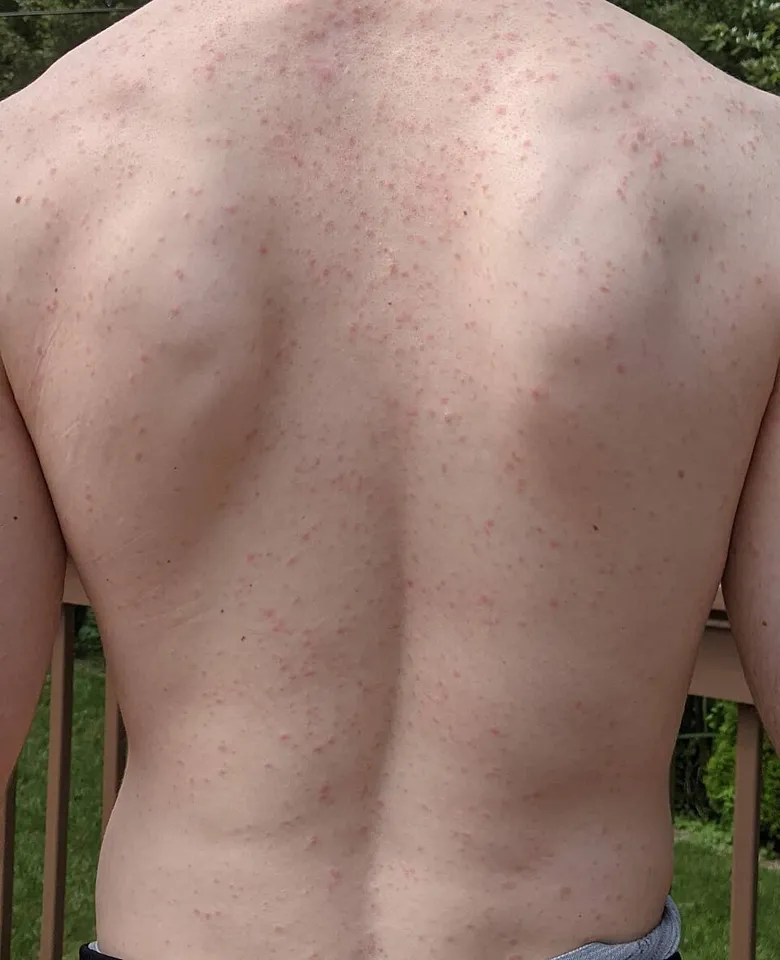
Morbilliform (exanthematous or maculopapular) drug eruption is the commonest cutaneous adverse drug reaction. It is a delayed, T-cell-mediated reaction that usually starts 4-14 days after a new drug (within 1-2 days on re-exposure). Symmetric pink-red macules and papules appear first on the trunk and proximal limbs, spread outwards and become confluent, with itch and sometimes low-grade fever; mucous membranes are spared. Aminopenicillins, sulfonamides, anticonvulsants and allopurinol are frequent culprits; amoxicillin during Epstein-Barr virus infection commonly causes a rash. The key task is to exclude severe cutaneous adverse reactions: facial oedema, skin pain, blisters, mucosal erosions, pustules, high fever, lymphadenopathy, eosinophilia or abnormal liver or renal tests point to DRESS, SJS/TEN or AGEP. Management is stopping the drug, emollients, a moderate-potency topical steroid and antihistamines. The rash fades in 1-2 weeks with fine scaling. Accurate allergy documentation and later delabelling, often by direct oral challenge for low-risk penicillin histories, prevent unnecessary avoidance.
Patient case, mechanism, investigations, management, flashcards and exam-style questions.Open the lesson →
Key facts
- Commonest drug eruption, making up most cutaneous adverse drug reactions
- Onset 4-14 days after starting the drug; may appear after the drug is stopped; faster on re-exposure
- Symmetric erythematous macules and papules on trunk and proximal limbs, spreading and becoming confluent; mucosa spared
- Culprits: aminopenicillins, cephalosporins, sulfonamides, anticonvulsants, allopurinol, nevirapine, vancomycin
- Amoxicillin during infectious mononucleosis often causes a rash that does not necessarily mean lasting allergy
- Red flags for SCAR: facial oedema, skin pain, blisters, mucositis, pustules, purpura, high fever, lymphadenopathy, eosinophilia, organ dysfunction
- Treatment: stop drug, emollient, moderate-potency topical corticosteroid, oral antihistamine; resolves in 1-2 weeks with scaling
- Low-risk remote benign rash with penicillin: direct oral amoxicillin challenge is recommended for delabelling (2022 practice parameter)
Differential diagnosis
| Condition | Clues | Key test |
|---|---|---|
| Viral exanthem (measles, EBV, HHV-6, enterovirus, parvovirus) | Prodrome, conjunctivitis, Koplik spots, lymphadenopathy, contacts; no new drug | Viral serology/PCR |
| DRESS | Latency 2-8 weeks, facial oedema, fever, lymphadenopathy, eosinophilia, hepatitis | FBC with film, LFT, creatinine; RegiSCAR |
| Early SJS/TEN | Painful dusky macules, atypical targets, mucosal erosions, blisters | Biopsy; SCORTEN |
| Acute generalised exanthematous pustulosis | Pustules on erythema within 48 hours, fever, neutrophilia | Biopsy: subcorneal pustules |
| Urticaria | Transient wheals lasting under 24 hours, may have angio-oedema | Clinical; mark lesions |
| Secondary syphilis | Copper-coloured papules including palms and soles, lymphadenopathy, mucous patches | Syphilis serology |
| Acute HIV seroconversion | Fever, pharyngitis, mucocutaneous ulcers, lymphadenopathy, risk exposure | HIV antigen/antibody test, viral load |
| Kawasaki disease (child) | Fever 5 days or more, conjunctivitis, red lips, hand and foot changes | Echocardiography; CRP |
Exam pearls
Guideline
AAAAI/ACAAI Joint Task Force Drug allergy practice parameter update 2022 and NICE CG183 Drug allergy (2014)
References
- Stern RS. Clinical practice. Exanthematous drug eruptions. N Engl J Med 2012.
- AAAAI/ACAAI Joint Task Force on Practice Parameters (Khan DA, Banerji A, Blumenthal KG, et al.). Drug allergy: a 2022 practice parameter update. J Allergy Clin Immunol 2022.
- Banerji A, Solensky R, Phillips EJ, Khan DA. Drug allergy practice parameter updates to incorporate into your clinical practice. J Allergy Clin Immunol Pract 2023.
- National Institute for Health and Care Excellence. Drug allergy: diagnosis and management (CG183). NICE, London 2014.
- Hung SI, Mockenhaupt M, Blumenthal KG, et al.. Severe cutaneous adverse reactions. Nat Rev Dis Primers 2024.
- International DRESS Delphi consensus group (Brüggen MC, Walsh S, Ameri MM, et al.). Management of adult patients with drug reaction with eosinophilia and systemic symptoms: a Delphi-based international consensus. JAMA Dermatol 2024.
Related topics
By Dr Khalid Seidi (B.Sc., M.D.) · MedEd World Clinical Knowledge library. Original teaching content checked against current guidelines (November 2026); confirm the latest local guidance before clinical use. Not a substitute for clinical judgement.