Clinical Knowledge › Dermatology › Urticaria, drug eruptions and reactive disorders
Sweet syndrome
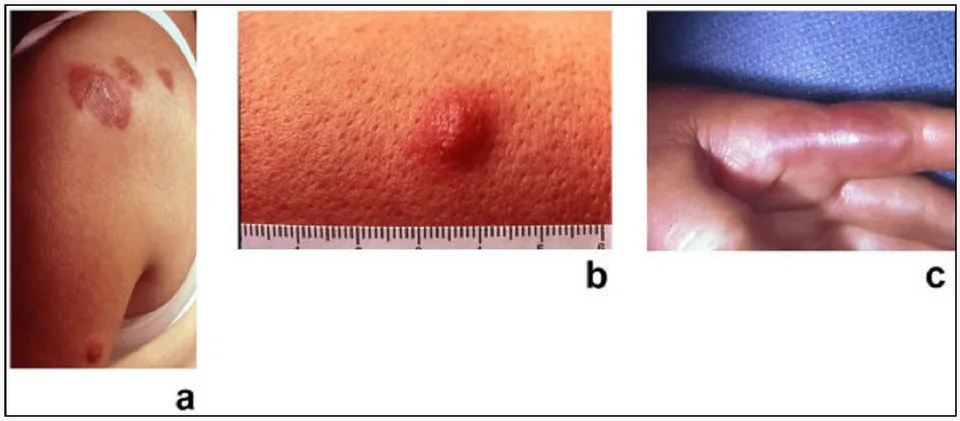
Sweet syndrome (acute febrile neutrophilic dermatosis) is the prototype neutrophilic dermatosis. It presents with the abrupt onset of fever and tender, oedematous, red to violaceous papules, plaques or nodules (often pseudovesicular) on the face, neck, upper limbs and backs of the hands, usually with neutrophilia and raised inflammatory markers. There are three settings: classical (mostly women aged 30-60, after infection, with IBD or pregnancy), malignancy-associated (about a fifth; most often acute myeloid leukaemia or myelodysplasia, sometimes solid tumours) and drug-induced (classically granulocyte colony-stimulating factor). Biopsy shows a dense dermal neutrophilic infiltrate with papillary oedema and no vasculitis; cultures exclude infection. Diagnosis uses the von den Driesch criteria (two major plus two minor). Systemic corticosteroids produce a dramatic response within days; potassium iodide, colchicine and dapsone are alternatives. Because Sweet syndrome can herald haematological malignancy or, in older men, VEXAS syndrome, a blood film and follow-up FBCs are essential.
Patient case, mechanism, investigations, management, flashcards and exam-style questions.Open the lesson →
Key facts
- Abrupt fever with tender, oedematous red-violaceous plaques and nodules on face, neck, upper limbs and dorsal hands
- Pseudovesicular or 'mammillated' plaques due to marked papillary dermal oedema
- Types: classical (about 70%; women 30-60, post-infection, IBD, pregnancy), malignancy-associated (about 20%; AML, MDS), drug-induced (G-CSF most common)
- Labs: neutrophilia, raised ESR/CRP; cytopenias or anaemia suggest underlying myeloid disease
- Histology: dense diffuse neutrophilic dermal infiltrate, papillary oedema, leukocytoclasia without primary vasculitis
- Criteria: both major (abrupt typical lesions; compatible histology) plus 2 of 4 minor (fever, association, steroid response, abnormal labs)
- Treatment: prednisolone 0.5-1 mg/kg/day with rapid response and taper over 4-6 weeks; potassium iodide, colchicine or dapsone as alternatives
- Older man with Sweet-like lesions, macrocytic anaemia, chondritis: consider VEXAS syndrome (somatic UBA1 mutation)
Differential diagnosis
| Condition | Clues | Key test |
|---|---|---|
| Cellulitis or erysipelas | Usually single, spreading, unilateral; portal of entry; responds to antibiotics | Clinical; cultures; biopsy if atypical |
| Erythema multiforme | Typical targets on acral sites after HSV, no high fever or neutrophilia | Biopsy: interface dermatitis |
| Erythema nodosum | Deep tender shin nodules, no surface oedema or pseudovesicles | Biopsy: septal panniculitis |
| Pyoderma gangrenosum (bullous) | Ulcerating lesions with undermined edge; overlaps with Sweet in myeloid disease | Biopsy; clinical course |
| Leukaemia cutis | Firm violaceous papules/nodules in leukaemia, not tender, no steroid response | Biopsy with immunohistochemistry |
| Cutaneous small-vessel vasculitis | Palpable purpura on legs | Biopsy: leukocytoclastic vasculitis |
| Neutrophilic urticarial dermatosis / Still disease | Evanescent wheals or salmon rash with fever spikes | Ferritin; biopsy |
| Deep fungal or atypical mycobacterial infection (immunosuppressed) | Neutropenic or transplant patient; necrotic nodules | Biopsy with tissue culture and special stains |
Exam pearls
Guideline
No formal treatment guideline: von den Driesch diagnostic criteria (1994, modifying Su and Liu 1986), drug-induced criteria (Walker and Cohen 1996), revised criteria proposal (Nofal 2017) and recent reviews (Joshi 2022; Calabrese 2024)
References
- Cohen PR. Sweet's syndrome - a comprehensive review of an acute febrile neutrophilic dermatosis. Orphanet J Rare Dis 2007.
- von den Driesch P. Sweet's syndrome (acute febrile neutrophilic dermatosis). J Am Acad Dermatol 1994.
- Nofal A, Abdelmaksoud A, Amer H, et al.. Sweet's syndrome: diagnostic criteria revisited. J Dtsch Dermatol Ges 2017.
- Beck DB, Ferrada MA, Sikora KA, et al.. Somatic mutations in UBA1 and severe adult-onset autoinflammatory disease. N Engl J Med 2020.
- Calabrese L, Satoh TK, Aoki R, et al.. Sweet syndrome: an update on clinical aspects, pathophysiology, and treatment. Ital J Dermatol Venerol 2024.
- Joshi TP, Friske SK, Hsiou DA, Duvic M. New practical aspects of Sweet syndrome. Am J Clin Dermatol 2022.
Related topics
By Dr Khalid Seidi (B.Sc., M.D.) · MedEd World Clinical Knowledge library. Original teaching content checked against current guidelines (November 2026); confirm the latest local guidance before clinical use. Not a substitute for clinical judgement.