Clinical Knowledge › Paediatrics › Paediatric gastroenterology and surgery
Gastro-oesophageal reflux in infants
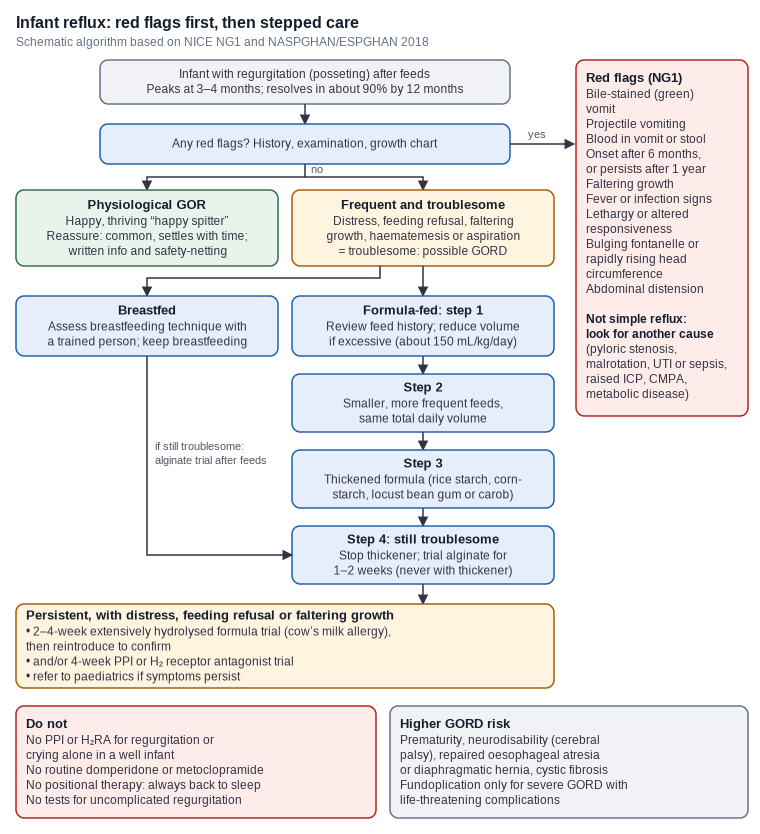
Gastro-oesophageal reflux (GOR), effortless regurgitation ('posseting') of stomach contents, is a normal physiological event in infancy. It affects more than half of babies at its peak around 3–4 months and resolves in about 90% by 12 months as the oesophagus lengthens, the diet becomes solid and the infant sits upright. Gastro-oesophageal reflux disease (GORD) is reserved for reflux that causes troublesome symptoms or complications, such as faltering growth, feeding refusal, oesophagitis or aspiration. The key clinical task is to reassure families of thriving 'happy spitters' while screening every vomiting infant for red flags that suggest another diagnosis: bile-stained or projectile vomiting, blood, onset after 6 months, faltering growth, fever, lethargy, a bulging fontanelle or abdominal distension. Management is stepped: review feed volumes, offer smaller frequent feeds, thickened formula, then a trial of alginate. Acid suppression is not used for regurgitation or crying alone, and positional sleep measures are not advised because of the risk of sudden infant death.
Patient case, mechanism, investigations, management, flashcards and exam-style questions.Open the lesson →
Key facts
- Regurgitation occurs in more than half of infants, peaks at about 3–4 months and resolves in about 90% by 12 months
- GOR = physiological regurgitation in a thriving infant; GORD = troublesome symptoms or complications
- Mechanism: transient lower oesophageal sphincter relaxations, short intra-abdominal oesophagus, liquid diet and large feed volume per kg
- Red flags (NICE NG1): bile-stained, projectile or blood-stained vomiting; onset after 6 months; faltering growth; fever; altered responsiveness; bulging fontanelle; abdominal distension or blood in stool
- Formula-fed: check feed volume (about 150 mL/kg/day), then smaller more frequent feeds, then thickened formula, then alginate trial
- Do not use PPIs or H2 receptor antagonists for overt regurgitation or crying in an otherwise well infant
- Infants should always sleep on their backs; positional therapy is not recommended for sleeping infants with reflux
- Higher risk of GORD: prematurity, neurodisability (cerebral palsy), repaired oesophageal atresia or congenital diaphragmatic hernia, cystic fibrosis
Differential diagnosis
| Condition | Clues | Key test |
|---|---|---|
| Pyloric stenosis | Projectile non-bilious vomiting at 2–8 weeks; hungry; weight loss | Blood gas (hypochloraemic alkalosis); pyloric ultrasound |
| Malrotation with volvulus | Bile-stained (green) vomiting at any age | Urgent upper GI contrast study |
| Cow's milk protein allergy | Reflux with eczema, blood or mucus in stools, diarrhoea or family atopy | 2–4-week elimination then reintroduction |
| Urinary tract infection or sepsis | Fever, lethargy, poor feeding, new vomiting | Urine culture; septic screen |
| Raised intracranial pressure or abusive head trauma | Bulging fontanelle, increasing head circumference, irritability, unexplained bruising | Cranial imaging; safeguarding assessment |
| Overfeeding | Thriving infant taking far more than 150 mL/kg/day | Feeding history and volume calculation |
| Inborn error of metabolism or adrenal insufficiency | Vomiting with lethargy, hypoglycaemia, acidosis or hyponatraemia | Glucose, ammonia, electrolytes, metabolic screen |
| Eosinophilic oesophagitis | Feeding refusal and vomiting persisting despite acid suppression, atopy | Endoscopy with oesophageal biopsies |
Exam pearls
Guideline
NICE NG1 Gastro-oesophageal reflux disease in children and young people (2015, updated 2019) and NASPGHAN/ESPGHAN paediatric GER clinical practice guidelines (2018), with the ESPGHAN cow's milk allergy position paper (2024)
References
- National Institute for Health and Care Excellence. Gastro-oesophageal reflux disease in children and young people: diagnosis and management (NG1). NICE guideline 2015.
- Rosen R, Vandenplas Y, Singendonk M, et al.. Pediatric gastroesophageal reflux clinical practice guidelines: joint recommendations of the North American Society for Pediatric Gastroenterology, Hepatology, and Nutrition and the European Society for Pediatric Gastroenterology, Hepatology, and Nutrition. J Pediatr Gastroenterol Nutr 2018.
- Vandenplas Y, Broekaert I, Domellöf M, et al.. An ESPGHAN position paper on the diagnosis, management, and prevention of cow's milk allergy. J Pediatr Gastroenterol Nutr 2024.
- Moon RY, Carlin RF, Hand I; Task Force on Sudden Infant Death Syndrome. Sleep-related infant deaths: updated 2022 recommendations for reducing infant deaths in the sleep environment. Pediatrics 2022.
- Eichenwald EC; Committee on Fetus and Newborn. Diagnosis and management of gastroesophageal reflux in preterm infants. Pediatrics 2018.
- BMJ Group; Royal Pharmaceutical Society; RCPCH. BNF for Children. 2025.
Related topics
By Dr Khalid Seidi (B.Sc., M.D.) · MedEd World Clinical Knowledge library. Original teaching content checked against current guidelines (November 2026); confirm the latest local guidance before clinical use. Not a substitute for clinical judgement.