Clinical Knowledge › Internal medicine › Endocrinology › Endocrine tumours and polyglandular syndromes
Glucagonoma, VIPoma and somatostatinoma
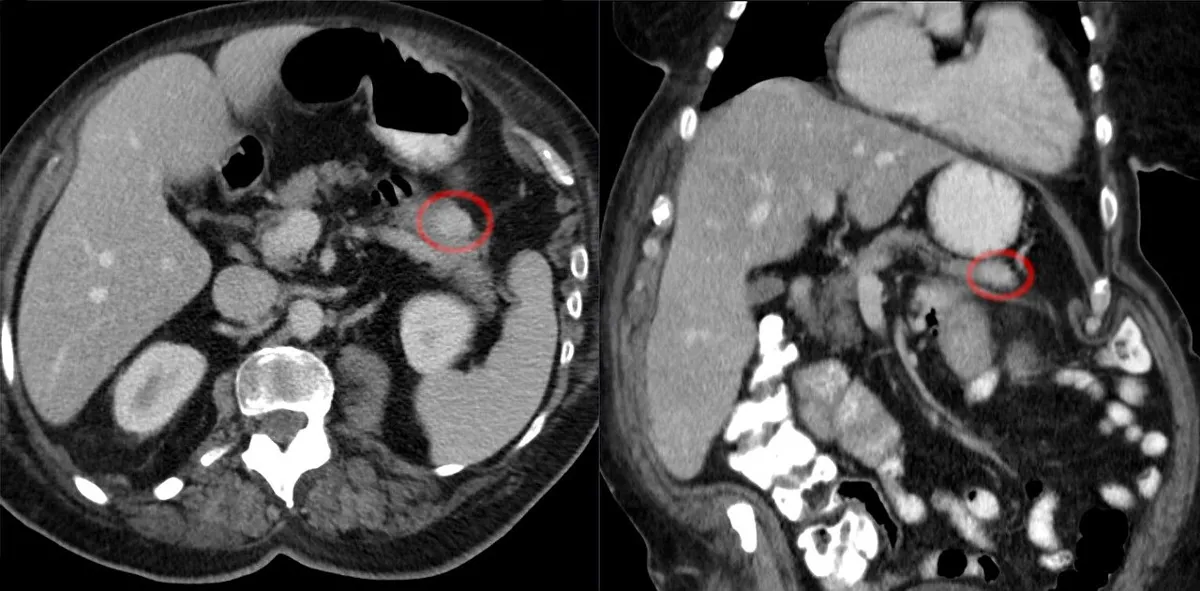
Glucagonoma, VIPoma and somatostatinoma are rare functioning pancreatic neuroendocrine tumours (pNETs), each defined by a clinical syndrome plus an inappropriately high level of its hormone. Glucagonoma causes necrolytic migratory erythema, diabetes, weight loss, venous thrombosis and low amino acids. VIPoma causes the WDHA (Verner–Morrison) syndrome: litres of secretory watery diarrhoea that persists on fasting, hypokalaemia, achlorhydria and a normal anion gap acidosis. Somatostatinoma gives an inhibitory triad of diabetes, gallstones and steatorrhoea, but most duodenal tumours (linked to NF1) are silent. All three are usually large and often metastatic to the liver at diagnosis. Work-up follows the ENETS 2023 guidance: fasting hormone level, cross-sectional imaging, somatostatin receptor PET, biopsy with WHO 2022 Ki-67 grading and screening for MEN1. Somatostatin analogues control hormone excess quickly and slow growth; surgery, liver-directed therapy, PRRT, everolimus, sunitinib and chemotherapy follow. Supportive care (fluids, potassium, anticoagulation, nutrition) is life-saving.
Patient case, mechanism, investigations, management, flashcards and exam-style questions.Open the lesson →
Key facts
- Functioning pNET = clinical syndrome plus inappropriately raised hormone; a raised hormone without symptoms is not a syndrome
- Glucagonoma: necrolytic migratory erythema, diabetes, weight loss, DVT/PE, glossitis, depression; fasting glucagon usually several times the upper limit
- VIPoma (WDHA): secretory diarrhoea often over 3 L/day that persists on fasting, stool osmotic gap below 50 mOsm/kg, hypokalaemia, achlorhydria
- Somatostatinoma: diabetes, gallstones, steatorrhoea and hypochlorhydria; duodenal/ampullary tumours are linked to NF1 and are usually non-functioning
- Most are over 3–4 cm and 50–80% have liver metastases at diagnosis
- 68Ga/64Cu-DOTA-somatostatin analogue PET/CT is the most sensitive staging test for well-differentiated tumours
- Somatostatin analogues (octreotide, lanreotide) are first-line for symptom control; CLARINET showed antiproliferative benefit in GEP-NETs
- Check calcium, PTH and prolactin (and MEN1 genetics when indicated) in every functioning pNET
Differential diagnosis
| Condition | Clues | Key test |
|---|---|---|
| Zinc deficiency or pellagra (glucagonoma mimic) | Periorificial or photo-exposed dermatitis without high glucagon | Serum zinc, niacin history, fasting glucagon |
| Pseudoglucagonoma syndrome | NME-like rash in cirrhosis, malabsorption or pancreatitis | Normal or mildly raised glucagon, no pancreatic mass |
| Stimulant laxative misuse (VIPoma mimic) | Secretory diarrhoea and hypokalaemia that stop when supervised | Urine/stool laxative screen |
| Gastrinoma (Zollinger–Ellison syndrome) | Diarrhoea with ulcers and high acid output, improves with PPI | Fasting gastrin with gastric pH |
| Carcinoid syndrome | Flushing, diarrhoea, wheeze with liver metastases from a midgut NET | 24-hour urine or plasma 5-HIAA |
| Medullary thyroid cancer | Secretory diarrhoea with neck mass and high calcitonin | Calcitonin, CEA, thyroid ultrasound |
| Microscopic colitis | Older woman, watery diarrhoea, normal imaging | Colonoscopy with biopsies |
| Type 2 diabetes with gallstones | Common combination; no steatorrhoea or mass | Imaging; somatostatin only if mass found |
Exam pearls
Guideline
ENETS 2023 guidance paper for functioning pancreatic neuroendocrine tumour syndromes, with the WHO 2022 classification of neuroendocrine neoplasms
References
- Hofland J, Falconi M, Christ E, et al.. European Neuroendocrine Tumor Society 2023 guidance paper for functioning pancreatic neuroendocrine tumour syndromes. J Neuroendocrinol 2023.
- Rindi G, Mete O, Uccella S, et al.. Overview of the 2022 WHO Classification of Neuroendocrine Neoplasms. Endocr Pathol 2022.
- Caplin ME, Pavel M, Ćwikła JB, et al.. Lanreotide in metastatic enteropancreatic neuroendocrine tumors. N Engl J Med 2014.
- Strosberg J, El-Haddad G, Wolin E, et al.. Phase 3 trial of 177Lu-Dotatate for midgut neuroendocrine tumors. N Engl J Med 2017.
- Yao JC, Shah MH, Ito T, et al.. Everolimus for advanced pancreatic neuroendocrine tumors. N Engl J Med 2011.
- Singh S, Halperin D, Myrehaug S, et al.. [177Lu]Lu-DOTA-TATE plus long-acting octreotide versus high-dose long-acting octreotide for the treatment of newly diagnosed, advanced grade 2–3, well-differentiated, gastroenteropancreatic neuroendocrine tumours (NETTER-2). Lancet 2024.
Related topics
By Dr Khalid Seidi (B.Sc., M.D.) · MedEd World Clinical Knowledge library. Original teaching content checked against current guidelines (November 2026); confirm the latest local guidance before clinical use. Not a substitute for clinical judgement.