Clinical Knowledge › Internal medicine › Gastroenterology and hepatology › Diseases of the oesophagus
Hiatus hernia
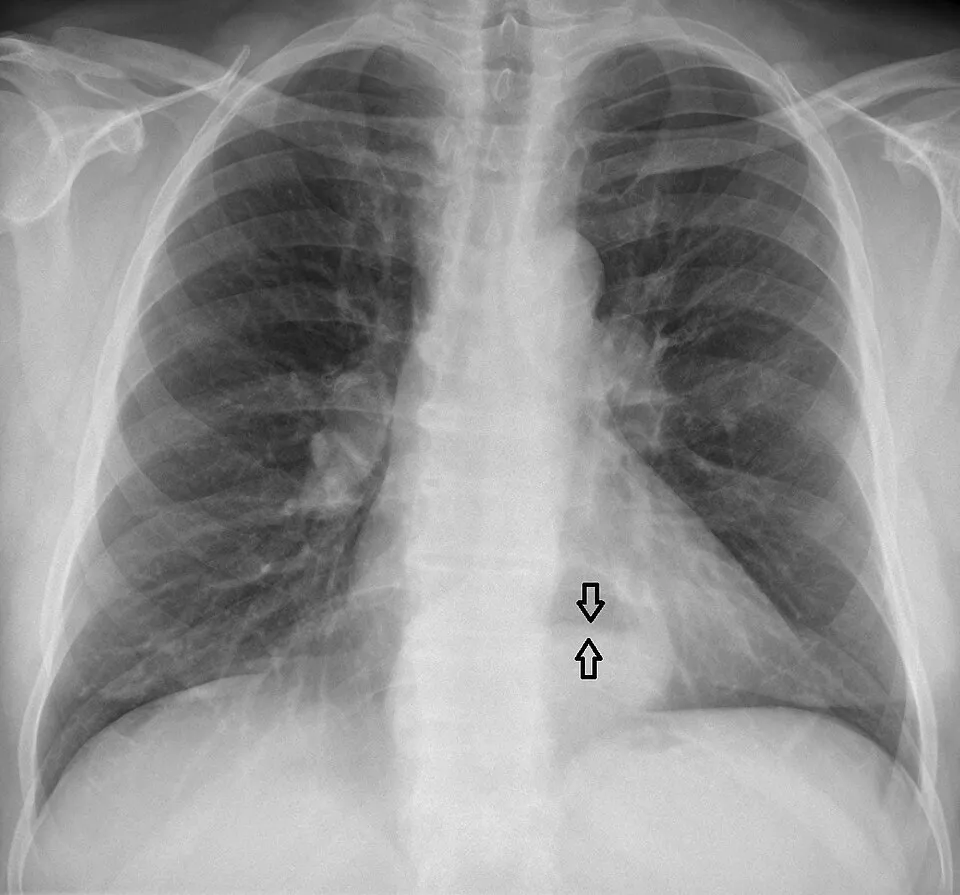
A hiatus hernia is the movement of part of the stomach, and sometimes other abdominal organs, through the oesophageal hiatus of the diaphragm into the chest. Most are sliding (type I) hernias, in which the gastro-oesophageal junction itself rises above the diaphragm; they become more common with age and obesity and matter mainly because they weaken the antireflux barrier and worsen GORD. The less common paraoesophageal hernias (types II–IV) push the gastric fundus up beside the junction and carry a mechanical risk of obstruction, bleeding, volvulus and strangulation. Diagnosis is made at endoscopy, barium swallow, CT or high-resolution manometry, often incidentally. Sliding hernias are treated as reflux disease, while symptomatic paraoesophageal hernias are repaired laparoscopically, and an acute gastric volvulus is a surgical emergency.
Patient case, mechanism, investigations, management, flashcards and exam-style questions.Open the lesson →
Key facts
- Type I (sliding) hernias make up about 85–95% of hiatus hernias; types II–IV (paraoesophageal) make up the rest.
- Type I: gastro-oesophageal junction above the diaphragm; type II: fundus herniates beside a normally placed junction; type III: both (mixed); type IV: another organ such as colon, spleen or omentum.
- A sliding hernia weakens the antireflux barrier by separating the lower oesophageal sphincter from the crural diaphragm and creating an acid reservoir above it.
- At endoscopy, a hernia is diagnosed when the gastro-oesophageal junction lies 2 cm or more above the diaphragmatic pinch.
- Cameron lesions are linear erosions at the diaphragmatic level of a large hernia and cause iron-deficiency anaemia.
- Borchardt triad of acute gastric volvulus: severe epigastric or chest pain, unproductive retching and failure to pass a nasogastric tube.
- Symptomatic paraoesophageal hernias should be repaired; asymptomatic ones can be watched in frail patients, with shared decision-making in the fit.
- Standard repair is laparoscopic: reduce the stomach, excise the sac, close the crura and add a fundoplication, with at least 2–3 cm of tension-free intra-abdominal oesophagus.
Differential diagnosis
| Condition | Clues | Key test |
|---|---|---|
| Gastro-oesophageal reflux disease without a hernia | Same symptoms, normal anatomy | Endoscopy and barium swallow showing no hernia |
| Acute coronary syndrome | Exertional or crushing chest pain, risk factors | ECG and serial troponin |
| Achalasia | Dysphagia to solids and liquids, regurgitation of undigested food | High-resolution manometry; barium swallow with bird-beak narrowing |
| Epiphrenic diverticulum | Regurgitation, outpouching above the junction | Barium swallow shows a pouch with a neck, separate from the stomach |
| Oesophageal or gastric cancer | Progressive dysphagia, weight loss, anaemia | Endoscopy with biopsy |
| Congenital diaphragmatic hernia (Bochdalek or Morgagni) | Posterolateral or anterior defect, colon or omentum in chest | CT showing the defect away from the oesophageal hiatus |
| Peptic ulcer disease | Epigastric pain related to meals, NSAID or H. pylori | Endoscopy and H. pylori testing |
Exam pearls
Guideline
SAGES Guidelines for the management of hiatal hernia (2013) and EAES Multidisciplinary Rapid Guideline on paraoesophageal hernias (2023), with ACG GORD guideline (2022)
References
- Kohn GP, Price RR, DeMeester SR, et al.. Guidelines for the management of hiatal hernia. Surg Endosc 2013.
- Markar SR, Menon N, Guidozzi N, et al.. EAES Multidisciplinary Rapid Guideline: systematic review, meta-analysis, GRADE assessment and evidence-informed recommendations on the surgical management of paraesophageal hernias. Surg Endosc 2023.
- Katz PO, Dunbar KB, Schnoll-Sussman FH, Greer KB, Yadlapati R, Spechler SJ. ACG Clinical Guideline for the Diagnosis and Management of Gastroesophageal Reflux Disease. Am J Gastroenterol 2022.
- Kahrilas PJ, Kim HC, Pandolfino JE. Approaches to the diagnosis and grading of hiatal hernia. Best Pract Res Clin Gastroenterol 2008.
- Yadlapati R, Kahrilas PJ, Fox MR, et al.. Esophageal motility disorders on high-resolution manometry: Chicago classification version 4.0. Neurogastroenterol Motil 2021.
- Gyawali CP, Yadlapati R, Fass R, et al.. Updates to the modern diagnosis of GERD: Lyon consensus 2.0. Gut 2024.
Related topics
By Dr Khalid Seidi (B.Sc., M.D.) · MedEd World Clinical Knowledge library. Original teaching content checked against current guidelines (November 2026); confirm the latest local guidance before clinical use. Not a substitute for clinical judgement.