Clinical Knowledge › Internal medicine › Gastroenterology and hepatology › Diseases of the oesophagus
Oesophageal cancer (squamous cell carcinoma and adenocarcinoma)
Oesophageal cancer is a highly lethal malignancy with two main types that differ in cause, site and geography: squamous cell carcinoma, which dominates worldwide and arises in the upper and middle oesophagus from tobacco, alcohol, very hot drinks and poor diet, and adenocarcinoma, which arises in the distal oesophagus from Barrett oesophagus driven by reflux and obesity. The classic presentation is progressive dysphagia, first to solids and then liquids, with weight loss, but by then most tumours are locally advanced. Any new dysphagia needs urgent endoscopy with biopsy; staging uses CT, PET-CT and endoscopic ultrasound, and the TNM stage decides between endoscopic resection, multimodal treatment with surgery, definitive chemoradiotherapy or palliation. Locally advanced disease is treated with neoadjuvant chemoradiotherapy (CROSS) or perioperative FLOT chemotherapy before oesophagectomy, and immunotherapy now has a place both after surgery and in advanced disease. Overall five-year survival is only about 20%, so prevention and early detection are central.
Patient case, mechanism, investigations, management, flashcards and exam-style questions.Open the lesson →
Key facts
- About 510,000 new cases and 445,000 deaths worldwide in 2022 (GLOBOCAN); seventh most common cause of cancer death.
- Squamous cell carcinoma (most cases worldwide): upper and middle third; tobacco, alcohol, hot drinks, nitrosamines, poor diet; high-incidence belts in East Africa, central Asia and northern China.
- Adenocarcinoma (most cases in Western countries): distal oesophagus and junction; reflux, Barrett oesophagus, obesity, male sex, smoking.
- Progressive dysphagia for solids then liquids with weight loss is the classic history; NICE advises urgent direct-access endoscopy for anyone with dysphagia.
- Staging: CT chest–abdomen–pelvis, then PET-CT and endoscopic ultrasound in potential surgical candidates; laparoscopy for junctional adenocarcinoma extending into the stomach.
- T1a tumours can be cured by endoscopic resection; locally advanced tumours get neoadjuvant chemoradiotherapy (CROSS) or perioperative FLOT, then oesophagectomy; definitive chemoradiotherapy is an option for squamous cell carcinoma.
- Adjuvant nivolumab improves disease-free survival when residual tumour remains after neoadjuvant chemoradiotherapy and resection (CheckMate 577).
- First-line advanced disease: platinum–fluoropyrimidine chemotherapy plus a PD-1 inhibitor guided by PD-L1; add trastuzumab for HER2-positive adenocarcinoma; stents or radiotherapy for dysphagia.
Differential diagnosis
| Condition | Clues | Key test |
|---|---|---|
| Benign peptic stricture | Long reflux history, smooth tapered stricture, little weight loss | Endoscopy with biopsy |
| Achalasia | Dysphagia to solids and liquids from onset over years | High-resolution manometry after endoscopy |
| Eosinophilic oesophagitis | Young atopic patient with food bolus impaction; rings and furrows | Biopsies showing eosinophils |
| Gastric cancer of the cardia | Tumour centred more than 2 cm below the junction | Endoscopy and CT to locate tumour epicentre |
| Extrinsic compression | Mediastinal nodes, lung cancer or aortic aneurysm; normal mucosa | CT chest |
| Oesophageal candidiasis | Odynophagia in an immunosuppressed patient with white plaques | Endoscopy and brushings |
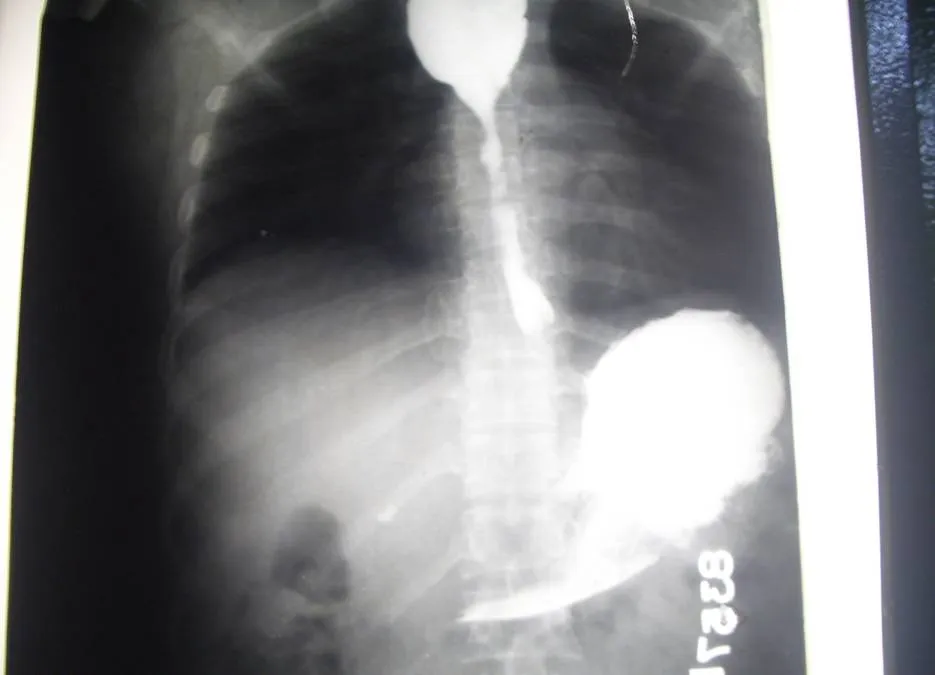
| Pharyngeal pouch (Zenker diverticulum) | Gurgling neck swelling and regurgitation of old food; oropharyngeal dysphagia | Barium swallow |
Exam pearls
Guideline
ESMO Clinical Practice Guideline: Oesophageal cancer (2022, with living-guideline updates) and NICE NG83 Oesophago-gastric cancer: assessment and management in adults
References
- Obermannová R, Alsina M, Cervantes A, et al.. Oesophageal cancer: ESMO Clinical Practice Guideline for diagnosis, treatment and follow-up. Ann Oncol 2022.
- National Institute for Health and Care Excellence. Oesophago-gastric cancer: assessment and management in adults (NICE guideline NG83). 2018.
- National Institute for Health and Care Excellence. Suspected cancer: recognition and referral (NICE guideline NG12). 2015.
- Bray F, Laversanne M, Sung H, et al.. Global cancer statistics 2022: GLOBOCAN estimates of incidence and mortality worldwide for 36 cancers in 185 countries. CA Cancer J Clin 2024.
- Smyth EC, Lagergren J, Fitzgerald RC, et al.. Oesophageal cancer. Nat Rev Dis Primers 2017.
- van Hagen P, Hulshof MC, van Lanschot JJ, et al.. Preoperative chemoradiotherapy for esophageal or junctional cancer. N Engl J Med 2012.
Related topics
By Dr Khalid Seidi (B.Sc., M.D.) · MedEd World Clinical Knowledge library. Original teaching content checked against current guidelines (November 2026); confirm the latest local guidance before clinical use. Not a substitute for clinical judgement.