Clinical Knowledge › Internal medicine › Gastroenterology and hepatology › Diseases of the oesophagus
Oesophageal tears and perforation (Mallory–Weiss syndrome, Boerhaave syndrome)
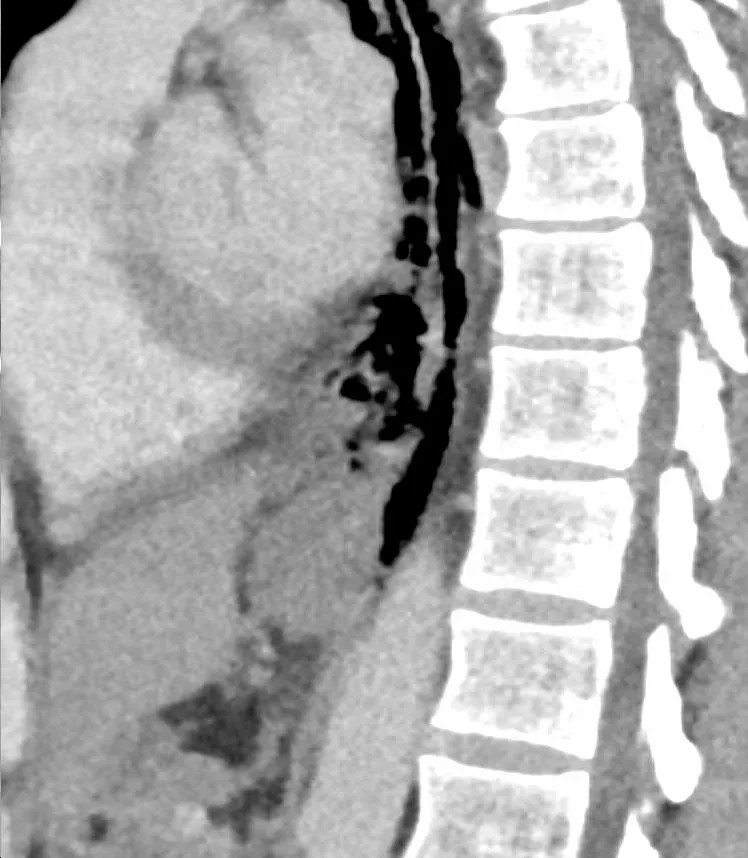
Forceful vomiting can injure the oesophagus at two depths. A Mallory–Weiss tear is a partial-thickness mucosal laceration at the gastro-oesophageal junction that presents with haematemesis after retching and usually stops bleeding by itself. Boerhaave syndrome is a full-thickness rupture, typically of the left posterolateral distal oesophagus, that spills gastric contents into the mediastinum and pleura and presents with severe chest pain, subcutaneous emphysema and rapid sepsis. Most oesophageal perforations overall are iatrogenic, from endoscopy and dilatation, and others follow foreign bodies, caustics or trauma. A Mallory–Weiss tear is managed on the upper gastrointestinal bleeding pathway, while any suspected perforation needs CT with oral contrast, nil by mouth, broad-spectrum antimicrobials and urgent specialist surgical or endoscopic repair, because mortality roughly doubles when treatment is delayed beyond 24 hours.
Patient case, mechanism, investigations, management, flashcards and exam-style questions.Open the lesson →
Key facts
- Mallory–Weiss tear: mucosal and submucosal laceration at the gastro-oesophageal junction, usually on the gastric side; causes roughly 5% of upper gastrointestinal bleeds.
- Most Mallory–Weiss bleeds stop spontaneously; endoscopic haemostasis is needed only for active bleeding or a visible vessel.
- Boerhaave syndrome: transmural rupture after a sudden rise in intraluminal pressure against a closed upper sphincter, usually the left posterolateral wall 2–3 cm above the junction.
- Mackler triad (vomiting, lower chest pain, subcutaneous emphysema) is classic for Boerhaave syndrome but is present in only a minority of patients.
- Iatrogenic injury during endoscopic procedures is the most common cause of oesophageal perforation overall.
- CT of the chest with oral water-soluble contrast is the investigation of choice for suspected perforation.
- Overall mortality of oesophageal perforation is about 10–20%, and delaying treatment beyond 24 hours roughly doubles it.
- Contained perforations in stable patients can be managed non-operatively or endoscopically; uncontained leaks with sepsis need surgical repair and drainage.
Differential diagnosis
| Condition | Clues | Key test |
|---|---|---|
| Acute myocardial infarction | Exertional or crushing chest pain, no vomiting trigger, no crepitus | ECG and troponin |
| Aortic dissection | Tearing pain to the back, pulse or blood pressure differential | CT aortogram |
| Perforated peptic ulcer | Epigastric pain and peritonism, free air under the diaphragm | CT abdomen showing gastric or duodenal leak |
| Acute pancreatitis | Epigastric pain radiating to the back, high amylase or lipase | Lipase above three times normal; CT pancreas |
| Spontaneous pneumothorax or pneumomediastinum | Young patient, no vomiting, no pleural fluid | CT with oral contrast shows no leak |
| Variceal or peptic ulcer bleeding | Haematemesis without retching, liver disease or NSAID use | Endoscopy |
| Pneumonia with effusion | Cough, fever, consolidation | Chest imaging; pleural fluid without food or high amylase |
Exam pearls
Guideline
WSES Esophageal emergencies guidelines (2019) with the ESGE iatrogenic perforation position statement (2020) and ESGE/ACG upper gastrointestinal bleeding guidelines (2021)
References
- Chirica M, Kelly MD, Siboni S, et al.. Esophageal emergencies: WSES guidelines. World J Emerg Surg 2019.
- Paspatis GA, Arvanitakis M, Dumonceau JM, et al.. Diagnosis and management of iatrogenic endoscopic perforations: European Society of Gastrointestinal Endoscopy (ESGE) Position Statement - Update 2020. Endoscopy 2020.
- Gralnek IM, Stanley AJ, Morris AJ, et al.. Endoscopic diagnosis and management of nonvariceal upper gastrointestinal hemorrhage (NVUGIH): European Society of Gastrointestinal Endoscopy (ESGE) Guideline - Update 2021. Endoscopy 2021.
- Laine L, Barkun AN, Saltzman JR, Martel M, Leontiadis GI. ACG Clinical Guideline: Upper Gastrointestinal and Ulcer Bleeding. Am J Gastroenterol 2021.
- National Institute for Health and Care Excellence (NICE). Acute upper gastrointestinal bleeding in over 16s: management (CG141). 2012.
- Brinster CJ, Singhal S, Lee L, Marshall MB, Kaiser LR, Kucharczuk JC. Evolving options in the management of esophageal perforation. Ann Thorac Surg 2004.
Related topics
By Dr Khalid Seidi (B.Sc., M.D.) · MedEd World Clinical Knowledge library. Original teaching content checked against current guidelines (November 2026); confirm the latest local guidance before clinical use. Not a substitute for clinical judgement.