Clinical Knowledge › Anaesthesiology › Airway management
Laryngospasm
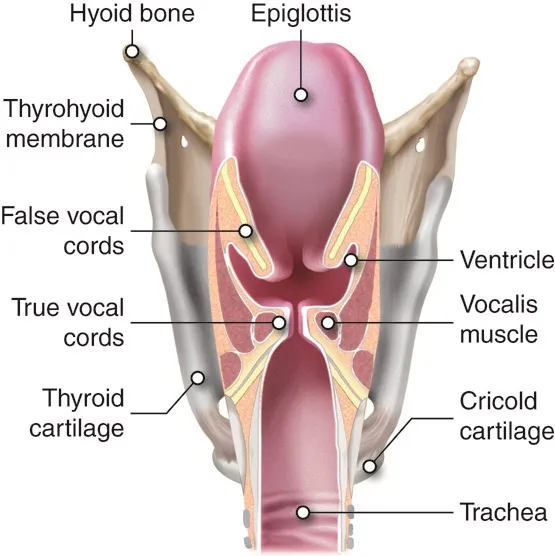
Laryngospasm is a sustained, reflex closure of the glottis that persists after the triggering stimulus has gone. Afferent signals in the superior laryngeal nerve drive adduction of the true and false vocal cords, so the airway closes and oxygenation fails. It typically occurs during light anaesthesia (induction, emergence or extubation in the excitement stage) when blood, secretions, airway instrumentation or surgical stimulation irritate the larynx. Children, especially infants and those with recent upper respiratory tract infection, airway surgery or passive smoking exposure, are at highest risk. Partial spasm causes high-pitched stridor; complete spasm is silent, with paradoxical chest movement and no capnography trace. Management is a drill: call for help, stop stimulation, 100% oxygen with tight facemask CPAP and jaw thrust (with pressure in the laryngospasm notch), deepen anaesthesia with propofol, and give suxamethonium if hypoxaemia persists, with atropine for bradycardia in children. Negative-pressure pulmonary oedema and aspiration are important complications.
Patient case, mechanism, investigations, management, flashcards and exam-style questions.Open the lesson →
Key facts
- Reflex glottic closure mediated by the superior laryngeal nerve (afferent) and adductor muscles via the recurrent laryngeal nerve
- Incidence about 8.7 per 1000 anaesthetics overall in a large Swedish cohort, roughly twice that in children under 10, highest in infants, and much higher in airway surgery such as tonsillectomy
- Triggers: light anaesthesia, secretions or blood on the cords, airway manipulation, irritant volatile agents, painful surgical stimuli
- Complete laryngospasm is silent: no breath sounds, no CO2 trace, paradoxical chest–abdominal movement
- Drill: 100% O2 + CPAP via tight facemask + jaw thrust/laryngospasm notch pressure, then propofol 0.5–1 mg/kg IV (teaching dose; check local protocol)
- If SpO2 keeps falling: suxamethonium IV (small doses about 0.1–0.5 mg/kg relax the cords; 1–2 mg/kg to intubate) or 4 mg/kg IM in a child without IV access (teaching doses)
- Bradycardia in a child signals hypoxia: give atropine 20 micrograms/kg and oxygenate
- Negative-pressure pulmonary oedema can follow forceful inspiration against a closed glottis
Differential diagnosis
| Condition | Clues | Key test |
|---|---|---|
| Bronchospasm | Expiratory wheeze, high airway pressure, sloping capnograph with some CO2 | Auscultation; capnography shape |
| Soft-tissue upper airway obstruction | Snoring, relieved by jaw thrust or oropharyngeal airway | Response to airway manoeuvres |
| Foreign body or retained throat pack | Sudden obstruction after ENT/dental procedure | Laryngoscopy; pack count |
| Opioid-induced chest wall rigidity | Rigid chest after rapid high-dose opioid | Responds to neuromuscular block or naloxone |
| Anaphylaxis with laryngeal oedema | Rash, hypotension, swelling after drug | Clinical; tryptase |
| Vocal cord dysfunction (non-anaesthetic) | Episodic inspiratory stridor in an awake patient, often anxiety | Laryngoscopy during symptoms |
| Equipment failure | Cannot ventilate | Switch to self-inflating bag |
Exam pearls
Guideline
Laryngospasm management: crisis algorithms (Australian Incident Monitoring Study/COVER ABCD sub-algorithm) and paediatric anaesthesia guidance; DAS extubation 2012
References
- Gavel G, Walker RWM. Laryngospasm in anaesthesia. Contin Educ Anaesth Crit Care Pain 2014.
- Visvanathan T, Kluger MT, Webb RK, Westhorpe RN. Crisis management during anaesthesia: laryngospasm. Qual Saf Health Care 2005.
- Olsson GL, Hallén B. Laryngospasm during anaesthesia. A computer-aided incidence study in 136,929 patients. Acta Anaesthesiol Scand 1984.
- von Ungern-Sternberg BS, Boda K, Chambers NA, et al.. Risk assessment for respiratory complications in paediatric anaesthesia: a prospective cohort study. Lancet 2010.
- Hampson-Evans D, Morgan P, Farrar M. Pediatric laryngospasm. Paediatr Anaesth 2008.
- Popat M, Mitchell V, Dravid R, et al.. Difficult Airway Society Guidelines for the management of tracheal extubation. Anaesthesia 2012.
Related topics
By Dr Khalid Seidi (B.Sc., M.D.) · MedEd World Clinical Knowledge library. Original teaching content checked against current guidelines (November 2026); confirm the latest local guidance before clinical use. Not a substitute for clinical judgement.