Clinical Knowledge › Anaesthesiology › Airway management
Supraglottic airway devices
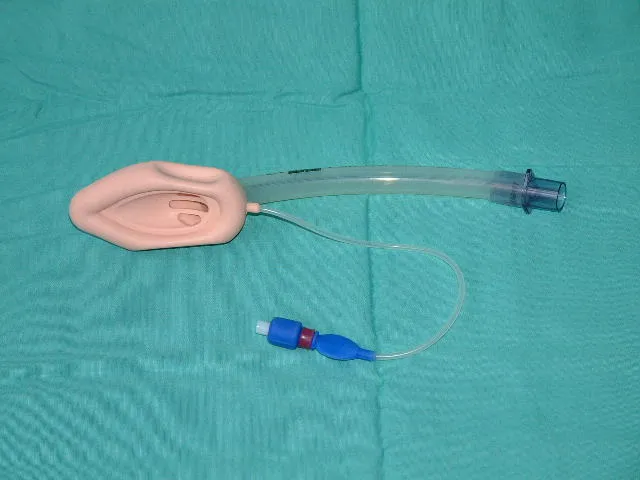
Supraglottic airway devices (SADs) sit in the hypopharynx above the glottis, forming a seal around the laryngeal inlet so that a patient can breathe spontaneously or be ventilated without tracheal intubation. Since Archie Brain's laryngeal mask (1983), SADs have become the commonest airway in elective anaesthesia. First-generation devices (classic LMA) have a low seal pressure of about 18–20 cmH2O; second-generation devices (i-gel, LMA ProSeal, LMA Supreme, Protector, AuraGain) add a gastric drain channel, a higher seal and often a bite block, giving better protection against gastric insufflation and aspiration. SADs are used for short elective procedures, as Plan B rescue after failed intubation in the DAS algorithms, as conduits for fibreoptic intubation and in cardiac arrest. Correct sizing, adequate anaesthetic depth, capnography, cuff pressure below 60 cmH2O and leak tests confirm placement. They do not reliably protect against aspiration: NAP4 found aspiration was the leading cause of SAD-related harm, usually from poor patient selection.
Patient case, mechanism, investigations, management, flashcards and exam-style questions.Open the lesson →
Key facts
- SAD = airway placed above the glottis; avoids laryngoscopy and neuromuscular blockade; less sore throat and haemodynamic response than tracheal intubation
- First generation (e.g. LMA Classic): airway tube only; oropharyngeal leak pressure about 18–20 cmH2O
- Second generation (i-gel, ProSeal, Supreme, Protector, AuraGain): gastric drain channel, higher leak pressure (about 25–30+ cmH2O), bite block; preferred for rescue and higher-risk use (DAS)
- Sizing by weight: LMA size 3 for 30–50 kg, 4 for 50–70 kg, 5 for 70–100 kg; i-gel size 3 for 30–60 kg, 4 for 50–90 kg, 5 above 90 kg
- Inflate cuffed devices to an intracuff pressure of no more than 60 cmH2O measured with a manometer; nitrous oxide diffuses into silicone cuffs and raises pressure
- Confirm placement: square capnography trace, chest movement, no audible leak at moderate airway pressure, gastric drain patency (gel or suprasternal notch test)
- Relative contraindications: high aspiration risk, need for high airway pressures, limited mouth opening, pharyngeal or glottic pathology
- DAS 2015 and 2025: after failed intubation, insert a second-generation SAD (Plan B); limit attempts and declare failure early; AIRWAYS-2: i-gel non-inferior to intubation for outcome in out-of-hospital cardiac arrest
Differential diagnosis
| Condition | Clues | Key test |
|---|---|---|
| Malposition with epiglottic downfolding | Partial obstruction, poor capnography trace, high airway pressure | Reposition (up-down manoeuvre) or reinsert; fibreoptic check |
| Laryngospasm | Stridor or silent obstruction during light anaesthesia | Deepen anaesthesia, CPAP; suxamethonium if severe |
| Bronchospasm | Expiratory wheeze, sloping capnograph, high airway pressure | Auscultation; capnography shape |
| Gastric insufflation | Gurgling in epigastrium, leak at low pressure | Gastric drain test; lower inspiratory pressure |
| Pulmonary aspiration | Fluid in drain tube or airway, hypoxia, wheeze | Suction, airway inspection; chest X-ray |
| Inadequate depth (coughing, biting) | Coughing, gagging, bite occlusion | Clinical; deepen anaesthesia |
| Device too small or too large | Leak at low pressure or obstruction | Change size |
Exam pearls
Guideline
Difficult Airway Society 2025 guidelines for unanticipated difficult tracheal intubation in adults (with DAS 2015, OAA/DAS 2015 obstetric and ASA 2022 difficult airway guidelines)
References
- Ahmad I, El-Boghdadly K, Iliff H, et al.. Difficult Airway Society 2025 guidelines for management of unanticipated difficult tracheal intubation in adults. Br J Anaesth 2026.
- Frerk C, Mitchell VS, McNarry AF, et al.. Difficult Airway Society 2015 guidelines for management of unanticipated difficult intubation in adults. Br J Anaesth 2015.
- Apfelbaum JL, Hagberg CA, Connis RT, et al.. 2022 American Society of Anesthesiologists practice guidelines for management of the difficult airway. Anesthesiology 2022.
- Mushambi MC, Kinsella SM, Popat M, et al.. Obstetric Anaesthetists' Association and Difficult Airway Society guidelines for the management of difficult and failed tracheal intubation in obstetrics. Anaesthesia 2015.
- European Resuscitation Council / Resuscitation Council UK. Resuscitation guidelines 2025: adult advanced life support and newborn life support. ERC/RCUK 2025.
- Cook TM, Woodall N, Frerk C; Fourth National Audit Project.. Major complications of airway management in the UK: results of the Fourth National Audit Project of the Royal College of Anaesthetists and the Difficult Airway Society. Part 1: anaesthesia. Br J Anaesth 2011.
Related topics
By Dr Khalid Seidi (B.Sc., M.D.) · MedEd World Clinical Knowledge library. Original teaching content checked against current guidelines (November 2026); confirm the latest local guidance before clinical use. Not a substitute for clinical judgement.