Clinical Knowledge › Ear, nose and throat › Oral cavity and pharynx
Ludwig angina
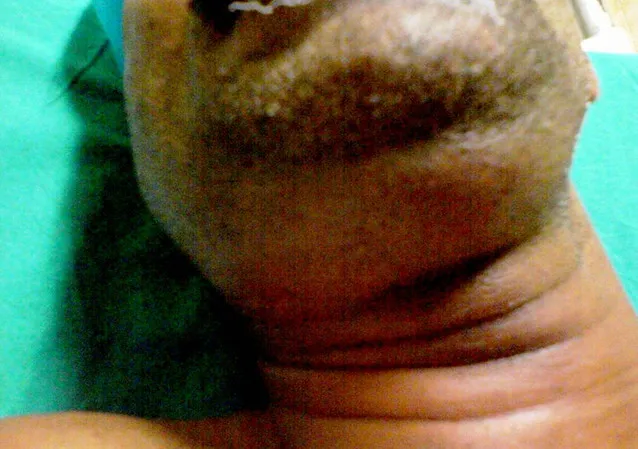
Ludwig angina is a rapidly spreading, bilateral cellulitis of the submandibular space (sublingual and submylohyoid compartments, divided by the mylohyoid muscle) and the submental space. Most cases come from an infected lower second or third molar, whose roots lie below the mylohyoid line. The infection is polymicrobial (oral streptococci, especially the Streptococcus anginosus group, and anaerobes) and spreads along fascial planes rather than lymphatics. The floor of the mouth becomes hard and raised, pushing the tongue up and back; the neck is board-like. Trismus, drooling, odynophagia and a muffled voice are typical; stridor is a late, ominous sign. Diagnosis is clinical and the airway comes first: senior anaesthetic and ENT teams secure it in theatre, usually by awake fibreoptic intubation with surgical backup, before contrast CT. Treatment is IV antibiotics, drainage of collections and removal of the dental source. Untreated, it causes asphyxia, mediastinitis and sepsis.
Patient case, mechanism, investigations, management, flashcards and exam-style questions.Open the lesson →
Key facts
- Bilateral cellulitis of the sublingual, submylohyoid (submandibular) and submental spaces; typically brawny induration without a discrete early abscess
- Odontogenic in about 70–90%: infected lower second or third molar whose roots lie below the mylohyoid line
- Polymicrobial: viridans and Streptococcus anginosus group, oral anaerobes (Prevotella, Fusobacterium, Peptostreptococcus), sometimes Staphylococcus aureus
- Classic signs: raised, hard floor of mouth, tongue pushed up and back, woody bilateral neck swelling, trismus, drooling, 'hot potato' voice
- Airway first: do not lie the patient flat, avoid sedation and avoid a standard rapid-sequence induction; awake fibreoptic intubation or awake tracheostomy with front-of-neck access ready
- Contrast CT of the neck (and chest if mediastinitis is suspected) only after the airway is safe or judged stable
- Empirical IV therapy, for example co-amoxiclav or ampicillin–sulbactam, or benzylpenicillin plus metronidazole; broaden (piperacillin–tazobactam ± MRSA cover) if immunocompromised (teaching dose; check local formulary)
- Mortality was above 50% before antibiotics and is now generally below 10%, mainly from airway loss and mediastinitis
Differential diagnosis
| Condition | Clues | Key test |
|---|---|---|
| Submandibular (dental) abscess, unilateral | One-sided fluctuant swelling, floor of mouth not raised, tongue normal | CT neck: localised rim-enhancing collection |
| Retropharyngeal or parapharyngeal abscess | Neck stiffness, torticollis, medial bulge of the lateral pharyngeal wall, little floor-of-mouth swelling | Contrast CT neck |
| Peritonsillar abscess (quinsy) | Unilateral tonsil swelling, uvula deviated, trismus | Oral examination; needle aspiration |
| Angio-oedema | Soft, non-tender swelling of lips and tongue, no fever, ACE inhibitor or allergy history | Clinical; C4 and C1-inhibitor if recurrent |
| Acute submandibular sialadenitis or obstructed stone | Swelling of one gland, pain with meals, pus at Wharton duct | Ultrasound; bimanual palpation |
| Epiglottitis or supraglottitis | Severe sore throat, drooling, normal floor of mouth | Flexible nasendoscopy in a controlled setting |
| Necrotising fasciitis of the neck | Rapid spread, skin discolouration, crepitus, pain out of proportion | CT with gas along fascial planes; surgical exploration |
Exam pearls
Guideline
Difficult Airway Society guidelines for awake tracheal intubation in adults (2020) applied to deep neck infection; evidence-based emergency review of Ludwig angina (2021); local antimicrobial guidance
References
- Bridwell R, Gottlieb M, Koyfman A, Long B. Diagnosis and management of Ludwig's angina: an evidence-based review. Am J Emerg Med 2021.
- Ahmad I, El-Boghdadly K, Bhagrath R, et al.. Difficult Airway Society guidelines for awake tracheal intubation (ATI) in adults. Anaesthesia 2020.
- Tami A, Othman S, Sudhakar A, McKinnon BJ. Ludwig's angina and steroid use: a narrative review. Am J Otolaryngol 2020.
- Saifeldeen K, Evans R. Ludwig's angina. Emerg Med J 2004.
- Parmar BD, Joshi KJ, Modi AD, Dave GP. Management of Ludwig's angina at a tertiary care hospital in western region of India. Cureus 2022.
- Papadakis MA, Rabow MW, McQuaid KR, eds.. CURRENT Medical Diagnosis & Treatment 2026 (chapter: Ear, nose, and throat disorders). McGraw Hill 2026.
Related topics
By Dr Khalid Seidi (B.Sc., M.D.) · MedEd World Clinical Knowledge library. Original teaching content checked against current guidelines (November 2026); confirm the latest local guidance before clinical use. Not a substitute for clinical judgement.