Clinical Knowledge › Ear, nose and throat › Oral cavity and pharynx
Retropharyngeal and parapharyngeal abscess
Retropharyngeal and parapharyngeal abscesses are deep neck space infections that can obstruct the airway and spread to the mediastinum and great vessels. Retropharyngeal abscess mainly affects children under 5, in whom suppuration of retropharyngeal lymph nodes follows an upper respiratory infection; in adults it usually follows pharyngeal trauma, a foreign body or instrumentation. Parapharyngeal abscess complicates tonsillitis, peritonsillar abscess, dental or salivary infection and affects older children and adults. Features are fever, odynophagia, drooling, painful reduced neck extension or torticollis, trismus (parapharyngeal), a bulging pharyngeal wall and, late, stridor. Contrast CT confirms the collection. Management begins with the airway, then intravenous antibiotics against streptococci, Staphylococcus aureus and anaerobes. Small abscesses in stable children may respond to antibiotics alone; larger or non-responding collections need transoral or transcervical drainage. Complications include mediastinitis, internal jugular thrombophlebitis (Lemierre syndrome), carotid erosion and sepsis.
Patient case, mechanism, investigations, management, flashcards and exam-style questions.Open the lesson →
Key facts
- The retropharyngeal space lies between the buccopharyngeal (visceral) fascia and the alar fascia, from the skull base to about T1–T2; the danger space behind it extends to the diaphragm
- Retropharyngeal lymph nodes involute by about 5 years, so retropharyngeal abscess is mainly a disease of young children
- Hallmarks in children: fever, neck pain, reduced neck extension or torticollis, drooling, dysphagia; stridor is uncommon and late
- Parapharyngeal abscess: trismus, swelling below the angle of the mandible, medial displacement of the tonsil and lateral pharyngeal wall
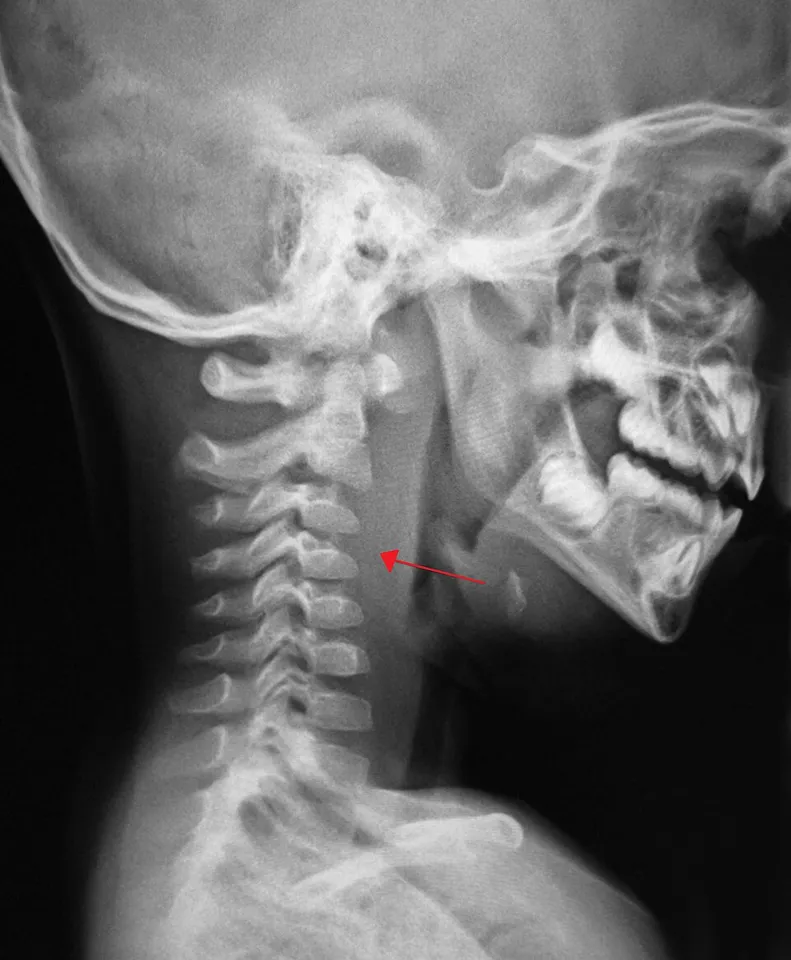
- Lateral neck X-ray: prevertebral soft tissue wider than about 7 mm at C2 (or wider than the vertebral body in young children) suggests retropharyngeal swelling
- Contrast CT of the neck is the investigation of choice; it distinguishes abscess from cellulitis and shows extension
- Infections are polymicrobial: Streptococcus pyogenes, Staphylococcus aureus (including MRSA), anaerobes and Haemophilus
- Airway first: involve senior anaesthesia and ENT early; avoid lying the patient flat or upsetting a child
Differential diagnosis
| Condition | Clues | Key test |
|---|---|---|
| Peritonsillar abscess (quinsy) | Unilateral peritonsillar bulge, uvula deviated away, trismus, adolescent or adult | Clinical; aspiration |
| Epiglottitis | Sudden toxic illness, drooling, tripod posture, stridor, no neck stiffness | Laryngoscopy in theatre; lateral X-ray thumb sign |
| Bacterial meningitis | Neck stiffness in flexion, photophobia, altered consciousness | Lumbar puncture when safe, blood cultures |
| Ludwig angina | Bilateral submandibular woody swelling, raised floor of mouth, dental source | Contrast CT |
| Acute calcific tendinitis of longus colli | Adult, neck pain and odynophagia, afebrile, prevertebral fluid without enhancing rim | CT: calcification anterior to C1–C2 |
| Retropharyngeal cellulitis or suppurative lymphadenitis | Similar symptoms without a rim-enhancing collection | Contrast CT |
| Croup | Barking cough, inspiratory stridor, well child, no neck stiffness | Clinical |
| Tuberculous (cold) abscess | Chronic, low-grade fever, cervical spine involvement | CT or MRI spine; culture, PCR |
Exam pearls
Guideline
No dedicated international guideline; management follows cohort evidence (paediatric retropharyngeal abscess 2003; deep neck infection series 2023–2025), a 2026 meta-analysis on adjuvant corticosteroids and Difficult Airway Society awake tracheal intubation guidance (2020)
References
- Craig FW, Schunk JE. Retropharyngeal abscess in children: clinical presentation, utility of imaging, and current management. Pediatrics 2003.
- Ho E, Fuzi J, Popovic G, Soma M. The impact of corticosteroid therapy on clinical outcomes in paediatric deep neck space infections: a meta-analysis. Int J Pediatr Otorhinolaryngol 2026.
- Sellami M, Kharrat I, Kharrat O, et al.. Acute retropharyngeal and parapharyngeal abscesses: a case series. Ear Nose Throat J 2025.
- Wang X, Chen Y, Jia D, Teng Y, Pan H. The role of adjuvant systemic corticosteroid in pediatric retropharyngeal and parapharyngeal abscess. Am J Otolaryngol 2024.
- Glavan M, Dreu L, Lanišnik B. Parapharyngeal and retropharyngeal abscesses in children: a report of eight cases. Children (Basel) 2025.
- Ahmad I, El-Boghdadly K, Bhagrath R, et al.. Difficult Airway Society guidelines for awake tracheal intubation (ATI) in adults. Anaesthesia 2020.
Related topics
By Dr Khalid Seidi (B.Sc., M.D.) · MedEd World Clinical Knowledge library. Original teaching content checked against current guidelines (November 2026); confirm the latest local guidance before clinical use. Not a substitute for clinical judgement.