Clinical Knowledge › Ear, nose and throat › Oral cavity and pharynx
Oral ulceration
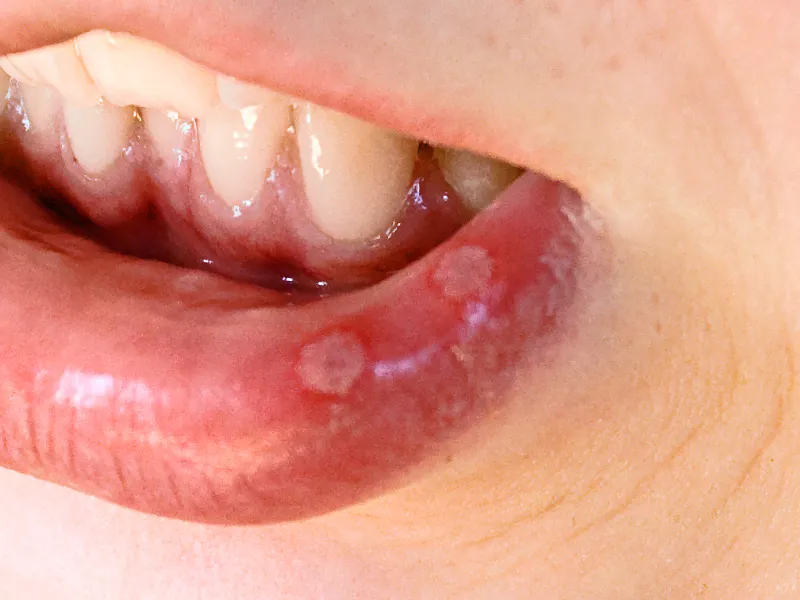
An oral ulcer is a breach of the full thickness of the oral epithelium. Most ulcers are traumatic or recurrent aphthous stomatitis. Aphthae are shallow, round, painful ulcers with a yellow-grey base and red halo on non-keratinised mucosa; they begin in childhood or adolescence and recur. Minor aphthae (under 1 cm) heal in 1–2 weeks without scarring; major aphthae are larger, deeper and scar; herpetiform ulcers are multiple and pinpoint. The key question is whether an ulcer is single and persistent, recurrent, or part of multiple acute ulceration. Infection (primary herpetic gingivostomatitis, hand, foot and mouth disease, syphilis, HIV), systemic disease (Behçet disease, Crohn and coeliac disease, iron, B12 or folate deficiency, neutropenia), mucocutaneous disease (lichen planus, pemphigus, pemphigoid, erythema multiforme) and drugs (nicorandil, NSAIDs, methotrexate, chemotherapy) must be considered. Any unexplained ulcer lasting more than 3 weeks needs urgent referral to exclude squamous cell carcinoma.
Patient case, mechanism, investigations, management, flashcards and exam-style questions.Open the lesson →
Key facts
- Commonest causes: trauma (dentures, sharp teeth, biting, burns) and recurrent aphthous stomatitis (about 1 in 5 people at some time)
- Minor aphthae: under 1 cm, non-keratinised mucosa, heal in 7–14 days without scarring; major: over 1 cm, weeks, scarring; herpetiform: dozens of 1–3 mm ulcers
- A single ulcer persisting over 3 weeks, especially indurated with rolled edges on the lateral tongue or floor of mouth, must be referred urgently for biopsy
- Screen recurrent or severe ulcers with full blood count, ferritin, B12, folate and coeliac serology; consider HIV, inflammatory bowel disease and Behçet disease
- Behçet disease (ICBD): oral aphthae, genital ulcers and eye lesions score 2 points each; 4 or more points classifies; HLA-B51; pathergy
- Primary herpetic gingivostomatitis: febrile child with swollen bleeding gums and many vesicles; aciclovir if seen early or severe, plus fluids
- Topical corticosteroids (e.g. betamethasone soluble tablet mouthwash or hydrocortisone mucoadhesive tablets) are the mainstay for aphthae (teaching dose; check local formulary)
- Drug causes: nicorandil (large painful ulcers), NSAIDs, methotrexate, beta-blockers, chemotherapy mucositis, alendronate
Differential diagnosis
| Condition | Clues | Key test |
|---|---|---|
| Oral squamous cell carcinoma | Single painless or painful indurated ulcer over 3 weeks, rolled edges, lateral tongue or floor of mouth, tobacco or betel use | Urgent biopsy |
| Traumatic ulcer | Adjacent sharp tooth, denture or bite; heals within 2 weeks of removing the cause | Review after removing cause; biopsy if not healed |
| Recurrent aphthous stomatitis | Recurrent round ulcers on non-keratinised mucosa since youth, heal without scar | Clinical; haematinics and coeliac serology if severe |
| Behçet disease | Oral plus genital ulcers, uveitis, skin lesions, Mediterranean, Middle Eastern or East Asian origin | ICBD criteria; pathergy test; HLA-B51; ophthalmology review |
| Primary herpetic gingivostomatitis | Febrile young child, gingivitis, multiple vesicles on keratinised and non-keratinised mucosa | Clinical; HSV PCR swab |
| Pemphigus vulgaris or mucous membrane pemphigoid | Persistent erosions, positive Nikolsky sign, skin or eye involvement | Perilesional biopsy with direct immunofluorescence; serum antibodies |
| Erosive lichen planus | White lacy striae around erosions, bilateral buccal mucosa | Biopsy |
| Syphilis or HIV-related ulceration | Painless chancre, snail-track ulcers, risk history | Syphilis serology; HIV test |
Exam pearls
Guideline
NICE NG12 Suspected cancer: recognition and referral (2015, updated), International Criteria for Behçet's Disease (2014) and current oral medicine practice for aphthous stomatitis
References
- Scully C, Porter S. Oral mucosal disease: recurrent aphthous stomatitis. Br J Oral Maxillofac Surg 2008.
- Edgar NR, Saleh D, Miller RA. Recurrent aphthous stomatitis: a review. J Clin Aesthet Dermatol 2017.
- International Team for the Revision of the International Criteria for Behçet's Disease (ITR-ICBD). The International Criteria for Behçet's Disease (ICBD): a collaborative study of 27 countries on the sensitivity and specificity of the new criteria. J Eur Acad Dermatol Venereol 2014.
- National Institute for Health and Care Excellence. Suspected cancer: recognition and referral (NG12) – head and neck cancers section. NICE, London 2015.
- Warnakulasuriya S, Kujan O, Aguirre-Urizar JM, et al.. Oral potentially malignant disorders: a consensus report from an international seminar on nomenclature and classification, convened by the WHO Collaborating Centre for Oral Cancer. Oral Dis 2021.
- Papadakis MA, Rabow MW, McQuaid KR, eds.. CURRENT Medical Diagnosis & Treatment 2026 (chapter: Ear, nose, and throat disorders). McGraw Hill 2026.
Related topics
By Dr Khalid Seidi (B.Sc., M.D.) · MedEd World Clinical Knowledge library. Original teaching content checked against current guidelines (November 2026); confirm the latest local guidance before clinical use. Not a substitute for clinical judgement.