Clinical Knowledge › Ear, nose and throat › Oral cavity and pharynx
Pharyngeal pouch (Zenker diverticulum)
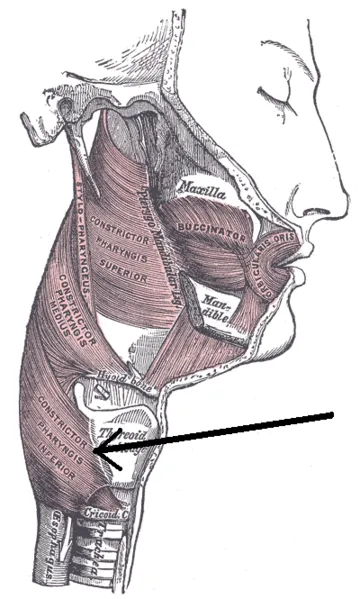
A pharyngeal pouch (Zenker diverticulum) is an acquired pulsion diverticulum of mucosa and submucosa that herniates backwards through Killian dehiscence, a weak triangle between the thyropharyngeus and cricopharyngeus parts of the inferior constrictor. A poorly compliant cricopharyngeus that does not open fully raises pressure in the hypopharynx during swallowing. It mainly affects people over 60 and is commoner in men. Symptoms are progressive high dysphagia, regurgitation of undigested food hours after eating, halitosis, gurgling in the neck, nocturnal cough, weight loss and aspiration pneumonia. A contrast swallow is the first test; endoscopy must be done carefully because the scope can enter and perforate the pouch. Asymptomatic small pouches can be observed. Symptomatic pouches need division of the cricopharyngeus: endoscopic stapling, flexible endoscopic septotomy, Z-POEM, or open myotomy with diverticulectomy or diverticulopexy. Carcinoma within a pouch is rare but should be considered when symptoms change.
Patient case, mechanism, investigations, management, flashcards and exam-style questions.Open the lesson →
Key facts
- Posterior midline pulsion diverticulum through Killian dehiscence, between thyropharyngeus (oblique fibres) and cricopharyngeus (horizontal fibres)
- False diverticulum: mucosa and submucosa only, without a full muscular wall
- Underlying problem: reduced compliance and incomplete opening of the upper oesophageal sphincter (cricopharyngeus)
- Typically men over 60; prevalence roughly 0.01–0.1% in swallow studies
- Classic triad: high dysphagia, regurgitation of undigested food, halitosis; plus gurgling, nocturnal cough and aspiration
- First-line test: contrast swallow (barium or water-soluble videofluoroscopy); blind endoscopy or NG tube insertion risks perforation
- Treatment must divide the cricopharyngeus: rigid endoscopic stapling, flexible septotomy, Z-POEM, or open myotomy with diverticulectomy or pexy
- Squamous cell carcinoma arises rarely (reported in roughly 0.3–1.5% of pouches); suspect it with bleeding, pain or rapid change in symptoms
Differential diagnosis
| Condition | Clues | Key test |
|---|---|---|
| Oesophageal or hypopharyngeal carcinoma | Progressive dysphagia to solids, weight loss, smoking, alcohol, otalgia | Endoscopy with biopsy; CT |
| Achalasia | Dysphagia to solids and liquids, regurgitation, chest pain, dilated oesophagus | High-resolution manometry; barium 'bird's beak' |
| Cricopharyngeal bar without pouch | High dysphagia, posterior indentation on swallow | Videofluoroscopy |
| Killian–Jamieson diverticulum | Lateral pouch below the cricopharyngeus, often smaller | Contrast swallow (AP view) |
| Oropharyngeal dysphagia from stroke or neuromuscular disease | Coughing on swallowing, dysarthria, other neurological signs | Neurological examination; videofluoroscopy; MRI brain |
| Globus pharyngeus | Lump sensation between meals, no true dysphagia or regurgitation | Normal examination and nasendoscopy |
| Eosinophilic oesophagitis | Young man, atopy, food bolus obstruction | Endoscopy with biopsies |
Exam pearls
Guideline
ESGE Guideline: endoscopic management of gastrointestinal motility disorders – part 2 (2020), with meta-analyses of Z-POEM versus flexible septotomy (2024–2025)
References
- Weusten BLAM, Barret M, Bredenoord AJ, et al.. Endoscopic management of gastrointestinal motility disorders – part 2: ESGE Guideline. Endoscopy 2020.
- Delgado LM, Meine GC, Santo P, et al.. Endoscopic submucosal tunneling techniques versus flexible endoscopic septotomy for Zenker's diverticulum: a systematic review and meta-analysis. Gastrointest Endosc 2025.
- Singh S, Chandan S, Bapaye J, et al.. Peroral endoscopic myotomy (Z-POEM) versus flexible endoscopic septotomy (FES) for treatment of Zenker's diverticulum: does either make the cut? A systematic review and meta-analysis of outcomes. Ann Gastroenterol 2025.
- Zhang H, Huang S, Xia H, et al.. The role of peroral endoscopic myotomy for Zenker's diverticulum: a systematic review and meta-analysis. Surg Endosc 2022.
- Bizzotto A, Iacopini F, Landi R, Costamagna G. Zenker's diverticulum: exploring treatment options. Acta Otorhinolaryngol Ital 2013.
- Ramamurthy S, Ahuja P, Dahiya DS, et al.. Management strategies for Zenker's diverticulum: a comprehensive review. J Clin Med 2025.
Related topics
By Dr Khalid Seidi (B.Sc., M.D.) · MedEd World Clinical Knowledge library. Original teaching content checked against current guidelines (November 2026); confirm the latest local guidance before clinical use. Not a substitute for clinical judgement.