Clinical Knowledge › Internal medicine › Pulmonology › Interstitial lung diseases
Lymphangioleiomyomatosis
Lymphangioleiomyomatosis (LAM) is a rare, low-grade metastasising neoplasm that almost exclusively affects women. Abnormal smooth-muscle-like 'LAM cells' carrying inactivating mutations of TSC2 (or TSC1) spread through the lungs and axial lymphatics, where constitutive mTORC1 signalling drives cell growth, lymphangiogenesis and destruction of lung tissue into diffuse thin-walled cysts. It occurs sporadically or as part of tuberous sclerosis complex (TSC). The classic patient is a woman of reproductive age with exertional breathlessness, a spontaneous pneumothorax or a chylous pleural effusion, sometimes with a renal angiomyolipoma. Spirometry is obstructive and DLCO falls early. Diagnosis rests on a typical HRCT plus one confirmatory feature (TSC, angiomyolipoma, serum VEGF-D of 800 pg/mL or more, chylous effusion, lymphangioleiomyoma or cytology), with biopsy only when these are absent. The mTOR inhibitor sirolimus stabilises lung function and shrinks chylous collections; pleurodesis after the first pneumothorax and lung transplantation for end-stage disease complete care.
Patient case, mechanism, investigations, management, flashcards and exam-style questions.Open the lesson →
Key facts
- LAM affects women almost exclusively; it is sporadic or associated with tuberous sclerosis complex (TSC), where about a third of adult women have cysts
- Loss of TSC2 (or TSC1) function activates mTORC1, so LAM cells proliferate, metastasise via lymphatics and secrete VEGF-D
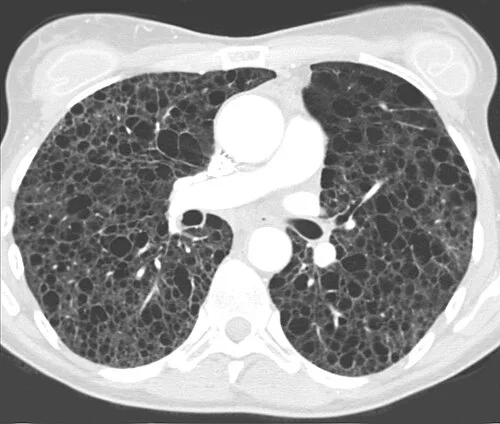
- HRCT shows diffuse, round, thin-walled cysts evenly distributed through all zones with normal intervening lung
- Recurrent pneumothorax (in up to two-thirds) and chylothorax are classic presenting complications
- Serum VEGF-D of 800 pg/mL or more with typical cysts confirms LAM without biopsy
- Spirometry is usually obstructive with a reduced DLCO, which is often the earliest abnormality
- Sirolimus (target trough 5–15 ng/mL) is recommended when FEV1 is reduced or declining and for symptomatic chylous effusions
- Avoid oestrogen-containing medicines; offer pleurodesis after the first pneumothorax; refer for transplantation in advanced disease
Differential diagnosis
| Condition | Clues | Key test |
|---|---|---|
| Pulmonary Langerhans cell histiocytosis | Smoker; bizarre-shaped upper-zone cysts and nodules sparing the costophrenic angles | HRCT pattern, smoking history, BAL CD1a cells or biopsy |
| Birt–Hogg–Dubé syndrome | Fewer lentiform cysts in basal and paramediastinal lung; fibrofolliculomas; renal tumours; family history | FLCN gene testing, skin biopsy |
| Lymphocytic interstitial pneumonia | Sjögren syndrome or HIV; few perivascular cysts with ground-glass | Anti-Ro/La, HIV test, biopsy |
| Centrilobular emphysema | Heavy smoker; low-attenuation areas without walls and with central dots | HRCT appearance, smoking history, alpha-1 antitrypsin level |
| Asthma or COPD | Obstructive spirometry, wheeze; no cysts | HRCT when DLCO is low or pneumothorax occurs |
| Primary spontaneous pneumothorax | Tall young smoker; apical blebs only | CT chest after pneumothorax in a woman to look for diffuse cysts |
| Light-chain deposition disease or amyloidosis | Cysts with nodules and calcification | Serum free light chains, biopsy with Congo red |
Exam pearls
Guideline
ATS/JRS clinical practice guidelines for LAM (2016, part 2 2017), ERS LAM guideline (2010), International TSC consensus (2021) and Brazilian Thoracic Association recommendations (2025)
References
- McCormack FX, Gupta N, Finlay GR, et al.. Official American Thoracic Society/Japanese Respiratory Society Clinical Practice Guidelines: Lymphangioleiomyomatosis Diagnosis and Management. Am J Respir Crit Care Med 2016.
- Gupta N, Finlay GA, Kotloff RM, et al.. Lymphangioleiomyomatosis Diagnosis and Management: High-Resolution Chest Computed Tomography, Transbronchial Lung Biopsy, and Pleural Disease Management. An Official American Thoracic Society/Japanese Respiratory Society Clinical Practice Guideline. Am J Respir Crit Care Med 2017.
- Johnson SR, Cordier JF, Lazor R, et al.. European Respiratory Society guidelines for the diagnosis and management of lymphangioleiomyomatosis. Eur Respir J 2010.
- McCormack FX, Inoue Y, Moss J, et al.. Efficacy and safety of sirolimus in lymphangioleiomyomatosis. N Engl J Med 2011.
- Young LR, Vandyke R, Gulleman PM, et al.. Serum vascular endothelial growth factor-D prospectively distinguishes lymphangioleiomyomatosis from other diseases. Chest 2010.
- Northrup H, Aronow ME, Bebin EM, et al.. Updated International Tuberous Sclerosis Complex Diagnostic Criteria and Surveillance and Management Recommendations. Pediatr Neurol 2021.
Related topics
By Dr Khalid Seidi (B.Sc., M.D.) · MedEd World Clinical Knowledge library. Original teaching content checked against current guidelines (November 2026); confirm the latest local guidance before clinical use. Not a substitute for clinical judgement.