Clinical Knowledge › Internal medicine › Endocrinology › Diabetes mellitus
Maturity-onset diabetes of the young (MODY)
Maturity-onset diabetes of the young (MODY) is a group of monogenic, autosomal dominant forms of diabetes caused by single-gene defects in beta-cell development or function. It accounts for about 1–3% of diabetes, yet most cases are misdiagnosed as type 1 or type 2 diabetes. Typical features are diagnosis before about 35 years, diabetes in a parent and successive generations, absent islet autoantibodies, preserved C-peptide years after diagnosis, no ketoacidosis and no marked insulin resistance. The three commonest forms behave very differently. GCK-MODY causes mild, stable fasting hyperglycaemia from birth that needs no treatment outside pregnancy. HNF1A- and HNF4A-MODY cause progressive diabetes with complications but respond exceptionally well to low-dose sulfonylureas. HNF1B-MODY combines diabetes with renal cysts, genital tract malformations and pancreatic atrophy. Diagnosis uses clinical probability tools, antibodies and C-peptide to select people for genetic testing; a confirmed diagnosis changes treatment, predicts prognosis and triggers family testing.
Patient case, mechanism, investigations, management, flashcards and exam-style questions.Open the lesson →
Key facts
- Monogenic, autosomal dominant (50% risk to each child); about 1–3% of diabetes, mostly undiagnosed
- Clues: diagnosis under 35 years, affected parent, antibody negative, C-peptide preserved over 3–5 years after diagnosis, no DKA, not obese
- GCK-MODY: fasting glucose 5.5–8 mmol/L (99–144 mg/dL), HbA1c about 38–60 mmol/mol (5.6–7.6%), small OGTT increment; no treatment outside pregnancy
- HNF1A-MODY: progressive diabetes, glycosuria at near-normal glucose (low renal threshold), very low hsCRP; highly sensitive to sulfonylureas
- HNF4A-MODY: like HNF1A plus neonatal macrosomia and transient neonatal hyperinsulinaemic hypoglycaemia
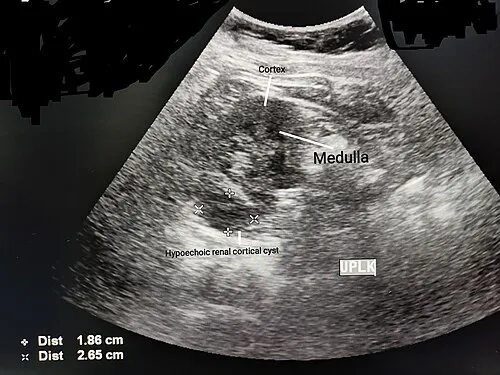
- HNF1B-MODY (renal cysts and diabetes): kidney cysts or dysplasia, genital tract anomalies, pancreatic hypoplasia, hypomagnesaemia, abnormal LFTs; often needs insulin
- Select for genetic testing with the MODY probability calculator, negative islet autoantibodies and detectable C-peptide (for example UCPCR 0.2 nmol/mmol or more)
- Diabetes diagnosed before 6 months of age is neonatal diabetes – test genetically regardless of family history (KCNJ11/ABCC8 respond to sulfonylureas)
Differential diagnosis
| Condition | Clues | Key test |
|---|---|---|
| Type 1 diabetes | Islet autoantibodies positive, rapidly falling C-peptide, DKA risk | GAD, IA-2, ZnT8 antibodies; C-peptide |
| Type 2 diabetes in young adults | Obesity, acanthosis nigricans, insulin resistance, often family history too | BMI, features of insulin resistance; MODY calculator |
| Latent autoimmune diabetes in adults | Adult onset, initially non-insulin-requiring but antibody positive | GAD antibodies |
| Neonatal diabetes | Diabetes before 6 months of age | Genetic testing (KCNJ11, ABCC8, INS) |
| Mitochondrial diabetes (MIDD) | Maternal inheritance, sensorineural deafness, short stature | m.3243A>G mutation testing |
| Gestational diabetes | Hyperglycaemia in pregnancy; resolves after birth | Postpartum OGTT; consider GCK-MODY if fasting hyperglycaemia persists |
| Secondary diabetes (cystic fibrosis, pancreatitis) | Exocrine disease, specific history | Faecal elastase, sweat test, imaging |
Exam pearls
Guideline
ISPAD Clinical Practice Consensus Guidelines 2022: monogenic diabetes in children and adolescents; ADA Standards of Care in Diabetes—2026, Section 2 Diagnosis and Classification of Diabetes; Second international consensus report on precision diabetes medicine (ADA/EASD, 2023)
References
- Greeley SAW, Polak M, Njølstad PR, et al.. ISPAD Clinical Practice Consensus Guidelines 2022: the diagnosis and management of monogenic diabetes in children and adolescents. Pediatr Diabetes 2022.
- American Diabetes Association Professional Practice Committee. 2. Diagnosis and classification of diabetes: Standards of Care in Diabetes—2026. Diabetes Care 2026.
- Tobias DK, Merino J, Ahmad A, et al.. Second international consensus report on gaps and opportunities for the clinical translation of precision diabetes medicine. Nat Med 2023.
- Shields BM, McDonald TJ, Ellard S, et al.. The development and validation of a clinical prediction model to determine the probability of MODY in patients with young-onset diabetes. Diabetologia 2012.
- Hattersley AT, Patel KA.. Precision diabetes: learning from monogenic diabetes. Diabetologia 2017.
- Melmed S, Auchus RJ, Goldfine AB, Rosen CJ, Kopp PA (eds).. Williams Textbook of Endocrinology. Elsevier 2024.
Related topics
By Dr Khalid Seidi (B.Sc., M.D.) · MedEd World Clinical Knowledge library. Original teaching content checked against current guidelines (November 2026); confirm the latest local guidance before clinical use. Not a substitute for clinical judgement.