Clinical Knowledge › Internal medicine › Gastroenterology and hepatology › Inflammatory bowel disease and colitis
Microscopic colitis
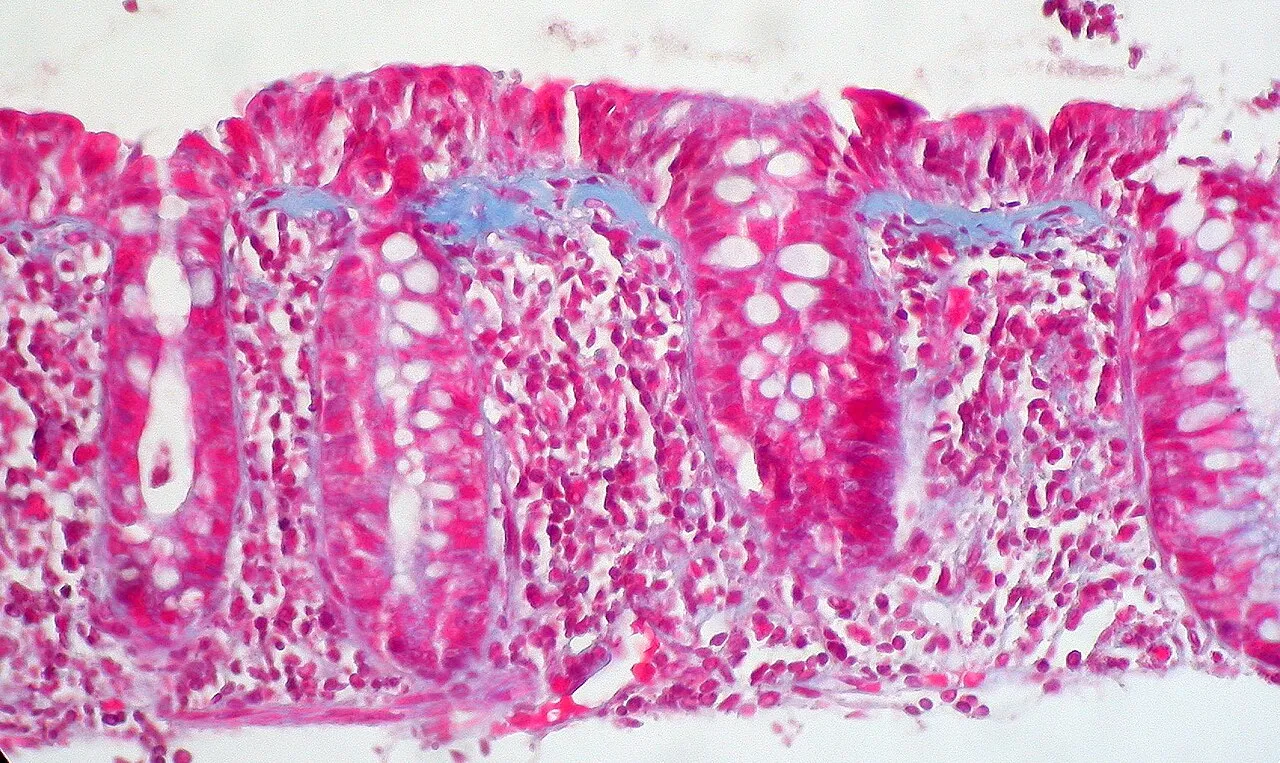
Microscopic colitis is a chronic inflammatory disease of the colon that causes watery, non-bloody diarrhoea in a colon that looks normal or nearly normal at colonoscopy. The diagnosis is made only by histology, so biopsies must be taken from both the right and the left colon in any adult investigated for chronic watery diarrhoea. There are two main subtypes: collagenous colitis, with a thickened subepithelial collagen band, and lymphocytic colitis, with an excess of intraepithelial lymphocytes. It mainly affects people over 50, especially women, and is linked to smoking, autoimmune disease (notably coeliac disease) and drugs such as NSAIDs, proton pump inhibitors and SSRIs. Patients often have urgency, nocturnal stools and faecal incontinence, which badly affect quality of life. Treatment is to stop any culprit drug and smoking and to give oral budesonide, which is the only well-proven therapy for inducing and maintaining remission. Relapse after stopping budesonide is common, but the disease does not raise colorectal cancer risk.
Patient case, mechanism, investigations, management, flashcards and exam-style questions.Open the lesson →
Key facts
- Chronic watery non-bloody diarrhoea with a normal or near-normal colonoscopy: microscopic colitis is a histological diagnosis
- Take biopsies from the right and left colon (UEG/EMCG 2021); rectal or sigmoid biopsies alone miss cases
- Collagenous colitis: subepithelial collagen band thicker than 10 µm; lymphocytic colitis: more than 20 intraepithelial lymphocytes per 100 epithelial cells
- Typical patient: woman over 50, often with autoimmune disease, smoking or culprit drugs (NSAIDs, PPIs, SSRIs, statins)
- Check coeliac serology in every patient: coeliac disease is several times more common in microscopic colitis
- Oral budesonide 9 mg daily for about 8 weeks is first-line induction (teaching dose; check local formulary); remission in roughly 80%
- Mesalazine is not effective and is not recommended; prednisolone is inferior to budesonide and has more adverse effects
- Relapse after stopping budesonide is common (more than half); low-dose budesonide maintains remission; no increased colorectal cancer risk
Differential diagnosis
| Condition | Clues | Key test |
|---|---|---|
| Irritable bowel syndrome with diarrhoea | Younger onset, pain relieved by defecation, no nocturnal stools, normal histology | Normal colonic biopsies; Rome criteria |
| Coeliac disease | Watery diarrhoea, iron or folate deficiency, may coexist with microscopic colitis | tTG-IgA with total IgA; duodenal biopsy |
| Bile acid diarrhoea | Watery diarrhoea after cholecystectomy or ileal resection; may coexist | SeHCAT retention or serum C4; trial of a bile acid sequestrant |
| Ulcerative colitis or Crohn colitis | Bloody diarrhoea, raised calprotectin and CRP, mucosal ulceration | Colonoscopy with chronic architectural changes on biopsy |
| Infective diarrhoea (Giardia, C. difficile) | Recent travel, antibiotics, hospital exposure | Stool PCR or antigen tests, C. difficile toxin |
| Colorectal cancer | Change in bowel habit, iron deficiency, weight loss, positive FIT | Colonoscopy |
| Drug-induced diarrhoea without colitis | Recent new drug (metformin, magnesium, olmesartan) with normal biopsies | Drug withdrawal; normal histology |
| Hyperthyroidism | Weight loss, tremor, frequent loose stools | TSH and free T4 |
Exam pearls
Guideline
UEG and European Microscopic Colitis Group (EMCG) European guidelines on microscopic colitis (2021) and AGA Institute guideline on medical management of microscopic colitis (2016)
References
- Miehlke S, Guagnozzi D, Zabana Y, et al.. European guidelines on microscopic colitis: United European Gastroenterology and European Microscopic Colitis Group statements and recommendations. United European Gastroenterol J 2021.
- Nguyen GC, Smalley WE, Vege SS, Carrasco-Labra A; Clinical Guidelines Committee.. American Gastroenterological Association Institute Guideline on the Medical Management of Microscopic Colitis. Gastroenterology 2016.
- Pardi DS.. Diagnosis and Management of Microscopic Colitis. Am J Gastroenterol 2017.
- Arasaradnam RP, Brown S, Forbes A, et al.. Guidelines for the investigation of chronic diarrhoea in adults: British Society of Gastroenterology, 3rd edition. Gut 2018.
- Moore M, Coleman HG, Allen PB, Loughrey MB.. Microscopic colitis in Northern Ireland: an updated clinicopathological audit and assessment of compliance with European guidelines. Colorectal Dis 2022.
- Strachan MWJ, Ralston SH, Dhaun N, Sutherland R, eds.. Davidson's Principles and Practice of Medicine. 2026.
Related topics
By Dr Khalid Seidi (B.Sc., M.D.) · MedEd World Clinical Knowledge library. Original teaching content checked against current guidelines (November 2026); confirm the latest local guidance before clinical use. Not a substitute for clinical judgement.