Clinical Knowledge › Obstetrics and gynaecology › Pelvic floor and urogynaecology
Overactive bladder and urge incontinence
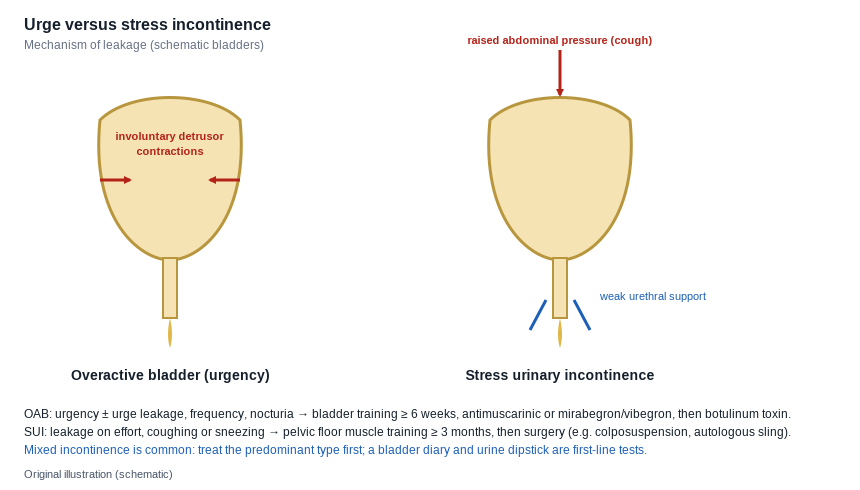
Overactive bladder (OAB) is a symptom syndrome of urinary urgency, usually with frequency and nocturia, with or without urgency incontinence, in the absence of infection or other obvious disease. It affects about 1 in 8 adults, rising with age. The usual mechanism is detrusor overactivity, idiopathic in most women but neurogenic in conditions such as multiple sclerosis or stroke. Assessment includes a bladder diary, urine dipstick, post-void residual and examination; red flags such as haematuria need referral. Urodynamics is reserved for women in whom invasive treatment is planned. First-line treatment is lifestyle advice (reducing caffeine, adjusting fluids, weight loss) and bladder training for at least 6 weeks. Drugs follow: antimuscarinics, chosen with attention to anticholinergic burden and dementia risk in older women, or beta-3 agonists (mirabegron or vibegron). Vaginal oestrogen helps postmenopausal women. Refractory OAB is treated after MDT review with intravesical botulinum toxin A, sacral or percutaneous tibial nerve stimulation and, rarely, augmentation cystoplasty.
Patient case, mechanism, investigations, management, flashcards and exam-style questions.Open the lesson →
Key facts
- OAB (ICS/IUGA): urgency, usually with frequency and nocturia, with or without urgency incontinence, without UTI or other obvious pathology
- Prevalence about 12–17% of adults, rising with age; urodynamic correlate is detrusor overactivity (idiopathic or neurogenic)
- Exclude UTI, haematuria (bladder cancer, stones), incomplete emptying, diabetes or polyuria, diuretics and genitourinary syndrome of menopause
- First line (NICE NG123): bladder training for at least 6 weeks plus lifestyle advice (reduce caffeine, modify fluid intake, weight loss)
- Antimuscarinics (oxybutynin, tolterodine, solifenacin, trospium, fesoterodine): review at 4 weeks; avoid immediate-release oxybutynin in frail older women; consider total anticholinergic burden (dementia risk)
- Beta-3 agonists: mirabegron 50 mg once daily (NICE TA290) or vibegron 75 mg once daily (NICE TA999, 2024) (teaching doses; check local formulary); check BP with mirabegron
- Refractory OAB with proven detrusor overactivity: intravesical onabotulinumtoxinA 100 units, only if willing and able to self-catheterise (retention in about 5–10%)
- Sacral nerve stimulation if botulinum toxin fails or is unsuitable; percutaneous tibial nerve stimulation in selected women after MDT review; augmentation cystoplasty rarely
Differential diagnosis
| Condition | Clues | Key test |
|---|---|---|
| Urinary tract infection | Acute onset with dysuria, cloudy or smelly urine | Dipstick and urine culture |
| Bladder cancer (including carcinoma in situ) | Haematuria, smoking history, persistent irritative symptoms | Cystoscopy, urine cytology, CT urography |
| Bladder pain syndrome (interstitial cystitis) | Pain or pressure relieved by voiding, frequency without leakage | Diagnosis of exclusion; cystoscopy |
| Incomplete emptying with overflow | Hesitancy, poor stream, high residual | Bladder scan PVR |
| Polyuria (diabetes mellitus or insipidus, diuretics, high intake) | Large voided volumes, more than about 3 L/24 h | Bladder diary; glucose; sodium and osmolality |
| Nocturnal polyuria | More than a third of 24-hour urine produced at night in an older adult | Bladder diary; consider heart failure, sleep apnoea |
| Genitourinary syndrome of menopause | Urgency with vaginal dryness and dyspareunia | Examination; trial of vaginal oestrogen |
| Neurogenic bladder (MS, stroke, Parkinson disease, spinal cord lesion) | Neurological signs or history | Neurological examination; urodynamics; MRI |
Exam pearls
Guideline
NICE NG123 Urinary incontinence and pelvic organ prolapse in women: management (2019), with NICE TA290 mirabegron (2013) and TA999 vibegron (2024); AUA/SUFU Guideline on the diagnosis and treatment of idiopathic overactive bladder (2024)
References
- National Institute for Health and Care Excellence. Urinary incontinence and pelvic organ prolapse in women: management (NG123). NICE guideline NG123 2019.
- Cameron AP, Chung DE, Dielubanza EJ, et al.. The AUA/SUFU guideline on the diagnosis and treatment of idiopathic overactive bladder. J Urol 2024.
- National Institute for Health and Care Excellence. Mirabegron for treating symptoms of overactive bladder (TA290). NICE technology appraisal guidance TA290 2013.
- National Institute for Health and Care Excellence. Vibegron for treating symptoms of overactive bladder syndrome (TA999). NICE technology appraisal guidance TA999 2024.
- Haylen BT, de Ridder D, Freeman RM, et al.. An International Urogynecological Association (IUGA)/International Continence Society (ICS) joint report on the terminology for female pelvic floor dysfunction. Neurourol Urodyn 2010.
- Coupland CAC, Hill T, Dening T, Morriss R, Moore M, Hippisley-Cox J.. Anticholinergic drug exposure and the risk of dementia: a nested case-control study. JAMA Intern Med 2019.
Related topics
By Dr Khalid Seidi (B.Sc., M.D.) · MedEd World Clinical Knowledge library. Original teaching content checked against current guidelines (November 2026); confirm the latest local guidance before clinical use. Not a substitute for clinical judgement.