Clinical Knowledge › Obstetrics and gynaecology › Pelvic floor and urogynaecology
Vesicovaginal and rectovaginal fistula
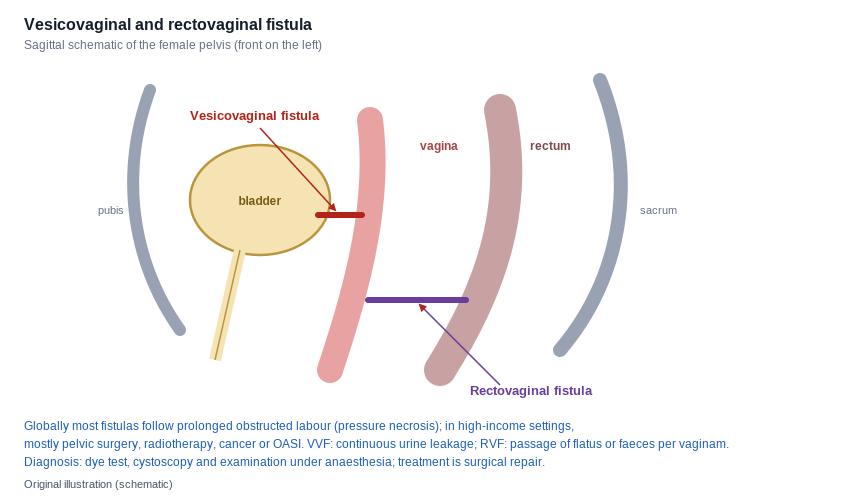
A genital tract fistula is an abnormal connection between the vagina and the urinary tract (vesicovaginal, urethrovaginal, ureterovaginal) or the bowel (rectovaginal). In low-resource settings most fistulas are obstetric: prolonged obstructed labour compresses the bladder base and rectum between the fetal head and the pelvis, and the necrotic tissue sloughs a few days after a birth that is usually a stillbirth. Estimates of the number of women living with an unrepaired obstetric fistula range from about half a million to 2 million, mainly in sub-Saharan Africa and South Asia. In high-income countries most vesicovaginal fistulas follow hysterectomy, caesarean section or pelvic radiotherapy, and rectovaginal fistulas follow obstetric anal sphincter injury, Crohn disease, radiotherapy, malignancy or rectal surgery. The hallmark of a vesicovaginal fistula is continuous painless leakage of urine; a rectovaginal fistula causes passage of flatus or faeces per vagina. Diagnosis uses speculum examination, a dye test, cystoscopy and imaging. Small fresh fistulas may close with catheter drainage; most need tension-free layered surgical repair by a trained surgeon, often with tissue interposition. Prevention through timely emergency obstetric care is the key public-health measure.
Patient case, mechanism, investigations, management, flashcards and exam-style questions.Open the lesson →
Key facts
- Obstetric fistula: prolonged obstructed labour causes pressure necrosis of the vesicovaginal or rectovaginal septum; leakage starts about 3–10 days after birth, and the baby is usually stillborn
- Global burden: estimates range from about half a million to 2 million women living with unrepaired obstetric fistula, with tens of thousands of new cases each year, mostly in sub-Saharan Africa and South Asia
- High-income settings: VVF mostly after hysterectomy (presenting about 1–3 weeks later), caesarean section and radiotherapy; RVF after OASI, Crohn disease, radiotherapy, cancer and low anterior resection
- VVF: continuous painless urinary leakage day and night; ureterovaginal fistula: continuous leakage plus normal voiding
- Dye (tampon) test: bladder instilled with methylene blue; blue staining = VVF; clear wet tampon with blue bladder suggests ureterovaginal fistula (confirm with oral phenazopyridine or CT urography)
- Small fresh obstetric or post-surgical VVF: continuous catheter drainage for several weeks may close it; otherwise layered, tension-free repair (vaginal or abdominal) with interposition flap if complex
- After simple obstetric fistula repair, 7 days of bladder catheterisation is non-inferior to 14 days (WHO-led RCT, Lancet 2015)
- Prevention: access to emergency obstetric care and caesarean, partograph use, 10–14 days of bladder catheterisation after prolonged obstructed labour, delaying first pregnancy, recognising intraoperative bladder injury
Differential diagnosis
| Condition | Clues | Key test |
|---|---|---|
| Stress urinary incontinence | Leakage only with effort; dry at rest and at night | Cough stress test; bladder diary |
| Overactive bladder | Urgency with frequent voids; leakage after urge | Bladder diary; urodynamics |
| Overflow incontinence (postoperative retention) | Dribbling with a large residual after surgery | Bladder scan PVR |
| Ureterovaginal fistula | Continuous leakage but also normal voiding; often after hysterectomy | Dye test with clear fluid; CT urography; retrograde pyelography |
| Ectopic ureter | Continuous dribbling since childhood with normal voiding | Renal imaging; MRI urography |
| Vaginal discharge or infection | Offensive discharge without urine or faeces | Microscopy; speculum; dye test negative |
| Faecal incontinence after OASI (no fistula) | Faecal leakage per anus, not per vagina | Endoanal ultrasound; examination |
| Peritoneal fluid or lymph leak after surgery | Watery vaginal discharge after hysterectomy | Creatinine of fluid similar to serum, not urine |
Exam pearls
Guideline
WHO Obstetric fistula: guiding principles for clinical management and programme development (2006); FIGO Global competency-based fistula surgery training manual (2011); ASCRS clinical practice guidelines for anorectal abscess, fistula-in-ano and rectovaginal fistula (2022); EAU Guidelines on non-neurogenic female LUTS (2025)
References
- World Health Organization. Obstetric fistula: guiding principles for clinical management and programme development. World Health Organization, Geneva 2006.
- International Federation of Gynecology and Obstetrics (FIGO) and partners. Global competency-based fistula surgery training manual. FIGO, London 2011.
- Wall LL.. Obstetric vesicovaginal fistula as an international public-health problem. Lancet 2006.
- Goh JT.. A new classification for female genital tract fistula. Aust N Z J Obstet Gynaecol 2004.
- Gaertner WB, Burgess PL, Davids JS, et al.. The American Society of Colon and Rectal Surgeons clinical practice guidelines for the management of anorectal abscess, fistula-in-ano, and rectovaginal fistula. Dis Colon Rectum 2022.
- European Association of Urology. EAU Guidelines on non-neurogenic female lower urinary tract symptoms (section on urogenital fistula). EAU Guidelines Office, Arnhem 2025.
Related topics
By Dr Khalid Seidi (B.Sc., M.D.) · MedEd World Clinical Knowledge library. Original teaching content checked against current guidelines (November 2026); confirm the latest local guidance before clinical use. Not a substitute for clinical judgement.