Clinical Knowledge › Obstetrics and gynaecology › Pelvic floor and urogynaecology
Stress urinary incontinence
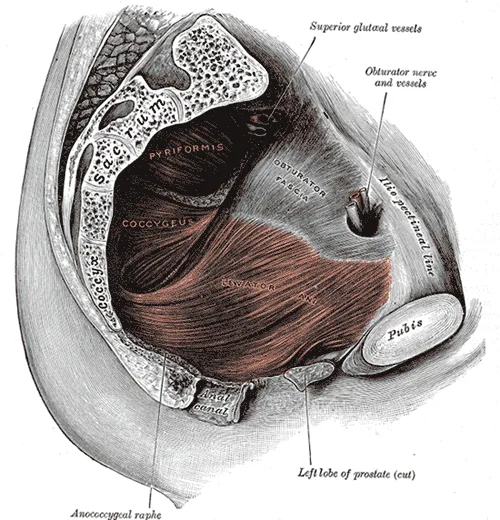
Stress urinary incontinence (SUI) is involuntary leakage of urine on effort or exertion, or on coughing or sneezing. It accounts for about half of female incontinence, alone or as part of mixed incontinence, and results from urethral hypermobility, when the pubocervical hammock and levator ani fail, and from intrinsic sphincter deficiency. The main risk factors are pregnancy and vaginal birth, obesity, ageing, menopause, chronic cough and pelvic surgery. Diagnosis rests on the history, a bladder diary of at least 3 days, urinalysis and examination with a cough stress test. Multichannel urodynamics is not needed before primary surgery when pure SUI is clear clinically. Treatment follows NICE NG123: lifestyle measures (weight loss, adjusting fluid and caffeine) and supervised pelvic floor muscle training for at least 3 months. Duloxetine is second line for women who want to avoid surgery. Surgical options are colposuspension, the autologous rectus fascial sling, the retropubic mid-urethral sling (restricted to specialist settings since the 2018 UK mesh pause) and urethral bulking agents.
Patient case, mechanism, investigations, management, flashcards and exam-style questions.Open the lesson →
Key facts
- SUI: involuntary leakage on effort, exertion, sneezing or coughing (ICS/IUGA); about 50% of female incontinence, with mixed about 30% and urgency about 15%
- Mechanisms: urethral hypermobility (loss of the pubocervical 'hammock' and levator support) and intrinsic sphincter deficiency
- Risk factors: vaginal birth and pregnancy, BMI over 30, age, menopause, chronic cough, constipation, high-impact sport, pelvic surgery or radiotherapy
- Assessment: categorise type by history; bladder diary at least 3 days; urine dipstick; PVR if voiding symptoms; vaginal examination with Modified Oxford scale; cough stress test
- Do not perform multichannel urodynamics before primary surgery if pure SUI is clearly diagnosed (VALUE trial; NICE); do it if mixed, unclear, voiding dysfunction, prolapse or previous surgery
- First line: lifestyle plus supervised pelvic floor muscle training for at least 3 months (at least 8 contractions, 3 times a day)
- Duloxetine 40 mg twice daily (teaching dose; check local formulary) is second line if surgery is declined or unsuitable; nausea is common
- Surgery: colposuspension, autologous fascial sling, retropubic mid-urethral sling (about 80–90% subjective cure), or bulking agents; NICE advises against transobturator tapes unless retropubic route unsuitable
Differential diagnosis
| Condition | Clues | Key test |
|---|---|---|
| Urgency urinary incontinence (overactive bladder) | Sudden urge then leakage, frequency, nocturia; leakage with key-in-door | Bladder diary; urodynamics shows detrusor overactivity |
| Mixed urinary incontinence | Both effort-related and urgency leakage | History and diary; treat predominant symptom first |
| Overflow incontinence (chronic retention) | Dribbling, poor stream, incomplete emptying, palpable bladder | Post-void residual by bladder scan |
| Vesicovaginal or ureterovaginal fistula | Continuous leakage day and night after surgery or obstructed labour | Speculum, dye test, cystoscopy, CT urography |
| Urinary tract infection | New frequency, dysuria and leakage | Urine dipstick and culture |
| Urethral diverticulum | Post-void dribbling, dyspareunia, tender anterior vaginal mass | MRI pelvis |
| Functional incontinence | Cognitive or mobility impairment prevents reaching the toilet | Functional and cognitive assessment |
Exam pearls
Guideline
NICE NG123 Urinary incontinence and pelvic organ prolapse in women: management (2019); AUA/SUFU Surgical treatment of female stress urinary incontinence (2017, amended 2023); EAU Guidelines on non-neurogenic female LUTS (2025)
References
- National Institute for Health and Care Excellence. Urinary incontinence and pelvic organ prolapse in women: management (NG123). NICE guideline NG123 2019.
- Kobashi KC, Vasavada S, Bloschichak A, et al.. Updates to surgical treatment of female stress urinary incontinence (SUI): AUA/SUFU guideline (2023). J Urol 2023.
- Haylen BT, de Ridder D, Freeman RM, et al.. An International Urogynecological Association (IUGA)/International Continence Society (ICS) joint report on the terminology for female pelvic floor dysfunction. Neurourol Urodyn 2010.
- European Association of Urology. EAU Guidelines on non-neurogenic female lower urinary tract symptoms. EAU Guidelines Office, Arnhem 2025.
- Nager CW, Brubaker L, Litman HJ, et al.. A randomized trial of urodynamic testing before stress-incontinence surgery. N Engl J Med 2012.
- Dumoulin C, Cacciari LP, Hay-Smith EJC.. Pelvic floor muscle training versus no treatment, or inactive control treatments, for urinary incontinence in women. Cochrane Database Syst Rev 2018.
Related topics
By Dr Khalid Seidi (B.Sc., M.D.) · MedEd World Clinical Knowledge library. Original teaching content checked against current guidelines (November 2026); confirm the latest local guidance before clinical use. Not a substitute for clinical judgement.