Clinical Knowledge › Obstetrics and gynaecology › Pelvic floor and urogynaecology
Pelvic organ prolapse
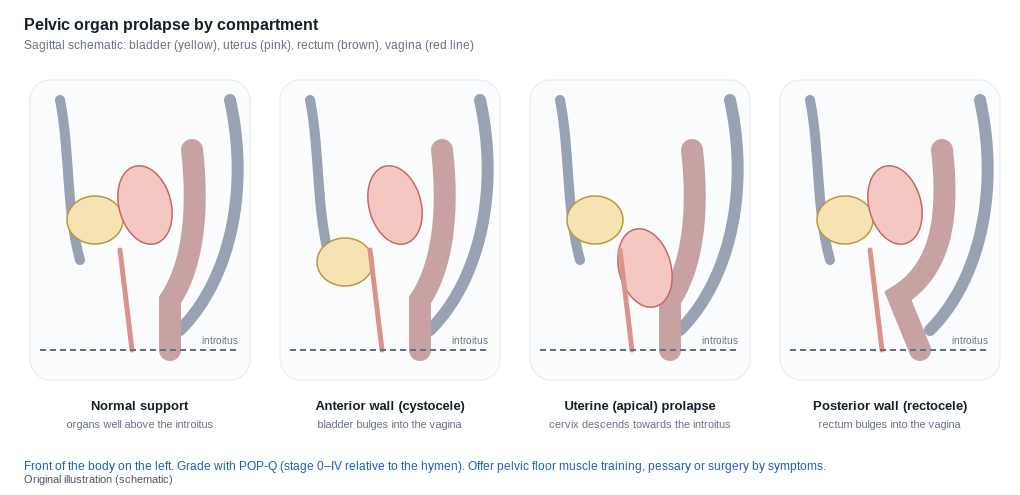
Pelvic organ prolapse (POP) is the descent of the anterior vaginal wall, posterior vaginal wall, uterus and cervix, or vaginal vault after hysterectomy. The bladder, rectum or small bowel descends with it (cystocele, rectocele, enterocele). Up to half of parous women have some descent, but few have symptoms. Risk factors are vaginal birth, ageing, menopause, obesity, chronic straining and connective tissue disorders. The typical symptom is a vaginal bulge or dragging that worsens through the day, often with urinary, bowel or sexual symptoms. Assessment is clinical, using a Sims speculum and POP-Q staging (stages 0–IV relative to the hymen), with a post-void residual and urinalysis. Asymptomatic prolapse needs no treatment. NICE NG123 recommends lifestyle advice, vaginal oestrogen for atrophy and supervised pelvic floor muscle training for at least 16 weeks, with a pessary or surgery as alternatives. Surgery is chosen by compartment: anterior or posterior repair, vaginal hysterectomy or hysteropexy, sacrospinous fixation, sacrocolpopexy or colpocleisis. Transvaginal mesh is restricted in many countries after safety concerns.
Patient case, mechanism, investigations, management, flashcards and exam-style questions.Open the lesson →
Key facts
- POP: descent of anterior wall, posterior wall, uterus/cervix or vault; symptoms matter more than anatomy
- Strongest risk factor: vaginal birth (parity, forceps, macrosomia, long second stage); also age, menopause, obesity, chronic cough, constipation, heavy lifting, connective tissue disease, previous hysterectomy
- POP-Q uses the hymen as 0: stage I leading edge more than 1 cm above; II within 1 cm above or below; III more than 1 cm below but not complete; IV complete eversion (procidentia)
- DeLancey support levels: I uterosacral–cardinal (apex), II paracolpium to arcus tendineus (mid-vagina), III perineal body (distal)
- Examine with a Sims speculum in left lateral, with Valsalva and standing if needed; check post-void residual and urinalysis; renal ultrasound for procidentia
- NICE NG123: supervised pelvic floor muscle training for at least 16 weeks for stage I–II symptomatic POP; vaginal oestrogen if atrophy; pessary as an alternative to surgery
- Pessaries (ring, ring with support, Gellhorn, shelf, cube) need review and change; neglect causes erosion, bleeding and fistula
- Transvaginal mesh for prolapse is paused or banned in several countries (UK 2018, US FDA 2019); PROSPECT showed no benefit over native tissue and 12% mesh complications
Differential diagnosis
| Condition | Clues | Key test |
|---|---|---|
| Rectal prolapse | Bulge comes through the anus with concentric mucosal folds | Examination while straining; proctoscopy |
| Urethral diverticulum | Tender anterior vaginal swelling with post-void dribbling and dyspareunia | MRI pelvis; urethroscopy |
| Vaginal or Gartner duct cyst | Smooth fixed cyst on the lateral or anterior wall that does not change with straining | Examination; ultrasound or MRI |
| Cervical elongation | Long cervix reaching the introitus while the uterine fundus stays well supported | Measure points C and D on POP-Q; ultrasound |
| Uterine or cervical polyp or fibroid | Mass protruding through the cervix, often with bleeding | Speculum; ultrasound; histology |
| Vaginal or vulval tumour | Ulcerated, fixed, bleeding mass | Biopsy |
| Urethral caruncle or prolapse | Small red lesion at the meatus, not the vaginal wall | Examination |
Exam pearls
Guideline
NICE NG123 Urinary incontinence and pelvic organ prolapse in women: management (2019); ACOG/AUGS Practice Bulletin No. 214 Pelvic organ prolapse (2019); IUGA/ICS joint report on terminology for female pelvic organ prolapse (2016)
References
- National Institute for Health and Care Excellence. Urinary incontinence and pelvic organ prolapse in women: management (NG123). NICE guideline NG123 2019.
- American College of Obstetricians and Gynecologists; American Urogynecologic Society. Pelvic organ prolapse: ACOG Practice Bulletin No. 214. Obstet Gynecol 2019.
- Bump RC, Mattiasson A, Bø K, et al.. The standardization of terminology of female pelvic organ prolapse and pelvic floor dysfunction. Am J Obstet Gynecol 1996.
- Haylen BT, Maher CF, Barber MD, et al.. An International Urogynecological Association (IUGA)/International Continence Society (ICS) joint report on the terminology for female pelvic organ prolapse (POP). Int Urogynecol J 2016.
- Glazener CM, Breeman S, Elders A, et al.. Mesh, graft, or standard repair for women having primary transvaginal anterior or posterior compartment prolapse surgery: two parallel-group, multicentre, randomised, controlled trials (PROSPECT). Lancet 2017.
- Cumberlege J. First Do No Harm: the report of the Independent Medicines and Medical Devices Safety Review. Department of Health and Social Care, London 2020.
Related topics
By Dr Khalid Seidi (B.Sc., M.D.) · MedEd World Clinical Knowledge library. Original teaching content checked against current guidelines (November 2026); confirm the latest local guidance before clinical use. Not a substitute for clinical judgement.