Clinical Knowledge › Internal medicine › Rheumatology and immunology › Inflammatory arthritis and spondyloarthritis
Palindromic rheumatism
Palindromic rheumatism (PR) is a recurrent inflammatory arthritis in which sudden attacks of pain, swelling and redness affect one or a few joints or the periarticular soft tissues, peak within hours, last from hours to a few days and then disappear completely, leaving no joint damage. Attacks recur at irregular intervals in different joints. Between attacks examination, inflammatory markers and radiographs are normal. Many patients are anti-CCP or rheumatoid factor positive, and about a third to a half eventually develop rheumatoid arthritis, so PR is now seen as part of the RA continuum; a minority evolve into other connective tissue diseases or remit. Diagnosis rests on the history, ideally a clinician witnessing an attack, and on excluding crystal arthritis, infection and other episodic arthritides, which needs joint aspiration where possible. Attacks are treated with NSAIDs or short glucocorticoid courses; hydroxychloroquine reduces attack frequency and may lower progression, and seropositive patients need regular review for evolving RA so that DMARDs can start early.
Patient case, mechanism, investigations, management, flashcards and exam-style questions.Open the lesson →
Key facts
- Recurrent attacks of arthritis or periarthritis lasting hours to a few days (usually under 72 hours) with complete resolution between attacks
- Typical sites: MCP and PIP joints, wrists, knees, shoulders; finger pads and periarticular soft tissue may swell
- No radiographic damage; ESR/CRP may rise during but normalise between attacks
- Anti-CCP and/or RF positive in about half; seropositivity strongly predicts progression to RA
- About a third to a half progress to RA, a few to SLE or other CTD; a minority remit
- Guerne–Weisman criteria: ≥6 months of brief recurrent attacks, an attack seen by a physician, ≥3 joints involved over different attacks, normal radiographs, other causes excluded
- Aspirate during an attack to exclude gout, CPPD and infection
- Hydroxychloroquine reduces attack frequency and (in observational data) progression; NSAIDs or short steroids treat attacks
Differential diagnosis
| Condition | Clues | Key test |
|---|---|---|
| Gout | Older man, first MTP, attacks lasting about 1–2 weeks untreated, tophi, raised urate | Synovial fluid: negatively birefringent needle crystals |
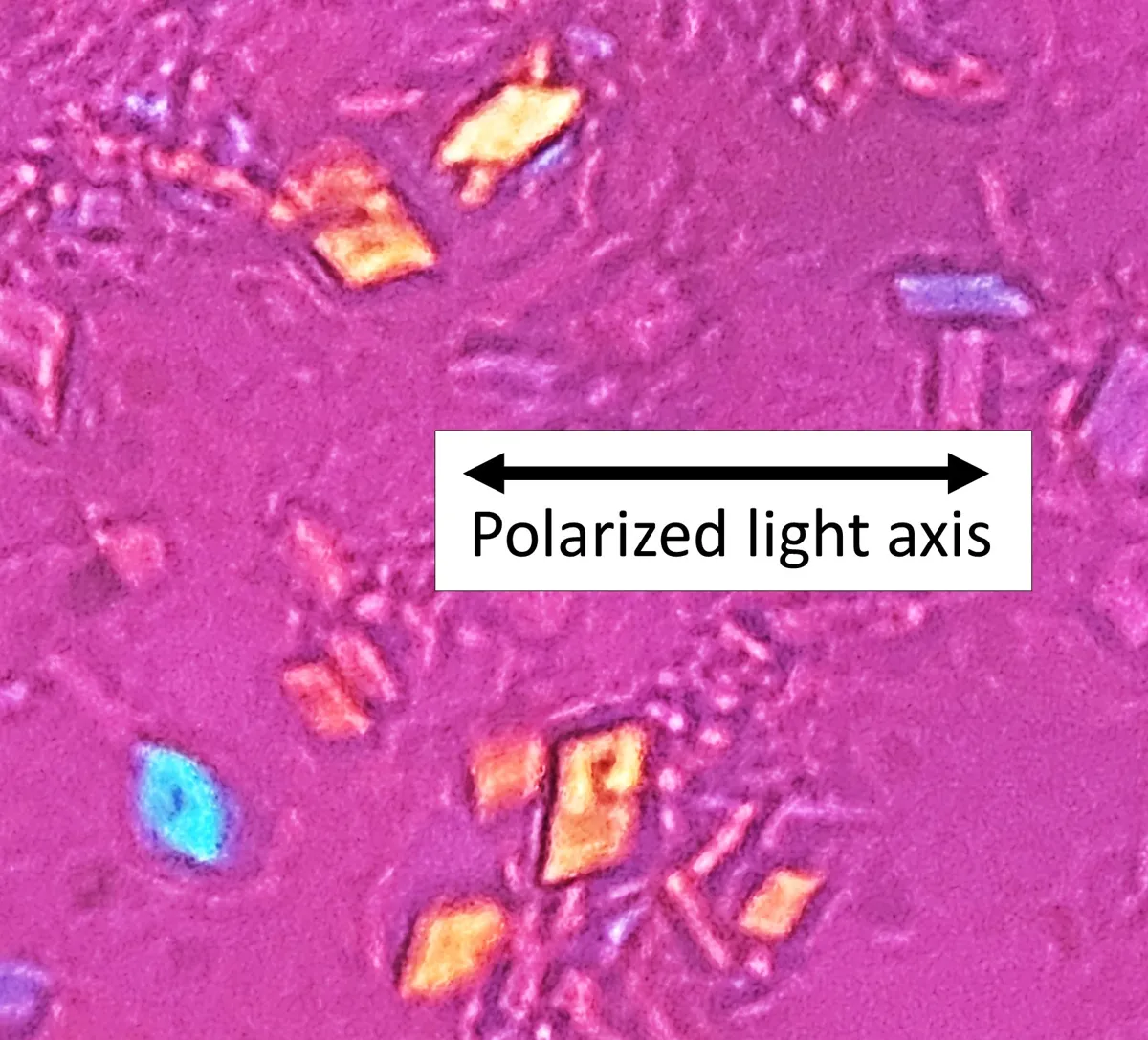
| CPPD (acute CPP crystal arthritis) | Older adult, knee or wrist, chondrocalcinosis | Synovial fluid: positively birefringent rhomboid crystals; radiograph |
| Early rheumatoid arthritis | Persistent symmetrical small-joint synovitis over 6 weeks | Examination, ultrasound, anti-CCP, RF, CRP |
| Intermittent hydrarthrosis | Regular, predictable knee effusions without much inflammation | History of cyclical pattern; non-inflammatory fluid |
| Familial Mediterranean fever | Episodic fever with serositis and monoarthritis; Mediterranean ancestry | MEFV genetic testing; CRP during attacks |
| Calcific periarthritis (hydroxyapatite) | Acute severe pain around a shoulder or finger joint with periarticular calcification | Radiograph or ultrasound showing calcific deposit |
| Reactive arthritis, Behçet disease, Whipple disease | Preceding infection; oral ulcers; diarrhoea and weight loss | Stool/urine tests, pathergy, small-bowel biopsy/PCR |
| Systemic lupus erythematosus | Migratory non-erosive arthritis with rash, ulcers, cytopenias | ANA, anti-dsDNA, complement |
Exam pearls
Guideline
No disease-specific guideline: EULAR definition of arthralgia suspicious for progression to RA (2017), EULAR recommendations for the management of early arthritis (2016 update), EULAR RA management recommendations (2025 update) and 2010 ACR/EULAR RA classification criteria
References
- Hench PS, Rosenberg EF.. Palindromic rheumatism: a 'new', oft-recurring disease of joints (arthritis, periarthritis, para-arthritis) apparently producing no articular residues. Arch Intern Med 1944.
- Guerne PA, Weisman MH.. Palindromic rheumatism: part of or apart from the spectrum of rheumatoid arthritis. Am J Med 1992.
- Mankia K, Emery P.. Palindromic rheumatism as part of the rheumatoid arthritis continuum. Nat Rev Rheumatol 2019.
- Combe B, Landewe R, Daien CI, et al.. 2016 update of the EULAR recommendations for the management of early arthritis. Ann Rheum Dis 2017.
- van Steenbergen HW, Aletaha D, Beaart-van de Voorde LJJ, et al.. EULAR definition of arthralgia suspicious for progression to rheumatoid arthritis. Ann Rheum Dis 2017.
- Cope AP, Jasenecova M, Vasconcelos JC, et al.. Abatacept in individuals at high risk of rheumatoid arthritis (APIPPRA): a randomised, double-blind, multicentre, parallel, placebo-controlled, phase 2b clinical trial. Lancet 2024.
Related topics
By Dr Khalid Seidi (B.Sc., M.D.) · MedEd World Clinical Knowledge library. Original teaching content checked against current guidelines (November 2026); confirm the latest local guidance before clinical use. Not a substitute for clinical judgement.