Clinical Knowledge › Internal medicine › Rheumatology and immunology › Inflammatory arthritis and spondyloarthritis
Reactive arthritis
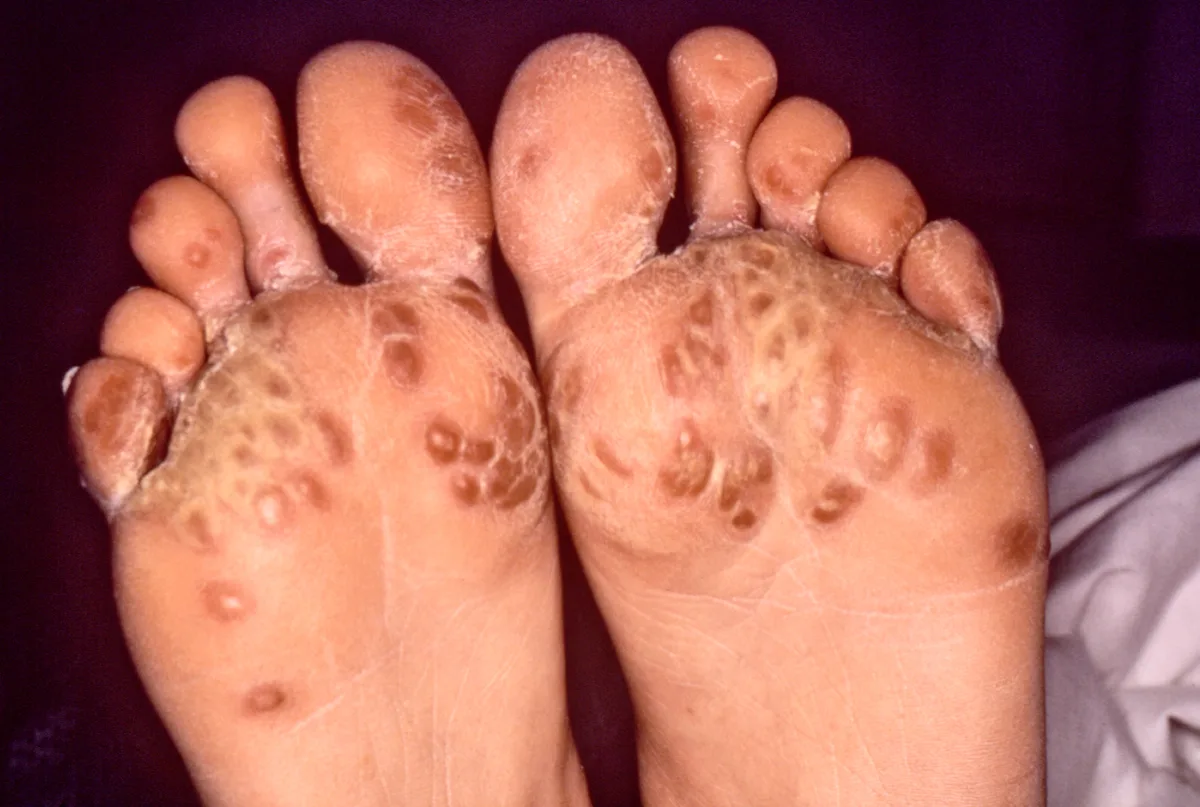
Reactive arthritis is a sterile spondyloarthritis that follows an infection elsewhere in the body, usually Chlamydia trachomatis in the urogenital tract or enteric bacteria such as Salmonella, Shigella, Yersinia and Campylobacter. One to four weeks after the infection, young adults develop an acute asymmetric oligoarthritis of the lower limbs, often with Achilles enthesitis, dactylitis and back pain. Extra-articular features include conjunctivitis, anterior uveitis, urethritis, circinate balanitis, keratoderma blennorrhagicum and painless oral ulcers, but the classic triad is uncommon. HLA-B27 is present in a third to a half of patients and predicts severity and chronicity. Diagnosis is clinical: aspirate joints to exclude septic and crystal arthritis and test for Chlamydia and gonorrhoea by NAAT. Treatment is with NSAIDs and joint injections; Chlamydia is treated with doxycycline and partners are notified. Most cases resolve within 6–12 months, but up to 30% become chronic and need DMARDs or biologics.
Patient case, mechanism, investigations, management, flashcards and exam-style questions.Open the lesson →
Key facts
- Sterile arthritis 1–4 weeks after urogenital (Chlamydia) or enteric (Salmonella, Shigella, Yersinia, Campylobacter) infection
- Acute asymmetric lower-limb oligoarthritis with enthesitis and dactylitis in young adults
- Classic triad: arthritis, urethritis, conjunctivitis ("can't see, can't pee, can't climb a tree") is present in a minority
- Skin: keratoderma blennorrhagicum and circinate balanitis; painless oral ulcers
- HLA-B27 positive in 30–50%; predicts chronic and axial disease
- Aspirate to exclude septic arthritis (including gonococcal) and crystals; test Chlamydia by NAAT
- Treat with NSAIDs and intra-articular steroid; doxycycline for Chlamydia with partner treatment
- Most resolve within 6–12 months; 15–30% chronic, treated with sulfasalazine, methotrexate or TNF inhibitors
Differential diagnosis
| Condition | Clues | Key test |
|---|---|---|
| Septic arthritis | Single hot joint, fever, very high fluid white count | Gram stain and culture of synovial fluid |
| Disseminated gonococcal infection | Migratory polyarthralgia, tenosynovitis, pustular skin lesions | NAAT and culture from mucosal sites, blood and joint |
| Gout | Acute podagra in older men | Needle-shaped crystals |
| Psoriatic arthritis | Psoriasis, nail disease, chronic course | Clinical; no preceding infection |
| Viral arthritis (parvovirus B19, hepatitis B, chikungunya) | Symmetric small-joint polyarthritis, rash | Viral serology |
| IBD-associated arthritis | Chronic diarrhoea, weight loss, bloody stool | Calprotectin, colonoscopy |
| Acute rheumatic fever | Migratory polyarthritis after streptococcal pharyngitis | ASO titre, Jones criteria, echocardiography |
Exam pearls
Guideline
No dedicated international ReA guideline: ASAS 2011 peripheral spondyloarthritis classification, CDC STI Treatment Guidelines 2021 and ASAS-EULAR 2022 spondyloarthritis principles
References
- Rudwaleit M, van der Heijde D, Landewé R, et al.. The development of Assessment of SpondyloArthritis international Society classification criteria for peripheral spondyloarthritis and for spondyloarthritis in general. Ann Rheum Dis 2011.
- Workowski KA, Bachmann LH, Chan PA, et al.. Sexually transmitted infections treatment guidelines, 2021. MMWR Recomm Rep 2021.
- Ramiro S, Nikiphorou E, Sepriano A, et al.. ASAS-EULAR recommendations for the management of axial spondyloarthritis: 2022 update. Ann Rheum Dis 2023.
- Schmitt SK.. Reactive arthritis. Infect Dis Clin North Am 2017.
- Carter JD, Espinoza LR, Inman RD, et al.. Combination antibiotics as a treatment for chronic Chlamydia-induced reactive arthritis: a double-blind, placebo-controlled, prospective trial. Arthritis Rheum 2010.
- Carter JD, Hudson AP.. Reactive arthritis: clinical aspects and medical management. Rheum Dis Clin North Am 2009.
Related topics
By Dr Khalid Seidi (B.Sc., M.D.) · MedEd World Clinical Knowledge library. Original teaching content checked against current guidelines (November 2026); confirm the latest local guidance before clinical use. Not a substitute for clinical judgement.